

Daily Dose Of Jazz…
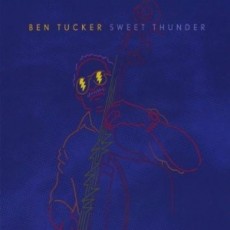
Ben Tucker was born on December 13, 1930 in Nashville, Tennessee. By age twelve he began on trumpet and later on the bass, quickly making a name around town. In high school he taught himself to play the tuba and at Tennessee State learned the fundamentals of bass violin on his own. Following a stint in the Air Force, he settled in California playing with Art Pepper and Shorty Rogers, among others and the legendary “Jazz of Two Cities”.
By the early 1960’s, he was regularly performing and recording with Herbie Mann, Billy Taylor, Dexter Gordon, Buddy Rich, Quincy Jones, Marian McPartland, and Mel Torme. He would go on to play with Gerry Mulligan, Peggy Lee, Tommy Flanagan, Ellis Marsalis, Cy Coleman and Red Norvo among others.
A prodigious composer of over 300 titles, many are jazz standards like “Comin’ Home Baby”, “Devilette”, “The Message,” “ Right Here, Right Now” and his most famous discovery and publishing being the Bobby Hebb tune “Sunny”.
Bassist Ben Tucker was named as one of the world’s Top Ten Bass Players in 1959 by Metronome Magazine, was appointed to the Advisory Committee of the Kennedy Center for the Arts, formed his own production company, bought a radio station, received a Clio, produced “Multiplication Rock”, the musical education tool, and created the Telfair Jazz Society and opened and operated Hard-Hearted Hannah’s, a Savannah jazz club.
Bassist Ben Tucker passed away on on June 4, 2013 of a traffic collision on Hutchinson Island, Georgia.
More Posts: bass
Daily Dose Of Jazz…
Bob Dorough, born December 12, 1923 in Cherry Hill, Arkansas, he grew up in Texas. He learned to play piano and would play in an Army band during World War II. After discharge he attended North Texas State University, majoring in composition and minored in piano.
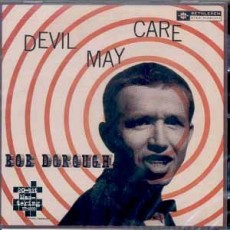
Around 1950 Bob moved to New York City and was playing piano in a Times square tap studio where he was introduced to the boxer sugar Ray Robinson, who was putting together a song and dance revue. He was hired, became the show’s music director and toured the U.S. and Europe. Leaving the revue in Paris in 1954, he recorded with singer Blossom Dearie during that time. Returning to the U.S. and moving to Los Angeles, he played various gigs, including a job between sets by comedian Lenny Bruce. Dorough released his first album, Devil May Care, in 1956 that contained a version of Charlie Parker’s “Yardbird Suite”.
Dorough penned the lyrics for Miles Davis on the Christmas song “Blue Xmas” and a few years later recorded “Nothing Like You” that is on the Sorcerer album. He worked with Allen Ginsberg, and his adventurous style influenced Mose Allison among other singers. He is perhaps best known as a voice and primary composer of many of the songs used in “Schoolhouse Rock!” during the Seventies and Eighties.
The cool jazz pianist and composer he has penned with bassist Ben Tucker the tune “Comin’ Home Baby” that earned Mel Torme two Grammy nominations and a Top 40 hit. A vocalese singer, he has released 28 vocal jazz albums as a leader, four singles and 17 as a sideman and/or guest over the last 50 years. Bob Dorough received an honorary degree from East Stroudsburg University of Pennsylvania with a Doctor of Fine Arts, was named Artist of the Year in 2002 by the Pennsylvania Governor’s Awards for the Arts. He garnered a Grammy nomination for Best Recording for Children and was inducted into the Arkansas Jazz Hall of Fame prior to passing away on April 23, 2018 in Mount Bethel, Pennsylvania at age 94.

From Broadway To 52nd Street
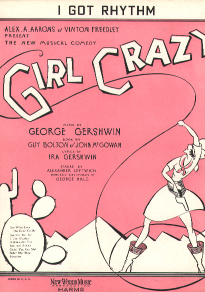
Girl Crazy opened on October 14, 1930 at the Alvin Theatre with a run of 272 performances starring Ethel Merman and Ginger Rogers singing music composed by the Gershwin Brothers. Two songs emerged from this musical to become jazz classics – Embraceable You and I Got Rhythm.
The Story: A tale where Danny Churchill, in an attempt to flee nightclubs, gambling casinos and women, hires a NY taxi driver to take him to Custerville, Arizona. There he hopes to rest on a dude ranch. Before long he has transformed the ranch into a club with gambling rooms and bevies of girls. He woos and wins the heart of one of the girls, Ginger, who is the daughter of the local saloonkeeper.
Broadway History:Though the Depression was in full swing, stars were still being made as musicals and revues continued to emerge on Broadway. From 1931 – 42 this decade made stars of Ray Bolger and Bert Lahr, who went on to fame as the Scarecrow and Cowardly Lion in The Wizard Of Oz; the double act of Gaxton & Moore, who were part of the comic backbone of vaudeville, got their individual starts on Broadway when Gaxton, having mastered the character of a loveable, oblivious bumbler resembling Elmer Fudd with a Porky Pig personality, performed in George M. Cohan’s Forty-Five Minutes From Broadway in 1906, and the much younger Moore was the romantic lead in Rodgers and Hart’s A Connecticut Yankee in 1927. They were paired in Gershwin’s “Of Thee I Sing” and continued their successful partnership well into the ‘40s. The tradition of the double act was later upheld by the likes of Abbott & Costello, Lewis & Martin and Burns & Allen.
Sponsored By

www.whatissuitetabu.com
More Posts: broadway
Daily Dose Of Jazz…
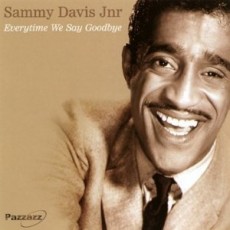
Sammy Davis Jr. was born Samuel George Davis, Jr. on December 8, 1925 to Cuban American parents in New York City. Starting as a child vaudevillian at age three, he toured for years nationally with the Will Masten Trio, and after military service, returned to the trio. He became an overnight sensation following a nightclub performance at Ciro’s in 1951 and with a trio became a recording artist.
As his father and uncle aged, Davis broke out to achieve success on his own and he released several albums that led to being hired to sing the title track for the Universal Pictures film “Six Bridges to Cross” in 1954. He amassed a catalogue of several dozen recordings for Decca, Reprise, Verve, Motown, MGM and 20th Century, consistently kept alive the Great American Songbook from Broadway accompanied by orchestras and big bands and had two #1 hits – “I Gotta Be Me” and The Candy Man.
Sammy starred in four Broadway musicals from 1956 to 1978 in Mr. Wonderful, Golden Boy, Sammy and Stop The World I Want To Get Off. His film career spanned nearly six decades with important roles and appearances in A Man Called Adam, Porgy & Bess, Anna Lucasta, Sweet Charity, Cannonball Run, Moon Over Parador and Tap. As a charter member of the Rat Pack he did several movies with them beginning with Oceans 11.
Not to let television escape his grasp in 1966 had his own variety show, The Sammy Davis Jr. Show, would appear on Archie Bunker, I Dream of Jeannie, The Rifleman, Charlie’s Angels, One Life To Live, General Hospital and the Cosby Show to name a few.
With his career slowing in the late sixties, by 1972 he was a star in Las Vegas earning him the nickname Mister Show Business. In 1987 Sammy toured internationally with Frank Sinatra, Dean Martin and Liza Minelli. He was awarded NAACP’s Spingarn Medal, won a Golden Globe and an Emmy, two-time recipient of the Kennedy Center Honors, has a star on the Hollywood Walk of Fame, was inducted into the Grammy Hall of Fame and posthumously awarded the Grammy Lifetime Achievement Awards.
Singer, tap dancer, impersonator and musician Sammy Davis Jr. passed away in Beverly Hills, California on May 16, 1990, of complications from throat cancer. On May 18, 1990, two days after Davis’ death, the neon lights of the Las Vegas Strip were darkened for ten minutes, as a tribute to him.

More Posts: vocal
Daily Dose Of Jazz…
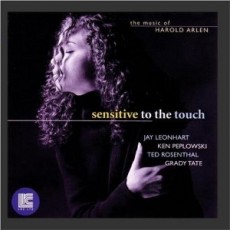
Jay Leonhart was born December 6, 1940 in Baltimore, Maryland and grew up in a musical family where everyone played the piano. By the age of seven, Jay and his older brother Bill were playing banjos and guitars and mandolins and basses. They played country music, jazz and anything with a beat. In their early teens, Jay and Bill were television stars in Baltimore and were touring the country performing on their banjos.
When Jay was fourteen he started playing the bass in The Pier Five Dixieland Jazz Band in Baltimore. After studying at The Peabody Institute he attended the Berklee College of Music and The Advanced School of Contemporary Music in Toronto before leaving school to start touring with the traveling big bands of the late 1950s and early 1960s.
By age 21 Leonhart moved to New York City to start his career and eventually began playing for many of the great jazz musicians, big bands, and singers like Thad Jones, Mel Lewis, Lou Marini, Tony Bennett, Marian McPartland and Jim Hall. He played lots of funky road gigs with big bands, small bands and singers and visited many little jazz joints around the world.
Jay became a very busy studio musician in New York City, visiting every musical genre from James Taylor to Ozzy Osborne to Queen Latifah, has recorded fifteen solo albums, performs a one-man show, regularly plays with Wycliffe Gordon in a duo, was named The Most Valuable Bassist in the recording industry three times by the National Academy of Arts and Sciences and continues to record, perform and tour worldwide.

More Posts: bass