

Daily Dose Of Jazz…
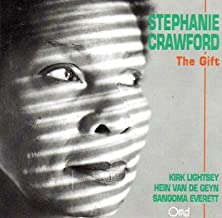
Stephanie Crawford was born on August 30, 1942 in Detroit, Michigan and divided her childhood between living with her mother in Detroit’s Black Bottom, called that due to its dark soil, and with an aunt in Chattanooga, Tennessee. She grew up surrounded by jazz, blues, R&B, and gospel music, from which she draws from.
Although singing was her first love from childhood she did not sing in public until she was 36, after working on a Chrysler assembly line and as a short-order cook, and earning a bachelor’s degree in painting from Wayne State University.
Her first live performance in front of an audience was accidental while taking in a rather bad pianist/vocalist in a local dive. Whe she would forget the words, Stephanie would call out the lyrics. Fed up, the woman challenged her to come up and sing and the rest is history. The invite to come back was given and she found her home.
A move to New York City, while working on her master’s in fine arts, Crawford became so immersed in the Manhattan jazz scene that she dropped out of school in order to devote more time to sitting in at jam sessions. She found herself seeking out and studying with Frank Foster and Barry Harris.
Her next stop was Paris, France where she won the prestigious Django d’Or award for Best International Jazz Vocalist in 1993. Singing did not pay the bills, so to support herself Stephanie taught jazz singing at two music schools. Returning to New York City she found work with a Portuguese wine importer.
Vocalist Stephanie Crawford, is clear that talent and fame are not synonymous, and though she continues to sing, helping to keep the fading local jazz scene alive, and continues with her passion for art. Just prior to the pandemic she performed in New York City at the Laurie Beechman Theater.

More Posts: bandleader,history,instrumental,jazz,music,vocal
Daily Dose Of Jazz…
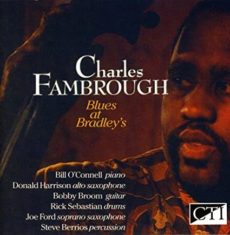
Charles Fambrough was born on August 25, 1950 in Philadelphia, Pennsylvania. He originally studied classical piano but switched to bass when he was 13. In 1968, he began playing with local pit bands for musicals and after some freelancing in 1970, he joined Grover Washington, Jr.’s band, staying with him until 1974.
Moving on he worked with Airto from 1975 to 1977), followed by McCoy Tyner for two years in 1978 and then on to be a part of the Jazz Messengers under Art Blakey from 1980 to 1982. Leaving the Messengers Charles freelanced as a sideman and led three CTI recordings with Wynton and Branford Marsalis, Roy Hargrove, Kenny Kirkland, Jerry Gonzalez, Steve Turre, Donald Harrison, Kenny Garrett, Abdullah Ibrahim, Grover Washington, Jr., Jeff “Tain” Watts, Stephen Scott, Billy Drummond, Bobby Broom, and Steve Berrios.
As a sideman, he worked and recorded sixteen albums with Kei Akagi, Craig Handy, Eric Mintel, and Roland Kirk among others. Reportedly been suffering from a number of serious ailments including end-stage renal disease and congestive heart failure, and benefit concerts had been held over the preceding several years in the Philadelphia area to help the bassist and his family defray the costs of his mounting medical bills.
Bassist, composer, and bandleader Charles Fambrough passed away at the age of 60 of a heart attack at his home in Allentown, Pennsylvania on January 1, 2011.
More Posts: bandleader,bass,composer,history,instrumental,jazz,music
Hollywood On 52nd Street
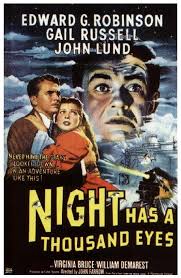
The Night Has A Thousand Eyes is a song composed by Jerry Brainin, with lyrics by Buddy Bernier. The song was written for the 1948 film noir Night Has a Thousand Eyes and was performed by an unknown band as rhumba in the background of a party.
The film stars Edward G. Robinson and was directed by John Farrow. The film is based on the novel of the same name by Cornell Woolrich, originally published under the pseudonym George Hopley.
Since its introduction, the song has been recorded by a number of artists, among them John Coltrane, Sonny Rollins, Horace Silver, UAB SuperJazz featuring Ellis Marsalis, Harry Belafonte, Paul Desmond with Jim Hall, Toshiko Akiyoshi, Pharoah Sanders, Irene Kral, Harry Beckett, Petula Clark, Gloria Lynne, and Carmen McRae.
The Story
The film opens in New Orleans, where John Triton (Robinson) is “The Mental Wizard”, a nightclub fortune teller. During a show one evening, Triton suddenly urges an audience member to rush home, cautioning that her son is in danger. As the story unfolds, Triton struggles with his new-found psychic ability, as all of his relentlessly bleak predictions prove accurate. Jerome Cowan plays Whitney Courtland, Triton’s best friend, who becomes wealthy using tips from the now-psychic Triton.

Hollywood On 52nd Street
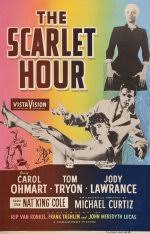
Never Let Me Go is a song composed and written by Jay Livingston and Ray Evans, that was performed by Nat King Cole in the 1956 American crime drama film, The Scarlet Hour. The movie was directed and produced by Michael Curtiz. The film stars Carol Ohmart, Tom Tryon, Jody Lawrance and Elaine Stritch. The screenplay was based on the story “The Kiss Off” by Frank Tashlin.
The Story
E. V. Marshall, known to all as “Marsh,” works for wealthy real-estate businessman Ralph Nevins and is having an affair with Ralph’s unhappy wife, Paulie. Not wanting to struggle Paulie refuses Marsh’s plea to get a divorce and live without her husband’s money.
Overhearing thieves planning a jewelry heist of the home of a doctor named Lynbury, Paulie pleads with Marsh to rob the jewels from the thieves as they leave the doctor’s house. Suspicious of his wife, Nevins follows, catches them in the act, and gets shot by Paulie. However, Marsh thinks that the thieves shot Nevins.
The police investigation reveals that Dr. Lynbury masterminded the burglary of his own home to collect insurance money after having replaced his wife’s jewels with worthless fakes. Police eventually place Lynbury under arrest and Paulie as well, with Marsh’s cooperation.
The Quarantined Jazz Voyager
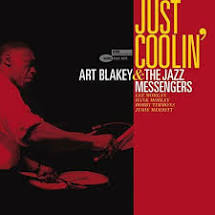
The Quarantined Jazz Voyager is pulling down from the stacks of his library a recently acquired, never-before-released studio album by Art Blakey & The Jazz Messengers titled Just Coolin’. Recorded on March 8, 1959 in Rudy Van Gelder’s living room studio in Hackensack, New Jersey, the session featured a short-lived line-up of The Jazz Messengers.
The album features two previously unissued compositions including Timmons’ tune Quick Trick. The session for Just Coolin’ finds The Jazz Messengers’ saxophone chair in transition. The interim saw the return of Mobley, who was a charter member of The Jazz Messengers when the band first formed in 1954 and appeared on their debut recording The Jazz Messengers At The Café Bohemia in 1955. Mobley also filled an important role as the band’s resident composer. Now, 61 years later jazz fans all over the world will have the chance to listen for themselves.
Track List Side 1 1. Hipsippy Blues (Hank Mobley) 2. Close Your Eyes (Bernice Petkere) 3. Jimerick (unknown) Side 2 1. Quick Trick (Bobby Timmons) 2. M&M (Hank Mobley) 3. Just Coolin’ (Hank Mobley)
Personnel
Lee Morgan: trumpet, Hank Mobley: tenor saxophone, Bobby Timmons: piano, Jymie Merritt: bass, Art Blakey: drums
More Posts: adventure,club,drums,genius,jazz,museum,music,preserving,restaurant,travel,voyager