

Requisites
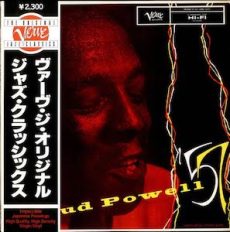
Bud Powell ‘57 ~ Bud Powell | By Eddie Carter
I wanted to hear something soothing after dinner a few nights ago, so I chose one of my favorite records by pianist Bud Powell. This morning’s album from the library comprised three sessions and was initially released as Jazz Original in 1955 and reissued two years later as Bud Powell ’57 (Norgran Records MG N-1098). He’s leading two trios in a program of nine standards. Percy Heath (tracks: A1 to A3), Lloyd Trotman (A4, B2 to B5) on bass, Max Roach (tracks: A1 to A3), and Art Blakey (A4, B2 to B5) on drums. My copy is the 1981 Verve Original Jazz Classics Japanese Mono audiophile reissue (UMV 2571) by Polygram Records.
Deep Night, by Charles E. Henderson and Rudy Vallée, opens the album and is introduced by Bud, then Percy and Max join him to complete the melody. Powell is the song’s only soloist and gives a briskly efficient interpretation complimented by the rhythm section’s compelling understructure leading to the climax. Next, the trio takes on That Old Black Magic by Harold Arlen and Johnny Mercer. It made its debut in the 1942 film Star Spangled Rhythm. The trio opens the song with a deceptively simple melody before Bud makes a tremendous statement toward the ensemble’s exit.
‘Round Midnight by Thelonious Monk, Cootie Williams, and Bernie Hanighen is one of the most recorded compositions in jazz. Powell opens with a hauntingly beautiful introduction which grows into the trio’s gorgeous melody. Bud has the spotlight and demonstrates delicacy over Percy and Max’s subtle accompaniment ahead of a pretty ending. Thou Swell by Richard Rodgers and Lorenz Hart comes from the 1927 musical, A Connecticut Yankee. The trio picks up their pace to a medium tempo, and Powell leads Trotman and Blakey in the melody. The pianist feeds off their energy and does an excellent job freshening up this old chestnut with a bright performance.
Side Two starts with Like Someone in Love by Jimmy Van Heusen and Johnny Burke, a solo performance by Bud that premiered in the 1944 film Belle of The Yukon. Powell has the showcase alone here, and right from the song’s entrance, he brings out its warmth of lyricism, tenderness, and sincerity in one of the album’s prettiest performances. Someone To Watch Over Me by George and Ira Gershwin is from the 1926 musical, Oh, Kay! Initially known as a torch song, the group’s interpretation is performed flawlessly, with Powell showing the utmost respect during the melody and in his solo. Trotman and Blakey anchor him politely, preceding the closing chorus.
The tempo moves upward again for Lover Come Back To Me by Sigmund Romberg and Oscar Hammerstein II. It appeared first in the 1928 musical, The New Moon, and it’s a catchy tune beginning with the threesome’s lively opening chorus. Bud opens the song’s only solo at a brisk gallop, complemented by Lloyd and Art leading to the trio’s finale. Tenderly by Walter Gross and Jack Lawrence is an enchanting song about finding love. Powell’s piano makes the introduction which grows into a delicately gentle theme; then Bud reminisces nostalgically in an excellent interpretation preceding the ending.
The album ends with How High The Moon by Morgan Lewis and Nancy Hamilton. It’s an infectious tune with a driving beat that takes off after Bud’s introduction. The pianist swings to Lloyd and Art’s zesty foundation into the theme’s reprise and climax. Norman Granz supervised the initial album, and it’s unknown who was the recording engineer. However, the reissue’s sound quality is excellent, with a stellar soundstage that brings the musicians into your listening room with incredible clarity. The record is pressed on virgin vinyl and silent until the music starts. If you’re in the mood for a relaxing album to enjoy after a long day or week, I offer for your consideration Bud Powell ’57. It’s an endlessly satisfying trio album that I’m sure you’ll enjoy!
~ Jazz Original (Norgran Records MG N-1017) – Source: Discogs.com ~ How High The Moon, Like Someone In Love, Lover Come Back To Me, ‘Round Midnight, Someone To Watch Over Me, Tenderly, That Old Black Magic, Thou Swell – Source: JazzStandards.com ~ Deep Night – Source: Wikipedia.org © 2023 by Edward Thomas Carter

More Posts: choice,classic,collectible,collector,history,instrumental,jazz,music,piano
Daily Dose Of Jazz…
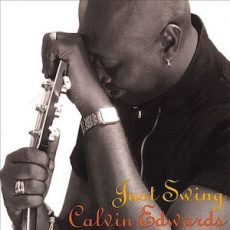
Calvin Edwards was born in Kings Mountain, North Carolina on May 14, 1957. At 17, he joined the famous Gospel group Five Blind Boys of Alabama for many years. Then, he moved to Los Angeles, California to play in his brother’s band, The Jett Edwards Band. During this time, he and his brother recorded two albums together, including one song which was recorded by George Benson.
He has released four CD’s as a band leader, and performed with and/or booked various artist through Chasity Music including Tom Brown, Tuck & Patti, Michael White, Kei Akagi, Lonnie Plaxico, Benny Maupin, Hidefumi Toke, Javon Jackson, Michael O’Neil, Ron Brown, Ali Jackson, Michael Paluo, Michael Wolf, Roy Ayers, Everette Harp, Dan Siegel, and Phil Perry.
A well-known international artist, Calvin has performed for President Clinton at the G8 Summit, as well as in Asia and across the United States. He continues to record and play both jazz and blues as he explores the genres.

More Posts: bandleader,guitar,history,instrumental,jazz,music
Requisites
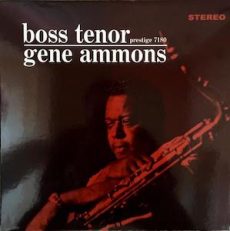
Boss Tenor ~ Gene Ammons | By Eddie Carter
Gene Ammons enters the spotlight of this morning’s discussion with a splendid quintet date titled Boss Tenor (Prestige PRLP 7180/PRST 7180). It hit the stores in 1960 and was the first album Ammons recorded after spending two years in prison for narcotics possession. It’s also considered one of the best in his extensive discography. Here, the tenor saxophonist demonstrates his strengths in a program of two originals and five standards with an excellent rhythm section. Tommy Flanagan on piano, Doug Watkins on bass, Arthur Taylor on drums, and Ray Barretto on congas complete the ensemble. My copy is the 2016 Analogue Productions Stereo audiophile reissue sharing the original catalog number.
The quartet opens Side One by Hittin’ The Jug, a slow tempo blues by Gene Ammons that gets underway with a short solo by Tommy. Gene takes over for an exquisitely tasteful melody and opening statement. Doug answers the tenor with a laid-back reading as fresh as a cool breeze on a warm evening. Gene returns for a few final thoughts ahead of the closing chorus. The foursome picks up the pace for a lively rendition of Close Your Eyes by Bernice Petkere. Ammons shows off his spirited lyricism in the opening chorus and first solo. Flanagan briefly expresses the song’s sunny nature next as the rhythm section’s sprightly supplement holds everything together until Jug’s ending theme gently fades into silence.
The first side finale, My Romance by Richard Rodgers and Lorenz Hart, is captured in its purest essence by the ensemble. Tommy makes his entrance gently in the introduction. Gene takes over to present an elegant melody and a sweet expression of love in the song’s only interpretation, complimented by the trio’s sensuously tender accompaniment into a lovely ending. The quintet kicks off Side Two with a pleasure trip to see the Canadian Sunset by Eddie Heywood and Norman Gimbel. The rhythm section sets this enjoyable excursion in motion with their introduction, then Ammons proceeds to take a leisurely trip through the opening chorus. He completes the journey with an entertaining ride in the song’s only solo ahead of the theme’s restatement and close.
Gene’s Blue Ammons is next and reminiscent of The Happy Blues that Gene recorded in 1956. It begins with a two-instrument introduction by Doug and Art that grows into the saxophonist’s medium melody. Gene starts the solos with a relaxing presentation that’s light and airy. Tommy comes in next and swings comfortably in a short statement, then Gene has an easy-going concise conversation with Art before the closing chorus gently fades into oblivion. Charlie Parker’s Confirmation picks up the beat from the start of the quintet’s brisk melody, and Ammons opens the solos with an effervescent presentation. Flanagan follows him and gives an enthusiastic statement, then Watkins delivers a concise comment. Ammons and Taylor share a brief exchange preceding the closing chorus and exit.
Savoy, aka Stompin’ at The Savoy, by Benny Goodman, Andy Razaf, Arthur Sampson, and Chick Webb, pays homage to the Savoy Ballroom in Harlem, where Webb was the orchestra leader, and people danced their troubles away during the Depression. Gene leads the quintet in the melody with a toe-tapping beat that extends to his spirited opening solo. Tommy soars cheerfully into the subsequent statement, and Ray adds a short footnote during the theme’s reprise and climax. Bob Weinstock supervised the initial album, and Rudy Van Gelder was the recording engineer. Kevin Gray mastered this reissue; the album cover is worthy of hanging on your wall, and the record is pressed on 200 grams of audiophile vinyl that’s dead silent until the music starts.
The sound quality of this reissue is so spectacular that if you close your eyes while listening, you’ll swear the quintet is playing right before you in your listening room. Ammons and company are at their best from the first note to the finale of every track. I happily recommend Boss Tenor for a spot in your library if you’re discovering Gene Ammons for the first time or are a longtime fan. It’s a fantastic performance that will enjoy repeated listens on the turntable for anyone who loves and appreciates the tenor sax!
~ Close Your Eyes, Confirmation, My Romance, Stompin’ at The Savoy – Source: JazzStandards.com ~Canadian Sunset – Source: Wikipedia.org © 2023 by Edward Thomas Carter
More Posts: choice,classic,collectible,collector,history,instrumental,jazz,music,saxophone

Daily Dose Of Jazz…
Ronaldo Folegatti was born on April 30, 1958 in Rio de Janeiro, Brazil and started playing the guitar at age 10. He studied mathematics and received a master’s degree in science.
When he was twenty-two, he moved to Germany and started a career in music. He released his debut album, Sound of Watercolors, in Germany in 1990. He recorded his sophomore album, Lust, Comics & Some Other Dreams, with Till Brönner and Ronnie Stevenson. The album crossed several genres including jazz, big band, free jazz, and Brazilian.
In 1995 he returned to Brazil and five years later recorded two more albums, Mazy Tales and Anjos & Estrellas. In 2005 he released Jamming! with guest appearances by Randy Brecker, Will Lee, Joel Rosenblatt, Zé Canuto, Teo Lima, Marcelo Martins, and Ada Rovatti. Composer, guitarist, and record producer Ronaldo Folegatti, who had been treated for cancer for two years, transitioned on August 1, 2007, Teresópolis, Brazil.
More Posts: bandleader,composer,guitar,history,instrumental,jazz,music,record producer
Daily Dose Of Jazz…
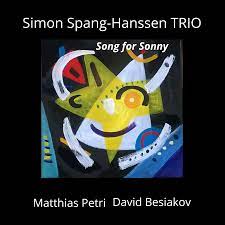
Simon Spang-Hanssen was born on April 13, 1955 in Copenhagen, Denmark andstarted playing alto saxophone but later added tenor and soprano. Receiving the annual Ben Webster Prize he created his own quartet Spacetrain with Ben Besiakov, Jesper Lundgaard and Alex Riel in 1979. He played in several groups before joining the sextet of Brazilian drummer and composer Nenê, and touring Denmark and France with Hermeto Pascoal e Grupo.
A move to Paris, France saw him playing with among others Denis Badault, Andy Emler, Nguyên Lê, Quintet Moutin, Ramuntcho Matta, Edouard Ferlet and with his own projects including musicians such as Richard Bona, Billy Hart, Niels Lan Doky, J.F. Jenny-Clarke, Bojan Z., and others. Returning to Copenhagen he created the tentet Central Earth and recorded Wondering with Maaneklar for Dacapo. Concerts and recording followed with a new quartet and quintet into the new millennium. He has had several iterations
Simon started the record label Alisio and released Rainbow Spirit and Coexistence with a quintet. These were followed with several other releases including The Riddle with Ear Witness, a live-recording in Copenhagen Jazzhouse with Maneklar XL, and two nominations for Danish Jazz Awards: Composer of the Year, Album of the year.
He has played and toured with the Aliso Ensemble South America, Scandinavia, and Zanzibar with Ear Witness. He released a new recording with the Epistrophy Septet with trombonist Peter Dahlgren. Saxophonist Simon Spang-Hanssen continues to perform and tour with a variety of musicians.
More Posts: bandleader,history,instrumental,jazz,music,saxophone