

Requisites
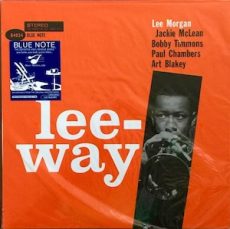
A few nights ago, I spent the evening listening to records by Howard McGhee, Freddie Hubbard and Woody Shaw and was still in the mood to hear another trumpet player, so I picked one of my favorite albums by Lee Morgan. This morning’s record submitted for your approval is Leeway (Blue Note BLP 4034/BST 84034), an excellent 1961 quintet session. I’ve always loved Lee’s tone, articulation, energy, and imagination since first hearing him on A Night In Tunisia, Blue Train, Candy, Houseparty, Introducing Wayne Shorter, The Cooker and The Sermon. An exceptional supporting cast backs Lee on this date: Jackie McLean on alto sax, Bobby Timmons on piano, Paul Chambers on bass and Art Blakey on drums. My copy is the 2016 Music Matters Stereo audiophile reissue (MMBST-84034).
These Are Soulful Days by Cal Massey opens Side One at an easy pace for the quintet’s bluesy melody. Paul leads off the solos with an immensely soothing interpretation. Bobby follows with an attractive performance. Jackie enters next with a satisfying statement, and Lee makes a brief point in the closing solo ahead of the theme’s return. Lee Morgan’s The Lion And The Wolff is his tribute to label founders Alfred Lion and Francis Wolff. The rhythm section’s introduction gets it started for the front line’s collective melody. Jackie leads the way with a relaxing solo; then Lee comes in for a carefree reading. Bobby delivers a delightful statement next, followed by Paul’s bouncy bass lines and Art’s concise comment until the closing chorus fades out slowly.
The quintet dives into Jackie McLean’s Midtown Blues to begin Side Two. The group’s leisurely-paced theme gets things off to a good start. Lee begins the opening solo in a happy vein. Jackie responds with a lightly swinging reading. Bobby keeps the ideas flowing in the third statement, and Paul puts together a satisfying conclusion preceding the ensemble’s reprise and exit. Nakatini Suite by Cal Massey was composed in 1948 and is dedicated to a columnist of The Pittsburgh Courier. The rhythm section sets the tone with their introduction to the quintet’s vibrant melody. Lee leads off the solos with a spirited statement. Bobby follows the leader and gets a chance to stretch out next. Art is right on the mark, with a brisk workout leading to the theme’s restatement.
Alfred Lion produced the original session, and Rudy Van Gelder was the recording engineer. Kevin Gray of Cohearent Audio mastered this audiophile reissue, and the album’s sound quality is simply breathtaking. If you close your eyes while listening, you’ll swear that the quintet is in your listening room playing. The record is pressed on 180 grams of audiophile vinyl and is dead silent until the music starts. The album cover is worthy of hanging on your listening room wall, and the gatefold photos from the session are gorgeous. Lee Morgan recorded thirty albums as a leader and appeared on some of the greatest jazz albums as a sideman. Leeway is sadly overlooked in his discography, but in my opinion, it’s one of his best releases of the sixties. If you’re in the mood for hard bop, I happily recommend Leeway by Lee Morgan. It’s an excellent introduction to his music and a terrific album you shouldn’t miss when record-shopping!
~ A Night In Tunisia (Blue Note BLP 4049/BST 84049), Blue Train (Blue Note BLP 1577/BST 1577), Candy (Blue Note BLP 1590/BNST 1590), Houseparty (Blue Note BLP 4002/BST 84002), Introducing Wayne Shorter (Vee Jay VJLP 3006/SR 3006), The Cooker (Blue Note BLP 1578/BST 81578), The Sermon (Blue Note BLP 4011/BST 84011) – Source: Discogs.com
© 2024 by Edward Thomas Carter
More Posts: choice,classic,collectible,collector,history,instrumental,jazz,music,trumpet

Daily Dose Of Jazz…
Cristian Amigo was born on January 2, 1963 in Santiago, Chile and emigrated with his family to the United States as a child. At twelve he began studying music with Joseph Torello in New Haven, Connecticut. Two years later the family moved to Miami, Florida where he began performing professionally with Six Feet Under, a rock band he formed. While attending Hialeah-Miami Lakes Senior High School he taught classes in guitar to his peers and took courses in music theory, classical guitar and jazz at Miami-Dade Community College.
By the time he turned 17 he was in the music program at Florida State University studying classical guitar. With an Associate of Arts diploma he returned to Miami, began actively performing in recording sessions and original and cover bands while attending music classes at University of Miami. His first recording session at 17 was producer Narada Michael Walden’s We Don’t Have To Take Our Clothes Off.
He moved to Los Angeles, California and earned his bachelor and master degrees and studied jazz with Kenny Burrell and Gary Pratt, and the sitar with Harihar Rao. He studied composition with Wadada Leo Smith. While a university student Amigo made a living as an assistant travel agent, a janitor, a session guitarist, band leader, music producer, film composer, jingle producer, concert producer, music teacher and performed in a number of bands.
He worked as a session guitarist with artists including Hans Zimmer, Mark Mancina, Jay Rifkin, Les Hooper, Wadada Leo Smith, David Ornette Cherry, John Van Tongeron, Justo Almario, and others.
His awards include the John Simon Guggenheim Fellowship in music composition, a Senior Fulbright Scholar/Teacher/Artist Award and the Van Leir Fellowship from Meet the Composer. His work has been supported and/or produced by numerous New York organizations, the Danish Arts Council, Smithsonian Institution Center for Folklife and Cultural Heritage and others too numerous to mention.
Guitarist and composer Cristian Amigo continues to compose, perform and record.

More Posts: guitar
Requisites
Maggie’s Back In Town ~ Howard McGhee | By Eddie Carter
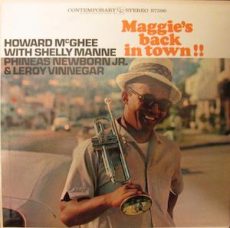
Howard McGhee opens this morning’s discussion with a superb 1961 album, Maggie’s Back In Town (Contemporary Records M3596/S7596). He was one of the earliest jazz musicians to begin playing bebop and became a leading trumpet player during the Forties. Howard was also an excellent arranger and composer who performed with some of the elite musicians during that era. Drug problems derailed his career during the fifties, but he returned in 1960 and recorded two impressive albums for Lester Koenig’s label. A first-class trio joins him on this studio session: Phineas Newborn Jr. on piano, Leroy Vinnegar on bass, and Shelly Manne on drums. My copy is the 1975 US Stereo reissue.
Side One opens with a Howard McGhee original, Demon Chase. The quartet swings easily into the melody; then, Howard gets to the song’s core first. Phineas follows happily along in the second reading. McGhee returns on muted horn with a solo that’s sheer heaven. Leroy closes things out ahead of the finale. Willow Weep For Me by Ann Ronell is one of the most beautiful and recorded song’s from The Great American Songbook. Newborn makes the introduction segueing into McGhee’s muted slow-tempo theme and mellow opening statement. Phineas demonstrates tenderness and intimacy next, and then Howard takes the song out thoughtfully with the mute removed.
Softly, As In a Morning Sunrise by Sigmund Romberg and Oscar Hammerstein II is taken at a brisk clip, with the leader’s mute building the melody effectively. Howard delivers the song’s only solo with joyful vitality fueled by the trio’s exceptional support ahead of the closing chorus and climax. Sunset Eyes by Teddy Edwards ends the first side. The rhythm section sets the scene for McGhee’s easygoing melody. The tempo moves upward for a fascinating interpretation by the leader. Newborn also puts together a well-constructed offering preceding the closing chorus and gentle fadeout.
Side Two starts with Maggie’s Back In Town, by Teddy Edwards. The title refers to Howard’s nickname and his return to the jazz scene after battling drug addiction. The quartet’s bluesy theme gets things underway, followed by Howard’s warm welcome in the first solo. Newborn’s second statement is as delicious as a good meal. McGhee returns for a short reading, and then Vinnegar takes a relaxing walk. Manne shares the closing statement with Howard ahead of the ending theme. Summertime by George and Ira Gershwin and DuBose Heyward starts at mid-tempo, with the leader back on a muted trumpet. McGhee’s solo is as enjoyable as a day at the seaside until the close.
Brownie Speaks by Clifford Brown takes off with the foursome’s vigorous uptempo workout. Howard generates plenty of heat in the first solo. Phineas takes a scintillating statement next. Leroy follows with a short, robust comment, and the leader’s finale flows vibrantly toward the climax. Lester Koenig produced Maggie’s Back In Town, and Roy DuNann was the recording engineer. It’s a great-sounding reissue with an outstanding soundstage that brings the quartet to your listening room with stunning fidelity. If you’re in the mood for a hard-bop album with great tunes and tight musicianship, I invite you to check out Maggie’s Back In Town by Howard McGhee on your next record shopping trip. It’s an excellent introduction to his music and a terrific album that’s sure to give you many hours of listening pleasure!
~ Together Again! (Contemporary Records M3588/S7588) – Source: Discogs.com ~ Softly, As In A Morning Sunrise, Summertime, Willow Weep For Me – Source: JazzStandards.com © 2023 by Edward Thomas Carter

More Posts: choice,classic,collectible,collector,history,instrumental,jazz,music,trumpet
Requisites
Together Again!!!! ~ Teddy Edwards and Howard McGhee | By Eddie Carter
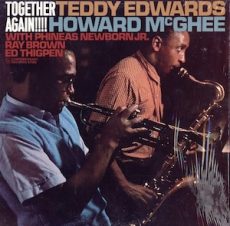
Teddy Edwards and Howard McGhee enter this morning’s spotlight with their excellent 1961 collaboration, Together Again!!!! (Contemporary Records M3588/S7588). The tenor saxophonist and trumpeter initially worked together from 1945 to 1947 when Edwards was a member of McGhee’s sextet. It’s their second collaboration since the Bebop era, but the first time the duo recorded together. The supporting cast is a magical rhythm section: Phineas Newborn Jr. on piano, Ray Brown on bass, and Ed Thigpen on drums. My copy is the 1975 U.S. Stereo reissue, sharing the original catalog number.
The album opener is the title track, Together Again, by Teddy Edwards. The quintet begins the melody harmonizing in perfect agreement. Howard takes the wheel and cruises leisurely on the opening statement. Teddy wails with a vibrant voice in the following solo. Phineas heightens the excitement with an impressive reading; then Ray adds a brisk footnote leading to the theme’s return and summation. McGhee introduces You Stepped Out Of A Dream by Nacio Herb Brown and Gus Kahn on the muted trumpet. He showcases the horn’s warm, lyrical tone in a lighthearted setting during two solos. In between them, Edwards gives a charming reading that bounces along over the rhythm section.
Up There by Ray Brown opens briskly from the pianist’s introduction, which evolves into the ensemble’s aggressive theme. Teddy tackles the first solo with fleet agility, and then Howard flies swiftly in the second statement. Phineas swings with a vengeance until the group’s theme restatement and abrupt finish. Side Two begins with Perhaps by Charlie Parker, featuring McGhee on muted trumpet during the opening and closing chorus. Edwards builds the opening solo exquisitely. Newborn follows with an exceptional interpretation. McGhee opens the horn for a passionately nimble reading, and Ray delivers the exclamation point into the group’s exit.
Teddy and the trio have the honors next on Misty by Erroll Garner and Johnny Burke. The quartet starts with a bass and piano duet. Teddy and Ed join them for the song’s very pretty melody. Edwards is the song’s only soloist and delivers an intimately personal interpretation that, to these ears, is one of the album’s highlights. Sandy by Howard McGhee begins with the quintet’s energetic theme. Howard is off to a rousing start on the lead solo. Edwards follows him with a reading of confident assurance. Newborn goes for the jugular next with vigorous enthusiasm. Brown wraps up the solos with dazzling bass lines preceding the quintet’s return to take the song out.
Lester Koenig produced Together Again!!!!, and Roy DuNann was the recording engineer. The reissue sounds great and possesses a vibrant soundstage, allowing the musicians to emerge from your speakers into your listening room with superb fidelity! Throughout the album, the quintet demonstrates how good West Coast jazz could sound in the right hands. The music is great from start to finish, and the musicians complement each other skillfully. If you’re a fan of Cool Jazz or Post Bop, I invite you to consider Together Again!!!! by Teddy Edwards and Howard McGhee on your next record-shopping trip. It offers the opportunity to appreciate two jazz giants who, after an absence of sixteen years, prove that great music doesn’t have an expiration date and can provide listening pleasure endlessly!
~ You Stepped Out of a Dream, Misty – Source: JazzStandards.com
~ Perhaps – Source: Wikipedia.org
© 2023 by Edward Thomas Carter
More Posts: choice,classic,collectible,collector,history,instrumental,jazz,music,saxophone,trumpet
Requisites
Starting Time ~ Clifford Jordan | By Eddie Carter
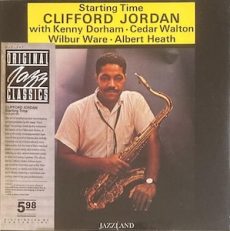
Clifford Jordan enters the spotlight to begin November with a wonderful 1961 quintet date called Starting Time (Jazzland JLP 52/JLP 52S). It was the tenor saxophonist’s seventh album as a leader and second on the label following A Story Tale. He was born in Chicago, Illinois, and early in his career, played with Max Roach and Sonny Stitt and was also a member of a few rhythm and blues groups. Clifford recorded three albums at Blue Note after moving to New York in 1957. Here, he is joined by Kenny Dorham on trumpet, Cedar Walton on piano, Wilbur Ware on bass, and Albert Heath on drums. My copy is the 1984 US Original Jazz Classics Stereo reissue (Jazzland OJC-147).
The opener, Sunrise in Mexico by Kenny Dorham, first appeared on the trumpeter’s album, Whistle Stop. The front line begins the introduction in unison, segueing into the quintet’s mid-tempo melody. Clifford is up first, and then Cedar has a satisfying statement. Wilbur and Albert share a brief comment before the group’s closing chorus fades out slowly. Extempore is a blues by Clifford Jordan that gets underway with the ensemble’s inviting theme. Jordan opens with a solo as smooth as velvet, and then Dorham glides through the second statement leisurely. Ware continues this bluesy trip in the following reading, and Walton speaks briefly ahead of the melody’s return and climax.
Down Through the Years is a very pretty ballad by the leader that the quintet begins with a delicately gentle melody. Clifford opens with a thoughtfully polite reading. Kenny takes a beautiful romantic interpretation next. Cedar closes with an elegantly serene performance preceding the ensemble’s tender reprise and conclusion. Quittin’ Time is the saxophonist’s lively way to end the first side with the group’s brisk theme. Jordan goes first with a spirited statement, and then Dorham keeps things rolling. Walton enters the next solo swiftly, and Heath swings comfortably in the closer, leading to the theme’s restatement and exit.
Side Two starts with One Flight Down, a funky blues by Cedar Walton that the quintet has some fun with. Cedar takes charge first with an infectiously laid-back solo. Kenny gets the next nod, and Jordan takes over for a short, satisfying statement leading to the closing chorus. Windmill by Kenny Dorham also comes from Whistle Stop and is a speedster from the quintet’s opening chorus. Dorham fires the first shot with an electrically charged interpretation. Jordan soars into an enthusiastic performance next, and then Walton shifts into high gear on the third reading. The leader has a vigorous exchange with Heath before the reprise and summation.
Don’t You Know I Care by Duke Ellington and Mack David is a quartet performance by Clifford and the rhythm section. The saxophonist is the featured soloist and begins with a warm tone on the melody and a beautifully phrased opening solo. Cedar shines briefly in a concise comment until Clifford reappears to take the song out tenderly. Mosaic by Cedar Walton became the title tune of an album by Art Blakey and The Jazz Messengers. The quintet begins with Dorham leading the way on the Eastern-flavored melody. Jordan takes the first statement, and then Dorham makes a profound impression next. Walton takes us into the ensemble’s reprise with a splendid solo.
Orrin Keepnews produced Starting Time, and Ray Fowler was the recording engineer. The sound quality of this OJC reissue is wonderful, with a soundstage that places the listener’s sweet spot in the studio as the musicians are playing. Clifford Jordan recorded thirty-six albums as a leader, and as a sideman, he appeared with some of the greatest musicians in jazz. For those fans of the tenor sax who enjoy a great hard-bop album, I invite you to check out Starting Time by Clifford Jordan on your next record-shopping trip. It’s a terrific record that I highly recommend as a welcome addition to any jazz library!
~ A Story Tale (Jazzland JLP 40/940S), Mosaic (Blue Note BLP 4090/BST 84090), Whistle Stop (Blue Note BLP 4063/BST 84063) – Source: Discogs.com © 2023 by Edward Thomas Carter
More Posts: choice,classic,collectible,collector,history,instrumental,jazz,music,saxophone