

Daily Dose Of Jazz…
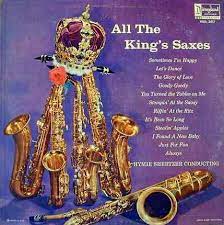
Hymie Schertzer was born Herman Schertzer on April 22, 1909 in New York City, New York and began playing violin when he was nine years old. He picked up the saxophone when he was a teenager and went on to work as a sideman for Gene Kardos at the club Birdland, then joined Benny Goodman’s band, where he was the lead saxophonist until 1938, though he recorded with Goodman intermittently until the mid-1940s.
Between 1938 and 1940 Hymie was in Tommy Dorsey’s band, and recorded in the late 1930s with Bunny Berigan and Lionel Hampton. He worked with Billie Holiday in 1941 and again in 1944, then became a house musician for NBC radio and television.
Working as a session player for studio recordings Schertzer was behind Ella Fitzgerald, Frank Sinatra, Sarah Vaughan, Sy Oliver, Louis Armstrong, and Artie Shaw during the years 1947-1953. He continued working with Goodman live, on television, and on record from 1951 until 1969.
Saxophonist and conductor Hymie Schertzer, who was a member of the Tonight Show Band during its Johnny Carson era, transitioned in New York City, on March 22, 1977 at the age of 67.
More Posts: conductor,history,instrumental,jazz,music,saxophone
Daily Dose Of Jazz…
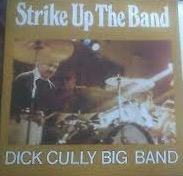
Richard Cully was born on April 19, 1949 in Manhattan, New York. He began his musical journey at the age of 16 studying with James Rago, Professor of Percussion at the University of Louisville. While still in high school, he formed a very popular quartet, The Charades, then went on to attend Berklee College of Music in Boston, Massachusetts. There he studied with Alan Dawson and continued his studies with former “Tonight Show” drummer Ed Shaughnessy.
Early in his career Dick performed a variety of musical styles, pop, rock, disco, jazz and country. However, in 1982, he formed the Dick Cully Big Band, a high energy, exciting unit performing a wide variety of arrangements for all age groups. In 1984, he became an artist/endorser for the world famous Slingerland Drum Company.
Cully has worked with Toni Tennille, Sandy Duncan, Florence Henderson, Frank Gorshin, Ray Anthony, Buddy Morrow, Skitch Henderson, Patti Page, Nanette Fabray, Les Elgart, Connie Haines, Bobby Rydell, comedians Foster Brooks and George Kirby. In 1989, the Dick Cully Big Band was chosen as “One of the best bands in the nation” by Down Beat magazine and featured on Black Entertainment Network’s “Jazz Discovery” television program.
Recognized as an educator and clinician, he is the author of Instructional Drum Videos The Workout, Secrets of the World’s Greatest Drummer and More Secrets of the World’s Greatest Drummer, which are in-depth analysis of the late Buddy Rich. Drummer Dick Cully continues to perform and lead his band.
More Posts: bandleader,drums,history,instrumental,jazz,music
Daily Dose Of Jazz…
Charlie Smith was born April 15, 1927 in New York City and played locally in the city during the late 1940s before taking a position accompanying Ella Fitzgerald. Working briefly with the Duke Ellington’s Orchestra in 1951 before being replaced by Louie Bellson, he also played with Joe Bushkin, Erroll Garner, Slim Gaillard, Benny Goodman, Hot Lips Page, Oscar Peterson, Artie Shaw, and Slam Stewart.
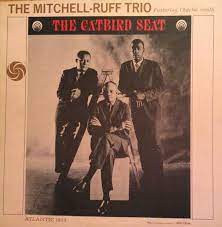
He performed on television with Dizzy Gillespie and Charlie Parker in 1952, and later in the decade worked with Billy Taylor, Aaron Bell, and Wild Bill Davison. Relocating to New Haven around 1960, Smith played with Willie Ruff and Dwike Mitchell in a trio setting.
Drummer Charlie Smith, who was an educator late in his life, transitioned on January 15, 1966 in New Haven, Connecticut.
More Posts: drums,history,instrumental,jazz,music
Daily Dose Of Jazz…
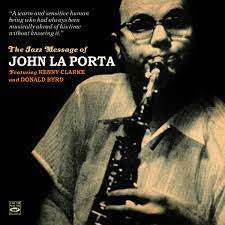
John Daniel LaPorta was born on April 13, 1920 in Philadelphia, Pennsylvania and started playing clarinet at the age of nine. He studied at the Mastbaum School in Philadelphia, alongside classmate Buddy DeFranco. As a teenager he played in local bands with Charlie Ventura and Bill Harris, and studied classically with Joseph Gigliotti of the Philadelphia Orchestra and Leon Russianoff at the Manhattan School of Music.
1942 saw him as a member of the Bob Chester big band for two years, then spent the following two years with the Woody Herman Orchestra. Beginning in 1947, he studied with Lennie Tristano, and with Teo Macero and Charles Mingus he was a member of the Jazz Composers Workshop, trying to combine jazz with classical music. Classically, he worked with Boston Pops, Leonard Bernstein, Leopold Stokowski, and Igor Stravinsky. In jazz he worked with Kenny Clarke, Miles Davis, Dizzy Gillespie, Charlie Parker, Buddy Rich, and Lester Young.
In 1956, La Porta played the first jazz concert in Venezuela at Caracas National Theater, where a selection of the repertoire performed was released under the title South American Brothers by Fantasy Records, becoming the first jazz recording in Venezuela.
As an educator he taught at Parkway Music School, then at public schools on Long Island, followed by the Manhattan School of Music and the Berklee College of Music. With guitarist Jack Petersen, he pioneered the use of Greek modes for teaching chord-scales.
In the 1990s, he retired to Sarasota, Florida, where he performed at the Sarasota Jazz Club and as a guest with the Fred Williams Trio. His autobiography is titled Playing It by Ear. Clarinetist and composer John LaPorta transitioned from complications of a stroke on May 12, 2004 in Sarasota.
More Posts: bandleader,clarinet,composer,history,instrumental,jazz,music
Daily Dose Of Jazz…
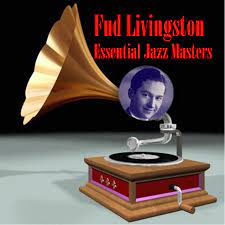
Joseph Anthony Livingston, better known by his peers as Fud, was born April 10, 1906 in Charleston, South Carolina and started out on accordion and piano before settling on saxophone. At seventeen he was playing with Tal Henry in Greensboro, North Carolina in 1923, then worked with Ben Pollack, the California Ramblers, Jean Goldkette, Nat Shilkret, Don Voorhees, and Jan Garber. He recorded freelance with musicians such as Joe Venuti, Red Nichols, and Miff Mole.
He did some arrangement work for Frankie Trumbauer and Bix Beiderbecke, including the nursery rhyme Humpty Dumpty. Livingston played on the 1928 Brunswick recording of “Room 1411” as a member of Bennie Goodman and His Boys, which also featured Glenn Miller, Jimmy McPartland, Bud Freeman, and Ben Pollack.
A stint in London,England in 1929 had him working with Fred Elizalde, then returned to New York City to play with Paul Whiteman. His time with Whiteman lasted from 1930 to 1933, and was mainly as an arranger, though he played occasionally. By the mid 1930s he worked with Benny Goodman, Jimmy Dorsey, Bob Zurke, and Pinky Tomlin as the country entered into the Forties. Essentially stopping his writing and arranging at this point, Fud would occasionally perform in small-time venues in New York in the 1950s.
His compositions included Feelin’ No Pain, Imagination, Humpty Dumpty, Harlem Twist, Sax Appeal, are well known but the jazz standard, I’m Thru With Love, written with Matty Malneck and Gus Kahn, has been recorded by over sixty musicians and vocalists, but a short list is Bing Crosby, Dizzy Gillespie, Arthur Prysock, Coleman Hawkins, Lorez Alexandria, John Pizzarelli, Joe Williams Marilyn Monroe, Maxine Sullivan and Steve Tyrell.
It has been sung in the films Everyone Says I Love You, Some Like It Hot, The Affairs Of Dobie Gillis and Spider~Man 3. Even Alfalfa from The Little Rascals had added it to his repertoire.
Clarinetist, saxophonist, arranger, and composer Fud Livingston, who never recorded as a leader, transitioned on March 25, 1957 in New York City.
More Posts: arranger,clarinet,composer,history,instrumental,jazz,music,saxophone