

Daily Dose Of Jazz…
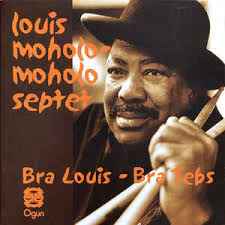
Louis Tebogo Moholo was born on March 10, 1940 in Cape Town, South Africa. He formed The Blue Notes with Chris McGregor, Johnny Dyani, Nikele Moyake, Mongezi Feza and Dudu Pukwana, and at the age of twenty-four, emigrated to Europe with them. He eventually settled in London, England where he formed part of a South African exile community that made an important contribution to British jazz.
In 1966, he toured Buenos Aires, Argentina, where he performed at the Theatron with Steve Lacy, Johnny Dyani and Enrico Rava and recorded the album The Forest and the Zoo with the same musicians. During the 1970s he was a member of the Brotherhood of Breath, a big band comprising several South African exiles and leading musicians of the British free jazz scene in the 1970s. He is the founder of Viva la Black and The Dedication Orchestra.
His first album under his own name, Spirits Rejoice on Ogun Records, is considered a classic example of the combination of British and South African players. In the early 1970s, Moholo was also a member of the afro-rock band Assagai.
He has played with, among others, Derek Bailey, Steve Lacy, Evan Parker, Enrico Rava, Roswell Rudd, Irène Schweizer, Cecil Taylor, John Tchicai, Archie Shepp, Peter Brötzmann, Mike Osborne, Keith Tippett, Elton Dean and Harry Miller.
Moholo returned to South Africa in September 2005, performing with George Lewis at the UNYAZI Festival of Electronic Music in Johannesburg, South Africa. Now going by the name Louis Moholo-Moholo because the name is more ethnically authentic, the drummer continues to perform and record.

More Posts: bandleader,drums,instrumental,jazz,jistory,music

Daily Dose Of Jazz…
Victor Ash was born in East London, England on March 9, 1930, of Jewish ancestry and began playing professionally in 1951 when, with Tubby Hayes, he joined the band of Kenny Baker, with whom he played until 1953. Following this association, Ash played with Vic Lewis from 1953–56, then accompanied Hoagy Carmichael and Cab Calloway on their English tours.
Leading his own group, he became a favourite in the Melody Maker fan polls of the 1950s. Concurrently he had a radio program called Sunday Break, which discussed jazz and religion. In 1954, the Vic Ash Quartet recorded with US singer Maxine Sullivan in London. Ash toured the U.S. in 1957 and returned to play with Lewis in 1959. That same year his ensemble was the only one representing British jazz at the Newport Jazz Festival.
Ash remained a mainstay on the British jazz scene for decades, playing in small and large ensembles including the BBC Big Band. He accompanied Frank Sinatra on his tours in Europe and the Middle East, from 1970 until Sinatra’s death.
He released many albums for Pye, Nixa and MGM, mostly in the mainstream jazz tradition. Saxophonist and clarinetist Vic Ash, who co-authored his autobiography I Blew It My Way in 2006, passed away on October 24, 2014.
More Posts: bandleader,clarinet,history,instrumental,jazz,music,saxophone

Daily Dose Of Jazz…
De Priest E. B. Wheeler was born on March 1, 1903 in Kansas City, Missouri and played trumpet and mellophone in The Knights of Pythias Band while attending Lincoln High School. With the band he journeyed to St. Louis, Missouri in 1917. Returning to Kansas City he worked in a local dance hall for a year, before becoming a member of the resident band at the Chauffeur’s Club in St. Louis in 1918.
He was with Dave Lewis’s Jazz Boys in Kansas City, then toured with a circus band until 1922. Joining the Wilson Robinson Syncopators in St. Louis in 1923, he toured the Pantages Circuit from Chicago, Illinois to California with that band. The band eventually settled in New York in early 1925 where they were renamed Andy Preer And His Cotton Club Orchestra. Subsequently they worked under the leadership of violinist Andrew Freer until his death in 1927. Later on the group became known as The Missourians, and when Cab Calloway joined as a singer in 1928, from 1930 on he took over and they became Cab’s band.
Wheeler remained with Calloway until 1940, touring Europe in 1934. He worked for the postal authorities for many years, but continued to play part-time with bands and orchestras through the 1950s. Trombonist De Preist Wheeler passed away April 10, 1998 in St. Albans, Queens, New York.
More Posts: history,instrumental,jazz,music,trombone
Daily Dose Of Jazz…
William Earnest Green was born on February 28, 1925 in Kansas City, Kansas and learned to play the alto saxophone at age ten, picking up the clarinet when he was twelve. He eventually learned to play most varieties of saxophone, clarinet, and flute.
Serving in the military until 1946, Green began working at a club called Small’s in Kansas City. Relocating to Los Angeles, California in 1947 he enrolled at the Los Angeles Conservatory of Music and Arts, and graduating in 1952 remained on staff as an educator until 1962. He also ran a music education studio on La Brea Avenue in Los Angeles for many years.
During his early career Bill played with Gerald Wilson, and began working with Benny Carter in the latter half of the 1950s. From 1959 to 1962 he played in Louie Bellson’s big band, then went to work extensively as a section player in the bands of Quincy Jones, Henry Mancini, and Buddy Rich. He would accompany vocalists such as Frank Sinatra, Tony Bennett, Nat King Cole, Nancy Wilson, and Dionne Warwick.
Through the mid to late Sixties he played the Monterey Jazz Festival with Gil Fuller, worked with Oliver Nelson, and then Blue Mitchell. The 1970s saw him performing or recording with Gene Ammons, the Capp-Pierce Juggernaut, Ella Fitzgerald, Sonny Rollins, and Sarah Vaughan. He continued working with the Capp-Pierce Orchestra in the early 1980s, as well as with Lionel Hampton, Woody Herman, and the Clayton-Hamilton Jazz Orchestra.
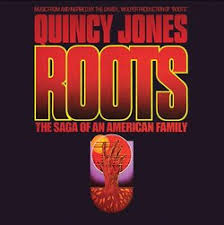
His most notable recordings are Benny Carter’s Aspects and the Quincy Jones recording of the soundtrack for Roots. Multi-instrumentalist Bill Green, who played most saxophones, clarinet and flute, passed away on July 29, 1996. His personal papers and recordings are archived at University of California, Los Angeles..

More Posts: clarinet,flute,history,instrumental,jazz,music,saxophone
Daily Dose Of Jazz…
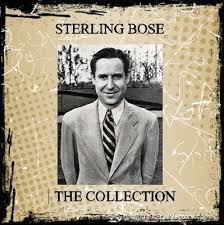
Sterling Belmont “Bozo” Bose was born on September 23, 1906 in Florence, Alabama and his style was heavily influenced by Bix Beiderbecke and changed little over the course of his life.
His early experience came with Dixieland jazz bands in his native Alabama before moving to St. Louis, Missouri in 1923. He played with the Crescent City Jazzers, the Arcadian Serenaders, and the Jean Goldkette’s Orchestra in 1927-28 after the departure of Beiderbecke. Following this he worked in the house band at radio station WGN in Chicago, Illinois before joining Ben Pollack from 1930 to 1933. He also worked with Eddie Sheasby in Chicago.
Moving to New York City in 1933, Bose had many gigs in the city during the 1930s to the mid 1940s, including time with Joe Haymes, Tommy Dorsey, Ray Noble, Benny Goodman, Lana Webster, Glenn Miller, Bob Crosby, Bobby Hackett, Bob Zurke, Jack Teagarden, Bud Freeman, George Brunies, Bobby Sherwood, Miff Mole, Art Hodes, Horace Heidt, and ending with Tiny Hill in 1946.
Following this period he did some further freelancing for the next two years in Chicago and New York, and finally moved to Florida in 1948, setting up his own bands there. Suffering from an extended period of illness in the 1950s, trumpeter and cornetist Sterling Bose, whose nickname was Bozo, eventually committed suicide in June of 1958. in St. Petersburg, Florida.
More Posts: bandleader,cornet,history,instrumental,jazz,music,trumpet