

Daily Dose Of Jazz…
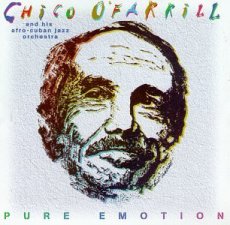
Arturo “Chico” O’Farrill was born on October 28, 1921 in Havana, Cuba of Irish/German heritage. Attending military school in Georgia he learned to play trumpet and was exposed to big band jazz.
Although he played trumpet early in his career, he became a sought-after composer and arranger, and was one of many leading the emergence of the Afro-Cuban jazz movement in the ‘50s dubbed Cubop.
Best known for his work in the Latin idiom, Chico also composed straight-ahead jazz pieces and even symphonic works. He composed works for Machito’s Afro-Cuban Suite with Charlie Parker and Benny Goodman’s Bebop Orchestra’s Undercurrent Blues and composed the Manteca Suite for Dizzy Gillespie and arranged for Stan Kenton and David Bowie, among others.
Over the course of his career he has recorded for Norman Granz’s label, with Todd Barkan at Fantasy, worked with the count Basie, Gato Barbieri, and Cal Tjader and has recorded and performed as a leader in small configurations, a bandleader and a sideman on more the two dozen albums. His music has been featured in the film Calle-54 and in the ‘90s he led a big band that took up residence at Birdland in New York.
Chico O’Farrill, Grammy nominee, passed away on June 27, 2001 in New York City and eventually his son Arturo took over the band.

Take A Dose On The Road
More Posts: piano
Daily Dose Of Jazz…
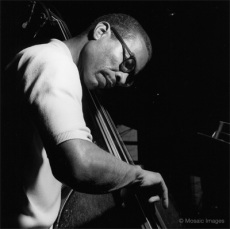
Wendell Marshall was born into a musical family on October 24, 1920 in St. Louis, Missouri. He took up the bass in emulation of and receiving his first lessons from his cousin Jimmy Blanton. He began playing professionally around his hometown in the late ‘30s and played with Lionel Hampton in ’42. Graduating from Lincoln University, he then served in the Army during World War II.
After his discharge, Marshall played and recorded with Stuff Smith, relocated to New York City and played with Mercer Ellington prior to his tenure with Duke Ellington from 1948 to 1955, appearing in several films with the orchestra.
Departing from Duke, Wendell played in pit orchestras on Broadway, freelanced with Mary Lou Williams, Art Blakey, Donald Byrd, Milt Jackson and Hank Jones among others. He was the house bassist for Prestige Records known for his rich tone, reliable sense of time and fine technique making him a popular collaborator.
It is estimated that he recorded with a prodigious list of musician with albums numbering over 150 including his own in 1955 as a leader, Wendell Marshall with the Billy Byers Orchestra. He was also a part of the Jazz Lab quintet led by Donald Byrd and Gigi Gryce.
However, by 1968 he retired from music and returned to St. Louis where he set up his own insurance business. Double bassist Wendell Marshall passed away of colon cancer on February 6, 2002 in his hometown of St. Louis.
Put A Dose In Your Pocket
More Posts: bass
Daily Dose Of Jazz…
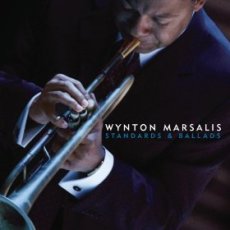
Wynton Learson Marsalis was born October 18, 1961 in New Orleans, Louisiana, the son of a jazz pianist. At an early age he exhibited an aptitude for music and by age eight he was performing traditional New Orleans music in the Fairview Baptist Church band. At 14, he performed with the New Orleans Philharmonic and during high school played with the New Orleans Symphony Brass Quintet, the New Orleans Community Concert Band, the New Orleans Youth Orchestra, the New Orleans Symphony, various jazz bands and with a local funk band, the Creators.
At age 17, Wynton was the youngest musician admitted to Tanglewood’s Berkshire Music Center where he won the school’s Harvey Shapiro Award for outstanding brass student. Moving to New York City he attended Julliard in 1979 and picked up gigs around town. He joined the Jazz Messengers led by Art Blakey in 1980 and in the years that followed he would perform with Sarah Vaughan, Dizzy Gillespie, Sweets Edison, Clark Terry, Sonny Rollins, Ron Carter, Herbie Hancock, Tony Williams and countless other jazz legends.
Marsalis has written, produced and hosted Marsalis On Music, an educational television series on jazz and classical music, National Public Radio aired the first of Marsalis’ 26-week series, titled Making the Music, was awarded a Peabody Award, has written five books, co-founded the jazz program at Lincoln Center that evolved into Jazz at Lincoln Center, opened Frederick P. Rose Hall, the first ever institution for jazz with three performance halls, recording, broadcast, rehearsal and education facilities.
Wynton Marsalis, jazz trumpeter, bandleader, composer and educator is currently the Artistic Director for Jazz at Lincoln Center and Music Director for the Jazz at Lincoln Center Orchestra. He was won nine Grammy Awards in both jazz and classical genres, and received the first ever Pulitzer Prize for Music.
Jazz Is Global – Share
More Posts: cornet,flugelhorn,flumpet,trumpet
Daily Dose Of Jazz…
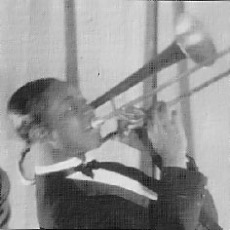
Jimmy Harrison was born on October 17, 1900 in Louisville, Kentucky and began on trombone at age 15, playing locally in the Toledo, Ohio area. He also played semi-pro baseball but chose music over a career in sports when he joined a traveling minstrel show in the late 1910s.
By 1919 Harrison was leading his own jazz ensemble in Atlantic City, New Jersey and played in the bands of Charlie Johnson and Sam Wooding. Moving to Detroit he played with Hank Duncan and Roland Smith. After returning to Toledo, he played gigs with June Clark and James P. Johnson. He followed this period with a stint in New York City with Fess Williams.
Giving leadership of his ensemble to June Clark in 1924, Jimmy continued to play with the group, worked with Duke Ellington during this period and in 1925 was working with Billy Fowler then with Elmer Snowden, Fletcher Henderson and Benny Carter’s Chocolate Dandies. While on tour with Henderson he took ill with a stomach ailment and though he continued to play for several months with Chick Webb. Trombonist Jimmy Harrison passed away on July 23, 1931 in New York City at the age of 30.
Put A Dose In Your Pocket
More Posts: trombone
Daily Dose Of Jazz…
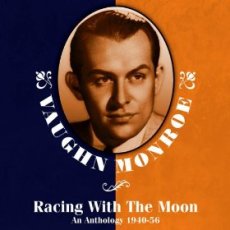
Vaughn Wilton Monroe was born on October 7, 1911 in Akron, Ohio and didn’t study music until attending the New England Conservatory in 1935 and then only one semester of voice. By 1940 he formed his first orchestra becoming lead vocalist and recording for the Bluebird label. That same year he built The Meadows, a restaurant/nightclub outside Boston and hosted the Camel Caravan radio program on location in 1946.
Monroe recorded extensively for RCA Victor into the 1950s and his signature tune was “Racing with the Moon” among his many other hits such as In The Still Of The Night, There I’ve Said It Again, Let It Snow, Let It Snow, Let It Snow; and Riders In The Sky are just a few. A composer, he also wrote a number of songs.
His interest turned to acting and as the movies also beckoned he pursued but with little vigor. He co-authored The Adventures of Mr. Putt Putt, a children’s book about airplanes and flying, published in 1949.
He hosted The Vaughn Monroe Show on CBS television in the Fifties, and appeared on Bonanza, the Mike Douglas Show, the Ed Sullivan Show, the Jackie Gleason Show and American Bandstand. A major stockholder in RCA, Monroe appeared in print ads and television commercials for the company’s TV and audio products.
Vaughan Monroe, baritone singer, trumpeter, bandleader actor and composer died on May 21, 1973 shortly after having stomach surgery. He has two stars on the Hollywood Walk of Fame for recording and radio.
Dose A Day – Blues Away