

Daily Dose Of Jazz…
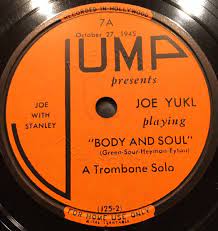
Joseph William Yukl was born on March 5, 1909 in Los Angeles, California and learned to play violin before switching to trombone as a teenager.
Yukl relocated to New York City in 1927 where he took a position playing in radio bands for CBS, and worked with Red Nichols and The Dorsey Brothers. During 1934 he played with Joe Haymes, then with the Dorseys once again.
Through the end of the decade he played with Louis Armstrong, Ray McKinley, Bing Crosby, Ben Pollack, Frankie Trumbauer, and Ted Fio Rito. The 1940s saw Joe working as a session musician for studio recordings in Los Angeles, California and for film and television.
He played with Wingy Manone and Charlie LaVere in the 1940s. He appears in the film Rhythm Inn in 1951 and is heard playing trombone in the 1953 movie The Glenn Miller Story.
Trombonist Joe Yukl transitioned on March 16, 1981 at the age of 72 in his hometown.

More Posts: history,instrumental,jazz,music,trombone
Daily Dose Of Jazz…
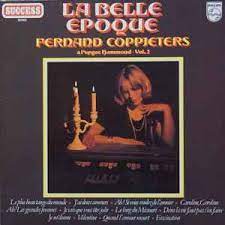
Fernand Coppieters was born in Brussels, Belgium on March 3, 1905. He took up piano in his youth and also played the Hammond organ. His first professional work was with the ensemble Bistrouille ADO in 1920 at age 15. Following this, he played in the Red Mills Ragtime Band and the Rhythmic Novelty Dance Orchestra.
Leaving Belgium for France he landed a place in Fud Candrix’s ensemble in France and Holland. Returning to Brussels in 1929, he played in a trio with René Compère and again with Candrix. Soon after this, he joined the 16 Baker Boys, led by Robert de Kers and, later, Oscar Aleman.
In the early 1930s, he accompanied Josephine Baker on tours of Europe, then worked with Roland Dorsay, Candrix once again, and Willie Lewis. In the 1940s and 1950s, he recorded as a leader and worked as a house pianist for Radio Schaerbeek, an independent Belgian radio station.
In the late 1950s and 1960s, he recorded several albums on Hammond organ, for Fontana Records and Philips Records. Pianist and organist Fernand Coppieters, who also played accordion, saxophone, and violin, transitioned on September 9, 1981 in Brussels.
More Posts: accordion,bandleader,history,instrumental,jazz,music,organ,piano,saxophone,violin
Daily Dose Of Jazz…
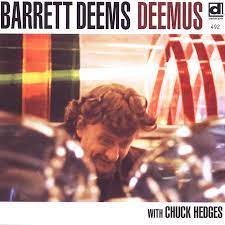
Barrett Deems was born March 1, 1914 in Springfield, Illinois. He worked in bands led by Jimmy Dorsey, Louis Armstrong, Red Norvo, and Muggsy Spanier.
He performed the drum solo during a scene on the back of the bus in the 1956 film High Society. The movie’s star, Bing Crosby, introduces the band members, including Deems, who then performs a short drum solo. Louis Armstrong and His All Stars play the song Now You Has Jazz.
He recorded three albums, Barrett Deems Big Band, Deemus and Barrett Deems and his WFL. Drummer Barrett Deems, who married twice, transitioned from pneumonia in Chicago, Illinois at the age of 84 on September 15, 1998.
More Posts: bandleader,drums,history,instrumental,jazz,music
Daily Dose Of Jazz…
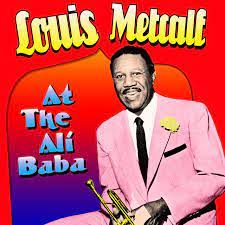
Louis Metcalf was born on February 28, 1905 in Webster Groves, Missouri. As a youth he first trained on the drums but switched over to cornet permanently. As a teenager in St. Louis, Missouri he played with Charlie Creath.
Moving to New York City in 1923 he participated in the fertile jazz scene there, playing with Willie The Lion Smith, Jelly Roll Morton, Benny Carter and King Oliver. In 1926, Duke Ellington hired Metcalf to play in his seminal orchestra, where his mellow tone contrasted with that of Bubber Miley. In the 1930s, he led his own bands and also joined Fletcher Henderson’s band.
1946 saw Louis moving to Montreal, Canada where he formed the International Band, the first to play the nascent bebop style in Canada. Under his leadership the Café Saint-Michel was the hub of the jazz scene in Montreal for a few years, with local musicians such as the young Oscar Peterson and visiting Americans Art Pepper, Fats Navarro and Sonny Rollins among others sitting in with the band.
A drug bust prompted Metcalf to return to New York City in 1951. He released an album titled I’ve Got The Peace Brother Blues in 1966, where he demonstrated that his style had indeed evolved since his days with Ellington.
Becoming less active after falling ill in 1968, trumpeter Louis Metcalf transitioned on October 27, 1981.

More Posts: bandleader,history,instrumental,jazz,music,trumpet
Daily Dose Of Jazz…
Gordon “Whitey” Mitchell was born on February 22, 1932 in Hackensack, New Jersey. He began on clarinet and tuba as a youngster before choosing bass as his primary instrument. He studied radio & television at Syracuse University and then plunged into the New York jazz scene, becoming a regular at the famed nightspots Birdland and Basin Street East.
He led his own groups at The Village Vanguard and The Embers and later toured with big band greats Benny Goodman and Pete Rugolo, played Carnegie Hall with Gene Krupa, appeared with Buddy Rich, Ella Fitzgerald, Dizzy Gillespie and Lester Young on Jazz At The Philharmonic.
In the early 1950s he played with Elinor Sherry and Shep Fields before serving in the Army during the Korean War. From 1954 he worked freelance in New York City, playing with Gene Krupa, Mel Tormé, Jack Jones, J.J. Johnson, Kai Winding, Lester Young, Charlie Ventura, Herbie Mann, Betty Roche, Oscar Pettiford, Gene Quill, Joe Puma, Johnny Richards, Peter Appleyard, André Previn, Benny Goodman, and again with Rugolo.
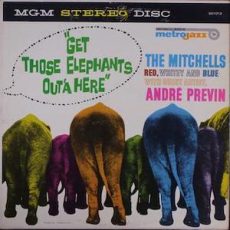
He performed on hundreds of recording sessions, television and film scores but only released one album under his own leadership on ABC-Paramount in 1956, and one with his brother Red and Blue Mitchell in 1958 as The Mitchells: Red, Whitey & Blue, released on MetroJazz Records. Whitey recorded with Anita O’Day, Barbra Streisand, Anthony Newley, and played the bass solo introduction on Ben E. King’s hit record Stand By Me.
After 1965 he largely ceased playing jazz and moved to Hollywood, California on advice from Lenny Bruce and André Previn to pursue a career as a television writer. He worked on shows such as Get Smart, All In the Family, The Jeffersons, Good Times, The Mary Tyler Moore Show, The Odd Couple, Mork and Mindy, and several Bob Hope television specials. He wrote the feature film Private Resort starring Johnny Depp.
As an educator he taught screenwriting at UCLA and UC Riverside. In 1995 he had his own radio show, The Power Lunch and wrote a golf column for a local magazine. He recorded his CD Just In Time and played jazz in all the nightclub venues. He was the author of two books, Hackensack to Hollywood: My Two Show Business Careers and Star Walk: A Guide to the Palm Springs Walk of Stars.
Bassist and television writer/producer Whitey Mitchell, who often placed in the Metronome and Downbeat jazz polls, transitioned on January 16, 2009.
More Posts: bandleader,bass,history,instrumental,jazz,music