

Daily Dose Of Jazz…
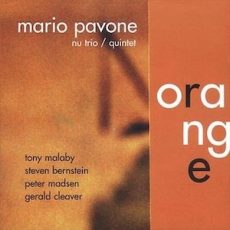
Mario Pavone was born on November 11, 1940 in Waterbury, Connecticut and attended B. W. Tinker grammar school, Leavenworth High School, and the University of Connecticut at Storrs, where he graduated with a B.S. in engineering. When his neighbor, guitarist Joe Diorio, recognized him as an unrealized musician Mario was inspired to take up the bass. Primarily self-taught, he was a natural on his instrument. Pavone began playing bass soon after witnessing John Coltrane at the Village Vanguard in 1961.
Pavone’s career took off during the Sixties when he toured Europe and was involved in the jazz loft era, playing in jam sessions nightly in New York City. From the late in the decade into the early Seventies he was a member of Paul Bley’s trio. The New Haven based Creative Musicians Improvising Forum (CMIF) was founded in 1975 by Pavone, Wadada Leo Smith, and Gerry Hemingway was influenced by Chicago’s Association for the Advancement of Creative Musicians. His venture into composition began here.
In 1979 Mario recorded his debut album as a leader and was a member of Bill Dixon’s trio during the 1980s. He also performed with Barry Altschul, Smith, and Hemingway. In 1980 he began an 18-year musical relationship with saxophonist Thomas Chapin. With drummer Michael Sarin, the group recorded seven albums for Knitting Factory Records, which also released an eight-CD box set of these albums plus a live recording following Chapin’s death in 1998.
He co-led a group with Anthony Braxton in the early 1990s, with Braxton on piano rather than his usual saxophones. His groups have included Matt Wilson, Gerald Cleaver, Peter Madsen, Joshua Redman, Tony Malaby, Dave Douglas, Steven Bernstein, George Schuller, Craig Taborn, and Jimmy Greene.
Bassist Mario Pavone, who has over 40 recordings and several films documenting his compositions and performances, died from carcinoid cancer in Madeira Beach, Florida on May 15, 2021 at the age of 80.

More Posts: bandleader,bass,composer,history,instrumental,jazz,music
Daily Dose Of Jazz…
Gustavo Casenave was born on November 10, 1971 in Montevideo, Uruguay where he studied classical piano from age 6 with Maestro Hector Tosar, who was Aaron Copland’s student. He led the group Kongo Bongo and recorded two albums, however, following a conversation with Hugo Fattoruso he decided to study in Boston, Massachusetts. In 1994 received a full scholarship from O.A.S. to study at the Berklee College of Music and two years later he graduated magna cum laude.
During this period he was awarded the Professional Music Achievement, and his composition Fragiltimer for the Past Future for piano was selected as one of the ten best original compositions coming out of Berklee in the last 30 years, 1966-1996. In 1995 he was accepted as a private student by the legendary jazz vibraphonist Gary Burton.
1997 saw Gustavo settling in New York City and creating a name for himself. He has been awarded three Grammys as a producer, composer and performer, Best Latin Jazz Album (producer), Best Tango Album, and Best Instrumental Album that showcased his ability to create compositions that resonate with audiences worldwide. He has also had six Latin Grammy nominations and three nods for Best Contemporary Classical Composition.
As an educator, Casenave has held positions as Jazz Department Director at the Harbor Conservatory for the Performing Arts and has conducted Tango Master Classes as well as being a guest artist lecturer at The Juilliard School, Yale University, Eastman School of Music, Oberlin Conservatory and Indiana University.
Pianist Gustavo Casenave continues to contribute to jazz as a performer, composer, educator, and scholar, having published his first music theory book, “The Harmonic Structure Levels.
More Posts: bandleader,composer,educator,history,instrumental,jazz,music,scholar
Daily Dose Of Jazz…
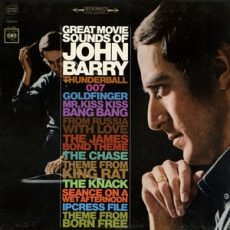
John Barry was born John Barry Prendergast in York, England on November 3, 1933 the youngest of four children, his mother, a classical pianist, his father a projectionist. Raised in and around cinemas, this childhood background influenced his musical tastes and interests. He was educated at St. Peter’s School, York, and received composition lessons from Francis Jackson, Organist of York Minster.
Spending his national service in the British Army playing the trumpet and working from a correspondence course with jazz composer Bill Russo, after his service he worked as an arranger for the orchestras of Jack Parnell and Ted Heath. Forming his own band, the John Barry Seven, in 1957, they recorded hit records on EMI’s Columbia label. By 1959 he gained commissions to arrange music for other acts, and his career breakthrough was the BBC television series Drumbeat, when he appeared with the John Barry Seven.
He was employed by EMI from 1959 until 1962 arranging orchestral accompaniments for the company’s singers. He began composing songs and scores for films and when Adam Faith made his first film, Beat Girl in 1960, Barry composed, arranged and conducted the film score, his first. His music was later released as the UK’s first soundtrack album. His composition and orchestration caught the attention of the Bond producers and he went on to have an accomplished career as a composer and arranger with the series.
In 2001, the University of York conferred an honorary degree on Barry, and in 2002 he was named an Honorary Freeman of the City of York. Fiancial issues in Britain forced him to emigrate to the United States where he lived for many years mainly in Oyster Bay, New York, in Centre Island on Long Island
He suffered a rupture of the esophagus in 1988, following a toxic reaction to a health tonic he had consumed. The incident rendered him unable to work for two years and left him vulnerable to pneumonia.
Composer, arranger and conductor John Barry, who won five Academy Awards and four Grammy Awards with scores for Born Free, The Lion in Winter, Midnight Cowboy and Somewhere in Time, died of a heart attack on January 30, 2011 at his Oyster Bay home, aged 77.
More Posts: arranger,composer,conductor,history,instrumental,jazz,music

Daily Dose Of Jazz…
Trilok Gurtu was born October 30, 1951 to Hindu Brahmin parents in Mumbai, India. His mother was a famous classical vocalist who encouraged him to learn to play the tabla. He attended Don Bosco High School in Mumbai and he received formal training in percussion from Shah Abdul Karim.
Gurtu began playing a western drum kit in the 1970s, and developed an interest in jazz. Not understanding overdubbing he learned multiple parts which most musicians would have never attempted. In the 1970s, he played with Charlie Mariano, John Tchicai, Terje Rypdal, and Don Cherry.
In 1977 he recorded Apo-Calypso, an album by the German ethnic fusion band Embryo. His mother also sang on that record, and later joined him on his first solo CD, Usfret. The 1980s saw Trilok playing with Swiss drummer Charly Antolini and with John McLaughlin in McLaughlin’s trio. He joined Oregon and played on three of their records. In the early 1990s, he resumed his career as a solo artist and a bandleader.
By the end of the decade he was a member of Tabla Beat Science, collaborated with the Arkè String Quartet in 2007, and in 2012 with the electronic folk duo Hari & Sukhmani. He has worked with Terje Rypdal, Gary Moore, John McLaughlin, Jan Garbarek, Joe Zawinul, Michel Bisceglia, Bill Laswell, Maria João & Mário Laginha, Stefano Bollani and Robert Miles.
Drummer, percussionist, tabla player and composer Trilok Gurtu continues to compose, perform and record.

More Posts: composer,drums,history,instrumental,jazz,music,percussion,tabla

Daily Dose Of Jazz…
Pharoah Sanders was born Ferrell Lee Sanders on October 13, 1940 in Little Rock, Arkansas, an only child. He began his musical career accompanying church hymns on clarinet but his initial artistic accomplishments were in the visual arts. When he was at Scipio Jones High School in North Little Rock, he began playing the tenor saxophone.
After graduating from high school in 1959, Sanders moved to Oakland, California, where he lived with relatives. He briefly studied art and music at Oakland City College. He earned a Bachelor of Fine Arts from an unknown art institution.
He began his professional career playing tenor saxophone in Oakland, then moved to New York City in 1962. The following year he was playing with Billy Higgins and Don Cherry and caught the attention of Eric Dolphy and John Coltrane. In 1965, he became a member of Coltrane’s band, as the latter gravitated towards the avant-garde jazz of Albert Ayler, Sun Ra, and Cecil Taylor.
Sanders first recorded with Coltrane on Ascension, followed by their dual-tenor album Meditations, then joined Coltrane’s final quintet. Pharoah released his debut album as a leader, Pharoah’s First, was not what he expected. In 1966 he signed with Impulse! and the years Sanders spent with the label were both a commercial and critical success.
The 1970s had Sanders continuing to produce his own recordings including the 30-minute wave-on-wave of free jazz, The Creator Has A Master Plan from the album Karma, featuring vocalist Leon Thomas and to work with Alice Coltrane on her Journey in Satchidananda album. Although supported by African-American radio, Sanders’ brand of brave free jazz became less popular.
His major-label return came in 1995 when Verve Records released Message from Home, followed by Save Our Children (1998). But again, Sanders’s disgust with the recording business prompted him to leave the label. In the 2000s, a resurgence of interest in jazz kept Sanders playing festivals and was awarded a NEA Jazz Masters Fellowship for 2016 and was honored at a tribute concert in Washington DC on April 4, 2016.
In 2020 he recorded the album Promises, with the English electronic music producer Floating Points and the London Symphony Orchestra. It was widely acclaimed as a clear late-career masterpiece.
Saxophonist Pharoah Sanders, known for his overblowing, harmonic, and multiphonic techniques, died on September 24, 2022 at his home in Los Angeles at the age of 81.
More Posts: bandleader,history,instrumental,jazz,music,saxophone