

Daily Dose Of Jazz…
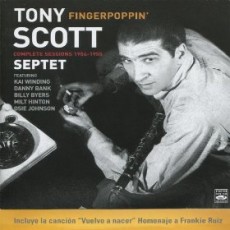
Tony Scott was born Anthony Joseph Sciacca June 17, 1921 in Morristown, New Jersey. He attended Julliard School in the early Forties and by the 50s was working with Sarah Vaughan, Billie Holiday and had a young Bill Evans as a sideman. Late in the decade he won on four occasions the Down Beat critics poll for clarinetist in 1955, 1957, 1958 and 1959 and was known for a more “cool” style than Buddy DeFranco.
For most of his career he was held in some esteem in New Age music circles because of his decades-long involvement in music linked to Asian cultures and to meditation. Despite this he remained relatively little known as the clarinet had been in eclipse in jazz since the emergence of bebop. In 1959 he left New York City and the United States touring South America, Europe, Africa and Southeast Asia. This led to his playing in a Hindu temple, spending time in Japan, and releasing Music for Zen Meditation and capturing Japan’s Down Beat poll for best clarinetist.
He settled in Italy in the 1980s, working with Italian jazz musicians such as Franco D’Andrea and Roman Mussolini, followed by an interest in electronica in his later years. Italian director Franco Maresco produced a documentary on the life of Tony Scott, released three years after his death on March 28, 2007. It was titled Tony Scott: The Story of How Italy Got Rid of the Greatest Jazz Clarinetists.
More Posts: clarinet
Daily Dose Of Jazz…
Tom Harrell was born on June 16, 1946 in Urbana, Illinois but by 5 was growing up in San Francisco. He started playing trumpet at eight and within five years, started playing gigs with local bands. Graduating from Stanford University with a music composition degree, he joined Stan Kenton’s orchestra, touring and recording with them throughout 1969.
After leaving Kenton, the post-bop trumpeter played with Woody Herman, Azteca, Horace Silver, the Sam Jones-Tom Harrell Big Band, the Lee Konitz Nonet, George Russell and the Mel Lewis Orchestra. Through the ‘80s he became a pivotal member of the Phil Woods Quintet making seven albums with the group.
Harrell is also plays flugelhorn and is a composer and arranger who has collaborated and recorded albums with Bill Evans, Dizzy Gillespie, Ronnie Cuber, Bob Brookmeyer, Lionel Hampton, Bob Berg, Bobby Shew, Joe Lovano, Charlie Haden’s Liberation Orchestra, Art Farmer, Charles McPherson and Kathleen Battle among others.
Since 1989 Harrell has led his own groups, usually quintets but has expanded ensembles such as chamber orchestra with strings and big bands. He has appeared at virtually every major jazz club and festival venues, and recorded under his own name for such record labels as RCA, Contemporary, Pinnacle, Blackhawk, Criss Cross, Steeplechase, Chesky and HighNote Records.
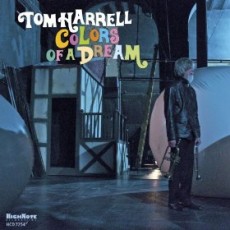
The Grammy-nominated artist has arranged and composed for Carlos Santana, Arturo O’Farrill, Metropole Orchestra and other big bands as well as his compositions being recorded by Ron Carter, Kenny Barron, Tom Scott, Chris Potter, Steve Kuhn and Hank Jones to name a few. In recent years he has formed and recorded with piano-less sextet “Colors Of A Dream” and piano-less quartet TRIP.
Despite his well-documented schizophrenia, Tom Harrell has successfully coped with the illness through medication and has become an influential figure in the jazz world. Throughout his career he has won numerous awards and grants, including multiple Trumpeter of the Year awards from Down Beat magazine, SESAC Jazz Award, BMI Composers Award, and Prix Oscar du Jazz. He has amassed a recorded discography of over 260 albums and continues to actively compose, record and tour extensively around the world.

Put A Dose In Your Pocket
More Posts: arranger,composer,flugelhorn,trumpet
Daily Dose Of Jazz…
Erroll Louis Garner was born on June 15, 1921 in Pittsburgh, Pennsylvania and began playing piano at age 3. Self-taught, he never learned to read music and remained an “ear player” all his life. At the age of 7, Erroll began appearing on radio station KDKA with a group called the Candy Kids, by 11 he was playing on the Allegheny riverboats and by the time he turned 14 in 1937, he joined local saxophonist Leroy Brown.
He moved to New York in 1944, worked with bassist Slam Stewart and though not a bebop musician in 1947 played with Charlie Parker on the famous “Cool Blues” session. Short in stature (5 foot 2 inches), Garner performed sitting on multiple telephone directories except in New York, where a Manhattan phone book was sufficient. He was also known for his occasional vocalizations while playing, which can be heard on many of his recordings and he helped bridge the gap for jazz musicians between nightclubs and the concert hall.
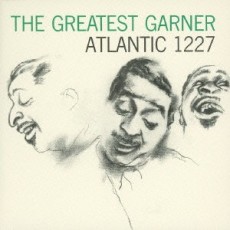
His best-selling album recorded at an Army base in Carmel, California was Concert By The Sea; and his best-known composition, the ballad “Misty” is a jazz standard and was featured in the 1971 Clint Eastwood vehicle “Play Misty for Me”. The brilliant virtuoso with a distinctive swing style was reportedly Tonight Show host Johnny Carson’s favorite jazz musician, toured both at home and abroad until his death from lung cancer on January 2, 1977.
Give The Gift Of Knowledge
More Posts: piano
Daily Dose Of Jazz…
Shelly Manne was born Sheldon Manne in New York City on June 11, 1920. His father and uncles were drummers, he got tips from drummer Billy Gladstone as a teenager and soon he rapidly developed his style in the 52nd Street clubs in the late 30s and 40s. He got his first professional job with the Bobby Byrne Orchestra and was soon recording with Coleman Hawkins, Charlie Shavers, Don Byas, Duke Ellington, Johnny Hodges, Harry Carney and Rex Stewart.
Manne rose to stardom when he became part of the bands of Woody Herman and Stan Kenton in the late 1940s and early 1950s, winning awards and developing a following at a time when jazz was the most popular music in the United States. When the bebop movement began to change jazz in the 1940s, Manne loved it and adapted to the style rapidly, performing with Dizzy Gillespie, Charlie Parker, Flip Phillips, Charlie Ventura, Lennie Tristano and Lee Konitz.
In the early 1950s, Manne left New York, settled permanently on a ranch outside Los Angeles, where he and his wife raised horses. This began his important role in the West Coast school of jazz, performing on the Los Angeles jazz scene with Shorty Rogers, Hampton Hawes, Red Mitchell, Art Pepper, Russ Freeman, Frank Rossolino, Chet Baker, Leroy Vinnegar and many others.
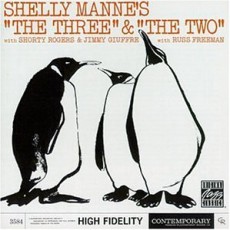
Shelly led a number of small groups that recorded under his name and leadership, recording his now famous live Black Hawk sessions and for Contemporary Records. He played in styles of Dixieland, swing, bebop, avant-garde jazz and fusion, as well as contributing to the musical background of hundreds of Hollywood films and television programs, collaborating with Henry Mancini on such films as Breakfast At Tiffany’s, Hatari and The Pink Panther and tv shows like Peter Gunn and Mr. Lucky.
Shelly Manne passed away of a heart attack on September 26, 1984 shortly before the popular revival of interest in jazz had gained momentum.
Give A Gift Of Jazz – Share
More Posts: drums
Daily Dose Of Jazz…
Eric Revis was born on May 31, 1967 in Los Angeles, California. He grew up listening mostly to funk and rock music and it was not until when he was 14 years of age that he picked up an electric bass and taught himself how to play. He attended Southern University as biology major for a year, Eric relocated to San Antonio, TX where he got a regular gig playing 6 nights a week.
While working the gig Revis got turned onto jazz, notably Kind Of Blue, which influenced him to switch to acoustic bass. He studied under Ellis Marsalis at the University of New Orleans but came to prominence attending the legendary school of Betty Carter in the mid-1990s.
In 1997, Eric met Branford Marsalis at a recording session with Russell Gunn. So impressed with the young bassist asked he Eric to join him on his recording, Bug Shot along with Kenny Kirkland and Jeff “Tain” Watts. The rest is history and the jazz bassist and composer has been a member of Branford Marsalis’s ensemble since 1997.
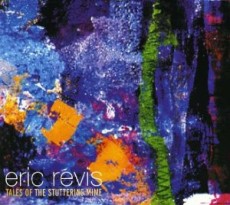
He released his debut album as a leader in 2004 titled Tales of the Stuttering Mime, has a sideman catalogue of thrity albums performing with Branford Marsalis, Kurt Rosenwinkel, Jeff “Tain” Watts, Joe Locke, Ralph Peterson, Orrin Evans, Frank McComb, J.D. Allen, Winard Harper, Sherman Irby and Russell Gunn among others. He has directed the Jazz Ensemble at Trinity University, in San Antonio, Texas from 2007/2008. He continues to perform, record and tour.
Put A Dose In Your Pocket
More Posts: bass