

Daily Dose Of Jazz…
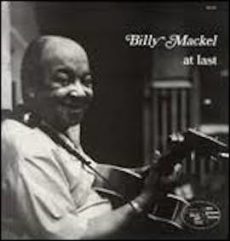
Billy Mackel was born John William Mackel on December 28, 1912 in Baltimore, Maryland and played banjo early in his career, but like many banjoists of his time he switched to guitar.
He led a band early in the 1940s, then joined Lionel Hampton in 1944 and spent the next thirty years with him. In the 1940s he also recorded with Milt Buckner, Arnett Cobb, Herbie Fields, and others, and worked with Billy Williams in the 1960s.
Guitarist Billy Mackel, who played left~handed and recorded as a leader, passed away on May 5, 1986.
More Posts: bandleader,guitar,history,instrumental,jazz,music
Daily Dose Of Jazz…
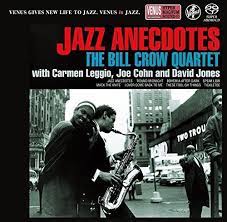
William Orval Crow was born December 27, 1927 in Othello, Washington but spent his childhood growing up in Kirkland, Washington, taking up the trumpet in fourth grade. When he joined the Army in 1946, he started to play brass instruments, remaining in the army until 1949. After leaving the Army, he played drums and trombone while a student at the University of Washington.
In 1950, Bill moved to New York City and within two years as a double bassist, he played with Teddy Charles and was with Stan Getz from October 1952 to the following April. He was part of Gerry Mulligan’s groups during the mid to late 1950s.
Crow joined the house band at Eddie Condon’s club in 1965 and then played with Walter Norris’s small group, which was one of the house bands at the Playboy Club in New York City in the mid~Sixties to early Seventies. From 1975 into the late 1990s he worked in theater orchestras on Broadway, where he sometimes played the tuba.
He authored a book called Jazz Anecdotes that was published by Oxford University Press in 1991. His autobiography, From Birdland to Broadway, was released by the same publisher two years later. Both were also the titles of his two albums as a leader.
As a sideman, he recorded 70 albums with Gerry Mulligan, Stan Getz, Zoot Sims, Bob Brookmeyer, Al Cohn, Clark Terry, Marian McPartland, J. J. Johnson, Al Haig, Jimmy Cleveland, Milt Jackson, Benny Goodman, Mose Allison, Jimmy Raney, Sal Salvador, Don Elliott, Teddy Charles, Manny Albam, Joe Morello, Bob Wilber, Eddie Bert, Jay McShann, Bob Dorough, Barbara Lea, Dick Sudhalter, Phil Woods, Dick Sudhalter, Ronnell Bright, Art Simmons, Rich Pearle, Spike Robinson, Claude Williamson, and Michelle Leblanc. Bassist Bill Crow continues to perform at the age of 92.
Daily Dose Of Jazz…
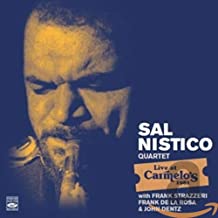
Frank de la Rosa was born on December 26, 1933 in El Paso, Texas. At age twenty he served in the US Army during the Korean War from 1953-1955, earning three medals and the GI Bill. After his discharge he attended the Los Angeles Conservatory of Music and Fine Arts, and began playing the bass at the age of 23.
Despite his late start in music education, Frank built an extraordinary career across the globe and performances with Sarah Vaughan, Nat King Cole, Chubby Checker, Harry “Sweets” Edison, and Don Ellis, to name a few.
He was also a part of the Don Menza & His ’80s Big Band, the Don Menza Sextet, Raoul Romero And His Jazz Stars Orchestra, René Bloch And His Big Latin Band, and the Don Ellis Orchestra.
Touring with Ella Fitzgerald, de la Rosa was a member of the Tommy Flanagan Trio from 1968 to 1972. He retired as a professional musician in 2003, however, the deer, dogs, and dandelions across his five acres of land enjoyed the daily melodies from his piano, bass, and/or cello until the summer of 2019 when bassist Frank de la Rosa passed away on July 5, at his home in Washougal, Washington. He was 85.
More Posts: bass,history,instrumental,jazz,music
Daily Dose Of Jazz…
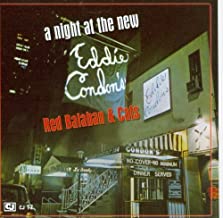
Red Balaban was born Leonard Balaban on December 22, 1929 in Chicago, Illinois. Moving the family to New York, he completed his early education at the Ethical Culture School. After graduating from Milford Academy in Connecticut, he graduated from Brown University.
Moving south to the panhandle, he raised breeding cattle on a farm in Bonifay, Florida and as a musician, he was a sideman, bandleader, and club owner. He played in regional ensembles from the 1950s, Red went on to hold a regular gig from 1966 at the Dixieland jazz club Your Father’s Mustache in New York City.
Balaban worked extensively as a sideman, for musicians such as Wild Bill Davison, Eddie Condon, Gene Krupa, Dick Wellstood, and Kenny Davern. He co-led Eddie Condon’s house band with Ed Polcer from 1975, and noted musicians in this outfit included Vic Dickenson, Warren Vache, and Connie Kay, before the club closed in the mid-1980s.
Tubist and sousaphonist Red Balaban, who also played banjo, stand-up bass, slide trombone, ukulele, and rhythm guitar, passed away after a brief illness seven days past his 84th birthday on December 29, 2013 in Milford, Connecticut.
More Posts: banjo,bass,guitar,history,instrumental,jazz,music,slide trombone,sousaphone,tuba,ukulele
Daily Dose Of Jazz…
Michael Lang was born on December 10, 1941 in Los Angeles, California. He obtained a bachelor of music at the University of Michigan in 1963, and studied under Leonard Stein, George Tremblay, Pearl Kaufman and Lalo Schifrin.
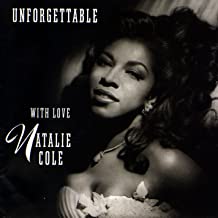
Well versed in various music forms, including jazz, classical, pop and R&B, he has collaborated and recorded more than two-dozen albums with Sarah Vaughan, Peggy Lee, Natalie Cole, Robbie Williams, Dusty Springfield, Solomon Burke, Tom Waits,, José Feliciano, Vince Gill, Bette Midler, Kenny Rogers, Aretha Franklin, Willie Nelson, Amy Grant, Paul Anka, Melissa Manchester, Neil Diamond, Michael Bolton, Barry Manilow, Carole Bayer Sager, and Barbra Streisand.
Pianist and composer Michael Lang, who has composed more than 2000 film scores, continues to play and compose.