

Daily Dose Of Jazz…
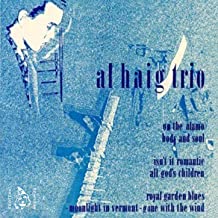
Alan Warren Haig was born on July 19, 1922 in Newark, New Jersey and raised in nearby Nutley. At eighteen he majored in piano at Oberlin College and started playing with Dizzy Gillespie and Charlie Parker in 1945. He performed and recorded from 1945 to 1951 with Gillespie, Parker, Eddie Davis and His Beboppers with Fats Navarro, the Eddie Davis Quintet, and Stan Getz. The Gillespie quintet, which included Haig, recorded four 78 r.p.m. sides for Guild Records in May 1945 which are regarded as the first recordings to demonstrate all elements of the mature bebop style. He was part of the nonet on the first session of Miles Davis’ Birth of the Cool.
For much of the 1950s and 1960s, Haig got by with semi-cocktail piano in New York bars. In 1969 he had a brush with the law having been accused and acquitted of the strangling murder charge of his thrid wife.
In 1974, Haig was invited to tour Europe by Tony Williams, owner of Spotlite Records in the United Kingdom. At the end of a very successful tour he recorded the Invitation album for Spotlite with Bibi Rovère on bass and Kenny Clarke on drums. This kick-started his re-emergence and, over the next eight years, he built a strong following in Europe and toured several times, recording in the UK and France, and appearing elsewhere. He also recorded for several Japanese labels.
Pianist Al Haig, best known as one of the pioneers of bebop, and who recorded twenty~three albums as a leader, passed away from a heart attack on November 16, 1982 in New York City.

More Posts: bandleader,history,instrumental,jazz,music,piano
Daily Dose Of Jazz…
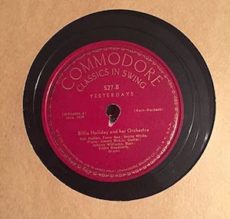
Eddie Dougherty was born July 17, 1915 in Brooklyn, New York. Playing drums from age 13, then started working with Billy Gusak before Dickie Wells’s band at 18 in Harlem, New York by the beginning of the 1930s. He gigged regularly up through 1940 with Kenny Watts & His Kilowatts. His recording career started as a sideman in the 1930s, with Taft Jordan, Frank Froeba, Mildred Bailey, Harry James, Billie Holiday, Frankie Newton, Pete Johnson, and Meade Lux Lewis.
Alongside this he held a gig as the drummer for Keny Watts and his Kilowatts through 1940. He subbed for Dave Tough in the Bud Freeman Orchestra in 1940, then played with Art Tatum, Joe Sullivan, Benny Carter, Benny Morton, and others in the first half of the 1940s. He worked with James P. Johnson several times, including on 1944 recording sessions. His later work included recordings with Cliff Jackson, Mary Lou Williams, Clyde Bernhardt, Wilbur De Paris, Teddy Wilson, and Albert Nicholas. He was still active into the 1980s.
When he finally retired from full-time music decades later, he had amassed a list of credits that not only rivals the length of some short stories, but represented a thorough involvement in many different styles of jazz, vocal music, and rhythm & blues. Drummer Eddie Dougherty passed away on December 14, 1994 in Brooklyn.
More Posts: drums,history,instrumental,jazz,music
Daily Dose Of Jazz…
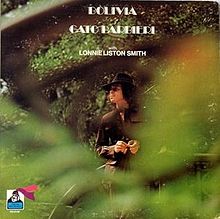
Jean-François “J.F.” Jenny-Clark was born July 12, 1944 in Toulouse, France. Together with drummer Aldo Romano he provided the rhythm section for Don Cherry’s 1965 European quintet of 1965. During the Seventies he recorded with Steve Lacy, performed in concerts with Keith Jarrett (around 1970) and for Jasper van’t Hof’s Pork Pie group and played with Charlie Mariano.
As a member of Diego Massons ensemble Musique Vivante he was interpreting contemporary music compositions by John Cage, Luciano Berio, Mauricio Kagel, Karlheinz Stockhausen, Pierre Boulez, or Vinko Globokar.
Along with Albert Mangelsdorff he led the German-French Jazz Ensemble from 1984 to 1987. Since 1985 Jenny-Clark was mainly working in an acclaimed trio with German pianist Joachim Kühn and Swiss drummer Daniel Humair.
His recording as a leader was minimal but as a sideman he recorded over a hundred albums. Double bassist Jean-François Jenny-Clark, one of the most important bass players of European jazz, passed away on October 6, 1998 in Paris, France.
More Posts: bandleader,bass,composer,history,instrumental,music

Daily Dose Of Jazz…
Duncan Lamont was born on July 4, 1931 in Greenock, Scotland and started out as a trumpet player, leading his own band in Scotland, which won recognition in Melody Maker in 1951. Spending time in London, England he played with Kenny Graham’s Afro-Cubists. During the early 1950s he continued to be active in Scotland and when he switched to tenor saxophone and became a jazz studio player.
He worked with numerous popular British dance bands and jazz groups led by Basil and Ivor Kirchin, Ken Mackintosh, Jack Parnell, Geraldo, Eric Delaney and Vic Lewis, with whom he toured the US. During the 1960s he played with Pat Smythe, Kenny Baker and freelanced extensively. Over the years Lamont led his own small bands and played in big bands and studio orchestras led by Kenny Wheeler, Gil Evans, Bobby Lamb and Raymond Premru, Nelson Riddle, Henry Mancini, Benny Carter and Bill Holman.
Lamont has accompanied on tour or studio orchestras with Frank Sinatra, Rosemary Clooney and Paul McCartney. He composed many songs that were recorded by Trudy Kerr, Nancy Marano, Cleo Laine, Joyce Breach and Norma Winstone. He wrote music for children’s television, was nominated for a Grammy, won the John Dankworth Jazz Award, and for more than a decade led a big band to raise money for cancer research. His activities as a composer have long been greatly respected by his professional peers and, at the start of the new century, are starting to receive the wider recognition they so richly deserve.
Tenor saxophonist Duncan Lamont, who gave masterclasses in improvisation and big band sessions at Brunel University, passed away on July 2, 2019 just two day shy of his 88th birthday.
More Posts: bandleader,composer,history,instrumental,jazz,music,saxophone
Daily Dose Of Jazz…
Clinton Joseph Houston was born on June 24, 1946 in New Orleans, Louisiana and spent his early childhood in Washington, D.C. before spending his adolescence in Queens, New York. At the age of 10, he began piano lessons and started playing jazz in his early teens after hearing Cannonball Adderley on the radio. After being turned down for a pianist role in his high school band, he switched to the double bass.
He began playing in bands outside of high school, with Lenny White, George Cables, Billy Cobham, Steve Grossman and Charles Sullivan, all of whom grew up in the same neighborhood. In his early years, he played in a band called the Jazz Samaritans, playing Latin-style music at local parties and drawing inspiration from Art Blakey. At the age of 19, Clint won a Jazz Interactions competition, leading to an encounter with Paul Chambers who encouraged him to pursue his music further.
After high school, he went to the Pratt Institute, then transferred to Queen’s College to study music before eventually obtaining a degree in Graphic Art from the Cooper Union. During his higher education, on weekends he played alongside Cables and White at Slugs’ matinées. This led to them playing extensively with better-known artists. A founding member of musical co-operative Free Life Communications, Clint performed alongside Dave Liebman, becoming more immersed in the loft jazz scene of 1970s New York.
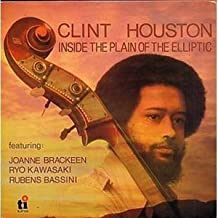
By 1972, Houston was playing alongside Joanne Brackeen in Stan Getz’ band. Their collaborations continued playing in New York clubs recording on many of Brackeen’s early records. He went on to play with Roy Ayers, George Cables, Lenny White, Nina Simone, Roy Haynes, Sonny Greenwich, Don Thompson, Charles Tolliver, Woody Shaw, Pepper Adams, Slide Hampton, Frank Foster, and Roland Hanna. Bassist Clint Houston passed away on June 7, 2000.
More Posts: bandleader,bass,history,instrumental,jazz,music