

Daily Dose Of Jazz…
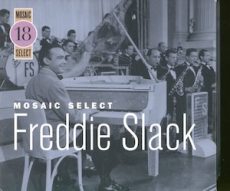
Frederick Charles Slack was born on August 7, 1910 in Westby, Wisconsin and learned to play drums as a boy. He later took up the xylophone and at the age of 13 he changed to the piano. He studied with a local teacher throughout high school and at the age of 17, he moved with his parents to Chicago, Illinois where he continued his musical training.
Meeting clarinetist Rosy McHargue gave him the opportunity to accompany her to hear Bix Beiderbecke and Earl Hines. His first job was with Johnny Tobin before moving to Los Angeles, California where he worked with Henry Halstead, Earl Burtnett and Lennie Hayton.Then in 1934 he joined Ben Pollack.
He went on to play with the Jimmy Dorsey Band in the 1930s and was a charter member of the Will Bradley Orchestra when it formed in 1939. Known to bandmates as Daddy Slack, he played the piano solo on Bradley’s recording of Beat Me Daddy, Eight to the Bar, one of the early white boogie-woogie hits and a classic of the big band era.
Forming his own band in 1942 he signed with the newly founded Capitol Records and recorded three songs at his third recording session. His recording of Cow Cow Boogie was sung by the 17-year-old Ella Mae Morse and was Capitol’s first gold single. Slack continued to record some 80 tracks with Capitol until 1950.
Slack also recorded with Big Joe Turner, Johnny Mercer, Margaret Whiting and Lisa Morrow. He has been mentioned in song, co-wrote the 1945 classic The House of Blue Lights, first recorded with singer Ella Mae Morse.
Swing and boogie-woogie pianist and bandleader Freddie Slack was found dead in his bedroom in Hollywood, Los Angeles, California, from undetermined causes on August 10, 1965.

More Posts: bandleader,instrumental,jazz,music,piano
Daily Dose Of Jazz…
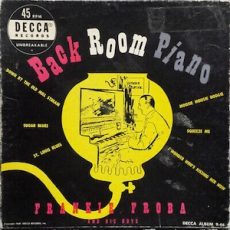
Frank Froeba was born August 6, 1907 in New Orleans, Louisiana. While still in his teens he held jobs in the bands of Johnny Wiggs and John Tobin. By the age of 17 he played with Johnny de Droit in New York City in 1924-1925, then led his own band in Atlantic City, New Jersey.
In the latter half of the decade Frank moonlighted in other dance ensembles. He recorded with Jack Purvis in 1930 and with Jack Bland in 1932, then worked with Benny Goodman from 1933 to 1935. This was followed in 1935 to 1944 where he led his own band and played on recordings for Columbia and Decca. Among his sidemen were Bunny Berigan, Jack Purvis, Bobby Hackett and Joe Marsala.
He was a house pianist for Decca in the 1930s and 1940s, playing behind Bob Howard and Lil Armstrong, among others. In 1955, he moved to Miami, Florida and performed as Frank Froba, moving more into popular performance.
One of his more popular tracks, Jumpin’ Jive, which he co-wrote with Cab Calloway. It was recorded by Joe Jackson on his Joe Jackson’s Jumpin’ Jive album.
Pianist and bandleader Frank Froeba died on February 16, 1981 in Miami.
More Posts: bandleader,history,instrumental,jazz,music,piano
Daily Dose Of Jazz
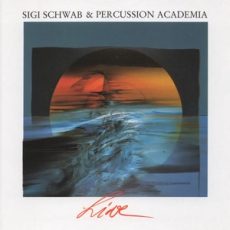
Siegfried “Sigi” Schwab was born in Ludwigshafen, Rhineland-Palatinate, Germany on August 5, 1940. He played in a wide variety of styles, including baroque and jazz. He played in German groups like Et Cetera with pianist Wolfgang Dauner, bassist Eberhard Weber, and drummers Fred Braceful and Roland Wittig.
With Embryo he was joined by drummer and percussionist Christian Burchard, Mal Waldron on piano, and bassist Dave King, and with percussionist Ramesh Shotham. He played with the Diabelli Trio, Peter Horton, Freddie Santiago, Guillermo Marchena, and Andreas Keller.
In 1980 he played with flutist Chris Hinze at the 5th North Sea Jazz Festival. In addition, Schwab has also published several books about various guitar playing styles. He was a teacher, and performed on more than 15,000 recordings for film, television, and as an accompanist to various artists.
Sigi Schwab, who recorded twenty-eight albums as a leader and died after a long illness on January 11, 2024 at the age of 83 in Munich, Bavaria, Germany.
More Posts: bandleader,guitar,history,instrumental,jazz,music

Daily Dose Of Jazz…
Floyd Maurice “Stumpy” Brady was born on August 4, 1910 in Brownsville, Pennsylvania. At the end of the 1920s he performed and recorded with Zack Whyte’s Chocolate Beau Brummels before touring with Al Sears. During the next decade he played with Andy Kirk in New York, recorded with Blanche Calloway, and returned briefly to Whyte’s band in 1933.
He replaced Ed Cuffee in McKinney’s Cotton Pickers, and then performed and recorded with Claude Hopkins from 1936 to 1938 and Teddy Wilson from 1939 to 1940. As a member of the Lucky Millinder orchestra, Stumpy played a solo while accompanying Sister Rosetta Tharpe in the soundie Lonesome Road in 1941.
Other musicians and bandleaders he worked with include Al Sears, Count Basie, Joe Guy touring with Billie Holiday in 1945, Jay McShann, Fletcher Henderson, Roy Eldridge, and Cat Anderson. After a period of inactivity in the 1950s, Brady resumed playing in the 1960s with Slide Hampton’s band, Luckey Roberts’s orchestra, and Edgar Battle’s big band.
Trombonist Stumpy Brady died on February 11, 1998.
More Posts: history,instrumental,jazz,music,trombone

Daily Dose Of Jazz…
Lawrence Brown was born on August 3, 1907 on August 3, 1907 in Lawrence, Kansas. When he was about six or seven years old his family moved to Oakland, California. He began playing the violin at a young age, but quickly grew tired of it and turned to playing the tuba in his school’s band.
Coming from a musical background, his mother played the organ and the piano and he often sang as a part of his father’s sermons when he preached at the A. M. E. Church. Brown discovered the trombone while doing janitorial work at his father’s church and wanted to replicate the sound of cello on a trombone.
Beginning his career with Charlie Echols and Paul Howard, in 1932 he joined Duke Ellington’s band. He was featured with the band every year on compositions such as Blue Cellophane and Golden Cress. Leaving Ellington’s band in 1951, Lawrence joined Johnny Hodge’s band, where he stayed for four years. After this stint he took a five year position as a session player with CBS.
He rejoined Ellington in 1960 and stayed with him until 1970. After leaving Ellington’s band the second time at the age of 63, Brown stopped performing.
Trombonist Lawrence Brown, whose fast technical style inspired trombonists from Tommy Dorsey to Bill Harris, died on September 5, 1988 in Los Angeles, California, at the age of 81.
More Posts: history,instrumental,jazz,music,trombone