


Daily Dose Of Jazz…
David Silliman was born on July 28, 1960 and raised in the San Francisco, California bay area where he was exposed to a wide variety of music. His first studies were in the classical field, studying snare drum, xylophone and timpani. He was later exposed to Jazz, Latin Jazz, Brazilian and Funk music. His current setup varies from the standard American drum set augmented with a South American cajon, drums from the Middle East, Africa and the Caribbean along with various other percussion instruments.
He hass performed on the stages of European and American jazz festivals, and spent years playing with Blossom Dearie as a member of her trio. He has toured with Al DiMeola, Cassandra Wilson, Leslie Uggams, Mariah Carey, Edmar Castaneda, and performed with Aretha Franklin. He is no stranger to the Broadway pit or the New Jersey Symphony, having sat in the chairs of both.
Drummer and percussionist David Silliman, who has yet to record as a leader, continues to perform.

More Posts: drums,history,instrumental,jazz,music,percussion

Daily Dose Of Jazz…
Charlie Queener was born in Pineville, Kentucky on July 27, 1921 or 1923, the actual year of his birth is in question. During the Forties he worked with the Muggsy Spanier Orchestra, Harry James Orchestra, Benny Goodman Orchestra, Joe Marsala Orchestra, and Glen Gray among others.
Between 1946-50 Queener settled into Nick’s in New York and then spent much of his career freelancing with Dixieland all-stars. Among his associations were Bobby Hackett, Billy Butterfield, Jimmy McPartland, Ruby Braff, Max Kaminsky, Wingy Manone from 1954 to 1960, Wild Bill Davison and with Clarence Hutchenrider on and off from 1958 to 1973, to name a few.
He worked into the 1990s, also composed orchestral works starting in the mid-1960s but never led a record session of his own. Pianist Charlie Queener, who played in Dixieland, swing and mainstream settings, died in July 1997.
More Posts: history,instrumental,jazz,music,piano
Daily Dose Of Jazz…
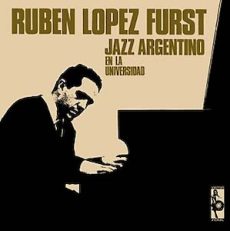
Rubén “Baby” López Fürst was born July 26, 1937 in Buenos Aires, Argentina. From the age of five he studied music and piano, and was soon attracted to jazz. In 1951 the 14 year old Ruben got the nickname Baby from the other musicians because he was a child. He made his debut on the jazz scene performing at the concerts organized by the Hot Club de Buenos Aires.
In 1953 Baby played in a string ensemble led by the López Fürst brothers who performed a jazz concert at the Provincial Hotel in the city of Mar del Plata, Argentina. With his brother Héctor on banjo and him on piano they created the Hot Jammers group and made two 78-single records for Victor. He went on to be part of the Dixie band, The Picking Up Timers.
In 1957 the big succes of Oscar Alemán inspired Baby to leave the piano and take up the guitar, trying to emulate one of his idols: Django Reinhardt. Then began regular performances with a string-group named the Blue Strings. It was a quartet in the vein of gypsy string swing.
Modern jazz captivated him in 1959, when he listened to Gerry Mulligan at the Hot Club de Montevideo in Uruguay. Trying to play those new sounds, in 1962 he joined the modern group of pianist Sergio Mihanovich. On the two albums recorded in 1962, the work began Argentine cool jazz with saxophonist Leandro “Gato” Barbieri, Sergio Mihanovich on piano, drummer Osvaldo “Pichi” Mazzei, trumpeter Rubén Barbieri, Oscar López Ruiz on electric guitar, Rubén López Furst on piano, Domingo Cura on percussion, Osvaldo Bissio vibráphone, and baritone saxophonist Julio Darré.
Fürst is one of the most important pianists in the history of Argentinean jazz and opted to stay in Buenos Aires and make a name for himself at home unlike his counterparts Barbieri and Lalo Schiffrin. He played for over 20 years, mainly with his own trio or quartet.
The hard bop musician also formed a swing group. Pianist and guitarist Baby Fürst, whose primary influences were Teddy Wilson and Bill Evans, died on July 26, 2000 at the age of 63 in Buenos Aires.
More Posts: bandleader,guitar,history,instrumental,jazz,music,piano

Daily Dose Of Jazz…
Denman Maroney was born on July 25, 1949 in Durfort-et-Saint-Martin-de-Sossenac, Occitanie, France. He went on to receive his Bachelor of Arts from William College and his Masters of Fine Arts in composition and piano from the California Instute of the Arts.
He plays what he calls hyperpiano involves stopping, sliding, bowing, plucking, striking and strumming the strings with copper bars, aluminum bowls, rubber blocks, plastic boxes and other household objects. This is sometimes done with one hand while the other hand is used to play the keys.
He received a grant from the National Endowment for the Arts for his work and worked on a new soundtrack to go with German horror film The Cabinet of Dr. Caligari. As an educator he held a position of adjunct professor at Ramapo College of New Jersey in 2010 and is currently at Fairleigh Dickinson University.
Pianist and composer Denman Maroney continues to explore and create music.
More Posts: bandleader,composer,history,instrumental,jazz,music,piano
Daily Dose Of Jazz…
Benoît Quersin was born in Brussels, Belgium on July 24, 1927 into a family with a classical tradition. He met personalities like the composer Béla Bartókor and the pianist Stefan Askenaseat at a very young age. Shortly before the war, he discovered jazz secretly in his bedroom while listening to the records of Fats Waller and Louis Armstrong, then Belgian jazz bandleader Fud Candrix.
His beginnings as a musician were with the kids in his Brussels neighborhood. At the Liberation, Quersin set up his first orchestra. In 1947 he hired Jean Thielemans, who later became known as Toots, with whom he played for some time. He abandoned the piano for the double bass and obtained his first engagements. Toots took him to the Paris, France festival at a time when the headliners were Charlie Parker and Miles Davis.
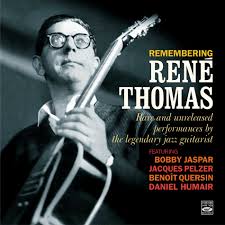
Moving to Paris in 1950 he played and recorded with Sidney Bechet, Lionel Hampton, Sarah Vaughan, Dizzy Gillespie, Chet Baker, Lucky Thompson, Zoot Sims, Lee Konitz, Jimmy Gourley, Blossom Dearie, Mary Lou Williams, Kenny Clarke, and Jonah Jones among others. The French musicians were Stéphane Grappelli, Maurice Vander, Barney Wilen, Henri Renaud, René Urtreger, Sacha Distel, and Martial Solal, the Belgians were René Thomas, Bobby Jaspar, Francy Boland, Leo Mouse, Jacques Pelzer, and Jack Sels.
Returning to Belgium in 1957 he opened a jazz club in Brussels, the Blue Note, where people like Lou Bennett, Jackie McLean, Martial Solalor and Marc Moulin. In 1961, Quersin became host of jazz programs on Belgium radio RTB and interviewed Charles Mingus, Thelonious Monk, Ray Charles, Fats Domino and John Coltrane. Late in life he became an ethno-musicologist, passionate about world civilizations and the music of West and Central Africa, and collected traditional music from the Mbam ethnic group inCameroon. He would go on tomove to Zaire, Democratic Reublic of Congo and release several albums of traditional instruments.
Double bassist Benoît Quersin, who was an important double bassist on the international jazz scene during the 1950s and Sixties, died on May 31, 1992 in Vaison-la-Romaine, France.
More Posts: bass,ethnomusicology,history,instrumental,jazz,music