

Daily Dose Of Jazz…
Joseph Copeland Garland was born on August 15, 1903 in Norfolk, Virginia and studied music at Shaw University and the Aeolian Conservatory. He started by playing classical music but joined a jazz band, Graham Jackson’s Seminole Syncopators, in 1924, where he first recorded.
He had a long run of associations as a sideman on saxophone and clarinet from 1925 to the end of the decade with Elmer Snowden, Joe Steele, Henri Saparo, Leon Abbey Charlie Skeete and Jelly Roll Morton. By the 1930s he was playing and arranging with Bobby Neal and the Mills Blue Rhythm Band from 1932 to 1936. When Lucky Millinder replaced him, he joined Edgar Hayes in 1937, then Don Redman the following year, and Louis Armstrong from 1939 to 1942.
In the 1940s, he played with Claude Hopkins and others, and then returned to Armstrong’s band mid decade for two years. Following this he played with Herbie Fields, Hopkins again, and Earl Hines. In the 1950s, he went into semi-retirement.
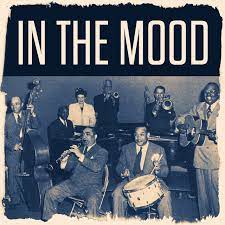
Garland wrote a number of well-known swing jazz hits, including Serenade To A Savage and Leap Frog. He is credited as the composer with lyricist Andy Razaf for In the Mood which became a Glenn Miller hit. Saxophonist, composer, and arranger Joe Garland transitioned on April 21, 1977 in Teaneck, New Jersey.

More Posts: arranger,clarinet,composer,history,instrumental,jazz,music,saxophone
Requisites
Blue Train ~ John Coltrane | By Eddie Carter
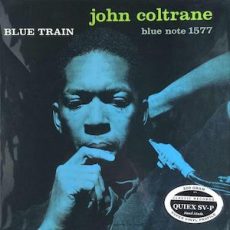
John Coltrane steps into the spotlight for this morning’s discussion with his only release for Alfred Lion’s label, Blue Train (Blue Note BLP 1577/BST 81577). It was recorded in 1957 and released a year later, has stood the test of time, and is considered one of the essential records to own in the tenor saxophonist’s discography. Blue Train is his third album as a leader and also highlights his compositions, he wrote four of the five selections and personally picked the musicians who accompany him on this date. Lee Morgan on trumpet, Curtis Fuller on trombone, Kenny Drew on piano, Paul Chambers on bass, and “Philly” Joe Jones on drums round out the sextet. My copy used in this report is the Classic Records Mono audiophile reissue sharing the original catalog number.
Side One leaves the station with Blue Train, a mid tempo blues that the sextet sets in motion to an easy-going beat. John soars effortlessly through the rhythm section in the first solo. Lee follows with a happy, relaxed groove, then Curtis gives a perfectly crafted, full-toned reading. Kenny shapes the next statement with some bluesy dialogue and Paul covers plenty of ground in the finale preceding the ensemble’s reprise and climax. Moment’s Notice is next and it’s ablaze from the start of the melody. Coltrane takes the lead with a pulse-quickening performance. Fuller comes in for an energetic excursion next, then Morgan swings vibrantly into the third reading. Chambers goes for a short walk and Drew gets a scintillating presentation on the closer leading to the ending theme.
Locomotion speeds down the track to begin Side Two and the sextet gives the uptempo melody a workout. John takes a swift run on the opening solo; next Curtis jumps into the second reading aggressively, then Lee follows with a stunning showpiece. Kenny raises the energy level of the following interpretation. Philly closes the proceedings on a few fiery phrases before the sextet takes it out. I’m Old Fashioned by Jerome Kern and Johnny Mercer starts with a tender melody by Coltrane who continues caressing the first solo with sultry notes. Fuller brings out breathtaking beauty in the next statement. Drew compliments them with sincere elegance subtly supported by Chambers and Jones. Morgan closes with a great delicacy that’s beautifully executed.
The sextet steps back into high gear on Lazy Bird with a nimble opening chorus. Lee leads the charge with electric energy. Curtis follows with fiery passion on the second statement, then John swings with fierce intensity. Kenny tears into the next reading enthusiastically, next Paul does a brief bit of bass walking. “Philly” adds a fitting closer with an exhilarating drum solo ahead of the ensemble’s finish. Blue Train was originally produced by Alfred Lion, and Rudy Van Gelder was the recording engineer. Bernie Grundman mastered the album from the original analog tapes. This reissue was pressed on 200-gram Quiex SV-P audiophile vinyl. The sound quality is sensational with a superb soundstage that’s a sonic treat, and the record is absolutely quiet until the music starts. If you like jazz, I can’t think of a better choice for your library than Blue Train by John Coltrane. The album is a bona fide classic that you can enjoy endlessly and a must-have for any jazz fan!
~ I’m Old Fashioned – Source: JazzStandards.com © 2022 by Edward Thomas Carter

More Posts: choice,classic,collectible,collector,history,instrumental,jazz,music,saxophone

Daily Dose Of Jazz…
Armando Joseph “Buddy” Greco was born Armando Joseph Greco to an Italian-American family in Philadelphia, Pennsylvania on August 14, 1926. His mother introduced him to piano at age four and as a child he sang on the radio, and in his teens performed in the city’s night clubs. Sixteen saw him hired by Benny Goodman and spent four years touring the world with the Goodman orchestra, playing piano, singing, and arranging. Becoming acquainted with Great Britain in 1949 he spent many years performing in numerous clubs. He moved to Essex, keeping his Palm Springs property as a vacation home.
In 1951 he started his recording career, signing with labels such as Coral, Kapp, Epic, and Reprise. 1969 saw Buddy form a duo with jazz guitarist Ron Escheté. He opened a small club in Palm Springs, California which became popular for celebrities to dine. After closing it, he moved to England.
In 2008, he and singer Lezlie Anders toured the UK, performed with the BBC Big Band and at Ronnie Scott’s Jazz Club in London. He was the first Las Vegas headliner to star at a British casino when he performed at the Circus Casino, and he performed a tribute to Frank Sinatra for BBC Radio 2 with the 42-piece BBC Concert Orchestra. He toured the UK with the Swinging Las Vegas Legends show beginning in July 2010.
In 2010, Greco and his wife Lezlie produced the stage show Fever! The Music of Miss Peggy Lee, which met with critical acclaim at its London West End opening. They continued to perform and tour for the next seven years. Vocalist Buddy Greco transitioned on January 10, 2017, in Las Vegas, Nevada, at the age of 90.
More Posts: bandleader,conductor,history,instrumental,jazz,music,vocal
Daily Dose Of Jazz…
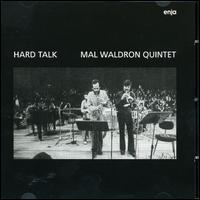
Allen Blairman was born on August 13, 1940 in Pittsburgh, Pennsylvania. Moving from Pittsburgh to New York City he worked with Charles Mingus, Chet Baker and Archie Shepp.In 1970 he played with Albert Ayler at the Fondation Maeght in France. Two years later he toured throughout Europe with Karl Berger, recorded with Mal Waldron for Enja, and with Albert Mangelsdorff. In 1976 Allen played with a German jazz rock group called Embryo and in France he collaborated with Bireli Lagrene.
By 1991 he recorded Life at the Montreux Music Festival in trio-formation with Günter Lenz and Uli Lenz. For over twenty years he played with saxophonist Olaf Schönborn and bassist Mario Fadani in Trio Variety. Since 2009 with tap dancer Kurt Albert and Olaf Schönborn in Melody Rhythm & Tap.
Drummer Allen Blairman was diagnosed with cancer in January and transitioned on April 29, 2022 in Heidelberg, Germany at 81 years of age.
More Posts: drums,history,instrumental,jazz,music

Daily Dose Of Jazz…
Andrew Anderson was born on August 12, 1912 in Mandeville, Louisiana. He played in the Young Tuxedo Band and the Allen Brass Band. In the mid to late Twenties he played with Joe Oliver in Chicago, Illinois.
He led the Pelican State Band in the late 1930s and continued playing in New Orleans with various bands until the 1980s. In the Seventies and Eighties he played and recorded with the New Orleans Ragtime Orchestra.
Trumpeter Andy Anderson transitioned on December 19, 1982.
More Posts: history,instrumental,jazz,music,trumpet