

Daily Dose Of Jazz…
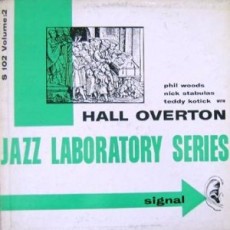
Hall Franklin Overton was born February 23, 1920 in Bangor, Michigan but grew up in Grand Rapids. As a youngster he found that his few piano lessons were not enough to discover that elusive “something” he was seeking in music. His high school music teacher urged him to study theory and composition at The Chicago Musical College, prior to military service. It was during this overseas duty that he learned to play jazz.
Following his discharge Hall attended the Julliard School of Music, graduated with a Masters and joined the faculty. As an educator he would eventually teach at Yale School of Music and The New School of Social Research. He would receive awards from both The Koussevitzky Foundation and The John Simon Guggenheim Memorial Foundation.
In 1954, his New York City loft at 821 Sixth Avenue, aka the Jazz Loft, provided the perfect setting for the musicians to practice. While composing his classical compositions, he was also deeply immersed in jazz, recording with Stan Getz, Duke Jordan, Jimmy Raney, and Teddy Charles. Thelonious Monk selected him to score his piano works for full orchestra and on February 28, 1959, Thelonious Monk Orchestra At Town Hall was recorded live. Monk later released another live album of Hall’s compositions on Big Band and Quartet in Concert.
Hall’s opera, Huckleberry Finn, commissioned by the Barney Jaffin Foundation, was presented by The Juilliard Opera Company just months before his death on November 24, 1972 from cirrhosis of the liver. Pianist, composer and educator Hall Overton was just 52.
More Posts: piano
Daily Dose Of Jazz…
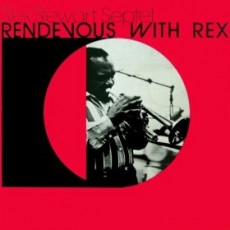
Rex Stewart was born on February 22, 1907 in Philadelphia, Pennsylvania and learned to play the cornet. He developed a half-valving technique that created quartertones that Duke Ellington would later showcase along with his muted sound and forceful style.
After stints with Elmer Snowden, Fletcher Henderson, Horace Henderson, the McKinney’s Cotton Pickers and Luis Russell, he joined the Ellington band in 1934, replacing Freddie Jenkins.
Stewart co-wrote “Boy Meets Horn” and “Morning Glory” while with Ellington, and frequently supervised outside recording sessions by members of the Ellington band. After eleven years Stewart left to lead his own little swing bands, that were a perfect setting for his solo playing.
He also toured Europe and Australia with Jazz At The Philharmonic from 1947 to 1951. From the early 1950s on he worked in radio and television and published highly regarded jazz criticism. The book Jazz Masters of the Thirties is a selection of his criticism.
Cornetist Rex Stewart passed away on September 7, 1967.
More Posts: cornet
Daily Dose Of Jazz…
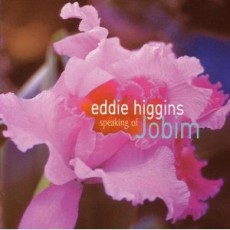
Eddie Higgins was born Edward Haydn Higgins on February 21, 1932 in Cambridge, Massachusetts and began study of piano with his mother. His professional career began in Chicago while attending Northwestern University. He played the most prestigious clubs in Chicago for more than two decades in the 50s and 60s with his longest tenure at the London House, playing opposite Cannonball Adderley, Bill Evans, Errol Garner, Stan Getz, Dizzy Gillespie, Oscar Peterson, and George Shearing among others.
As a leader he amassed a number of recordings during the Chicago years but as a sideman he added many more albums working with Wayne Shorter, Coleman Hawkins, Bobby Lewis, Freddie Hubbard, Jack Teagarden and Al Grey to name just a few.
Equally adept in every jazz circle Eddie was able to work in Dixieland, modal, bebop and swing as well as being a persuasive, elegant and sophisticated pianist whether he was soloing or accompanying a singer.
Higgins eventually moved to Fort Lauderdale, Florida, played in local clubs, performed the jazz festival circuit, toured Europe and Japan, and continued to record up until his death on August 31, 2009 at 77.
More Posts: piano
Daily Dose Of Jazz…
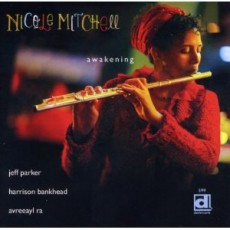
Nicole Mitchell was born on February 17, 1967 in Syracuse, New York where she was raised until age eight, when her family moved to Anaheim, California. She began with piano and viola in the fourth grade; however, she was classically trained in flute and played in youth orchestras as a teenager. Her initial college major in math was superseded by jazz while in college and took to busking in the streets playing jazz flute. After two years at the University of California, San Diego, in 1987 she transferred to Oberlin College.
In 1990 a move to Chicago saw her playing once again on the streets and working for third World Press and meeting members of the Association for the Advancement of Creative Musicians. Mitchell soon started playing with the all-women ensemble Samana under the AACM umbrella. Over the next several years she moved to New Orleans, became a mother, returned to school earning her BA and Masters, met and extensively began playing with Hamid Drake, then worked with saxophonist David Boykin prior to starting her group the Black Earth Ensemble” and co-hosting the Avant-Garde Jazz Jam Sessions in Chicago.
Releasing her debut album “Vision Quest” in 2001, she has been named “Rising Star” flautist for 2004 -2006 by Down Beat and by Down Beat International Critics Poll in 2010 & 2011. As an educator, Nicole has taught at Northern Illinois, Chicago State, Northeastern Illinois University, Wheaton College and the University of Illinois at Chicago; and has been co-president of the AACM since 2006.
More Posts: flute
Daily Dose Of Jazz…
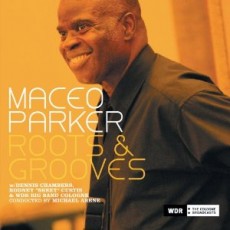
Maceo Parker was born February 14, 1943 in Kinston, North Carolina and was exposed to music early in life within his family and learned to play the saxophone. He and his brother Melvin, who played drums, joined James Brown in 1964 a relationship that lasted for six year before he left with Melvin and a few other Brown band members to form Maceo & All The King’s Men in 1970.
By ’74 he was back with Brown, charted a party single with Maceo & The Macks, joined Parliament-Funkadelic in the late 70s into the 89s, and then returned once again to James Brown for four years late in the decade. In the 1990s, Parker began his successful solo career releasing ten albums and performing 100 to 150 dates a year.
He has guest appeared on a variety of group’s albums and concerts and turning to jazz recorded “Roots & Grooves” with the WDR Big Band to critical acclaim as a tribute to Ray Charles. The album won a Jammie for best Jazz Album in 2009.
In October 2011 soul jazz saxophonist Maceo Parker was inducted into the North Carolina Music Hall of Fame. He continues touring throughout the world, headlining the major Jazz Festivals in Europe where his following is at its strongest.
More Posts: saxophone