

Daily Dose Of Jazz…
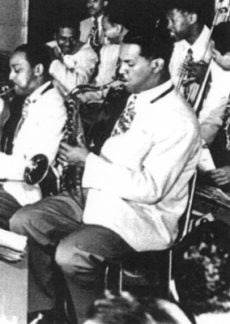
Bumps Myers was born Hubert Maxwell Myers on August 22, 1912 in Clarksburg, West Virginia. Influenced by Coleman Hawkins he played the tenor saxophone but also the alto and baritone. Growing up in California he began his musical career at the age of 17 in the Los Angeles area, playing with Curtis Mosby and His Dixieland Blue Blowers,
By 1927 he had recorded for the first time and two years later was playing in Seattle, Washington with Earl Whaley. The mid-1930s saw him with Buck Clayton and Teddy Weatherford, with whom he went on tour. From 1934 to 1936 he lived in Shanghai, China where he worked in Canidrome with Weatherford’s band and Buck Clayton. After returning to the United States in 1937 he played with Lionel Hampton and Les Hite .
The early Forties had Bumps working with the short-lived band of Lee and Lester Young. In 1942 and again in 1945 he worked at Jimmie Lunceford and 1943-48 in Benny Carter’s big band. Mid-1940s he performed several times with Jazz at the Philharmonic and in 1945 he played with Sid Catlett on.
1947 saw him playing with Benny Goodman and recording the hit Call It Stormy Monday (But Tuesday Is Just as Bad). Under his own name he released Bumps Myers & His Frantic Five in 1949 on the Blu, Selective and RPM labels.
In the 1950s, Myers worked as a studio musician, played with Red Callender, and Harry Belafonte in 1958 . After touring with Horace Henderson from 1961-62, Myers retired from music because of issues with his health.
In the field of swing and jazz, he was involved from 1927 to 1960 on some 90 recording sessions with Irving Ashby, Kay Starr, Lee Richardson, Ernestine Anderson, Freddie Slack, Mel Powell, Dan Grissom, Fletcher Henderson, Russell Jacquet, Louis Bellson and Maxwell Davis, Not limiting himself to jazz he also played on a number of rhythm and blues recordings by T-Bone Walker, George Vann, Amos Milburn, Jimmy Witherspoon, Helen Humes, Percy Mayfield, Tony Allen and B. B. King.
Swing saxophonist Bumps Myers, who never gained the notoriety or popularity of his contemporaries, due possibly to working mainly in the Los Angeles music scene, passed away on April 9, 1968 in Los Angeles, California.

Give A Gift Of Jazz – Share

More Posts: saxophone
Daily Dose Of Jazz…
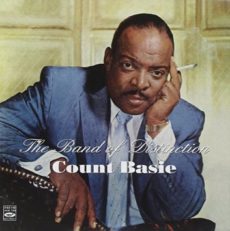
Count Basie was born William James Basie on August 21, 1904 in Red Bank, New Jersey. His father played mellophone, his mother piano and it was she who taught him to play the piano. She paid 25 cents for each piano lesson for him. Not much of a student in school, he finished junior high school before dropping out and spending much of his time at the Palace Theater learning to operate lights for vaudeville and to improvise accompaniment for acts and silent films at the hometown Palace Theater. Though a natural at the piano, he preferred drums but discouraged by the obvious talents of drummer Sonny Greer, who also lived in Red Bank, at age fifteen he switched to piano exclusively. By 16 years old, he increasingly played jazz piano at parties, resorts and other venues.
In 1924, Count went to Harlem, New York City where he met most of the major players including Willie “The Lion” Smith and James P. Johnson. His performing career expanded as he began touring with groups to the major jazz cities of Chicago, St. Louis and Kansas City on the Keith and TOBA vaudeville circuits. He met Fats Waller at Leroy’s cutting contest in Harlem who would teach him to play the organ and Smith gave him tips on piano technique and helped him book rent parties when times were lean. In 1929 he joined Bennie Moten’s band in Kansas City, and played with them until Moten’s death in 1935. Their tune The Moten Swing was an invaluable contribution to the development of swing.
At this point in his career he formed the Count Basie Orchestra and in 1936 they were in Chicago, Illinois for a long engagement and their first recording. Late one night they were improvising and came up with their signature tune One O’Clock Jump that stood for many years until their version of April In Paris.
He would go on to record for producer John Hammond on the Vocalion label with presiding members of the band being Ben Webster, Lester Young and Herschel Evans , Freddie Green, Jo Jones, Walter Page, Earle Warren, Buck Clayton and Harry Edison, Benny Morton and Dickie Wells.
He led the group for nearly 50 years, creating innovations like the use of two “split” tenor saxophones, emphasizing the rhythm section, riffing with a big band, using arrangers to broaden their sound, and others. Many musicians came to prominence under his direction, including Lester Young, Herschel Evans, Buck Clayton, Harry “Sweets” Edison, Paul Campbell, Tommy Turrentine, Johnny Letman, Idrees Sulieman, Joe Newman, Jimmy Wilkins, Benny Powell, Paul Quinichette and Floyd “Candy” Johnson, Marshal Royal, Ernie Wilkins and Charlie Fowlkes, as well as singers Jimmy Rushing, Joe Williams as well as recording with Ella Fitzgerald, Billy Eckstine, Frank Sinatra, Tony Bennett, Sammy Davis, Jr., Bing Crosby, and Sarah Vaughan.
He has won eight Grammy awards, had four recordings inducted into the Grammy Hall Of Fame, and has been inducted into the Long Island Hall of Fame, the Nesuhi Ertegun Jazz Hall of Fame, Down BEat Jazz Hall Of Fame, has been awarded NEA Jazz Master and has a star on the Hollywood Walk of Fame, among other awards. Pianist, organist, bandleader and composer Count Basie passed away pancreatic cancer in Hollywood, Florida on April 26, 1984.
Inspire A Young Mind
More Posts: piano
Daily Dose Of Jazz…
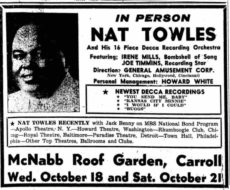
Nat Towles was born on August 10, 1905 in New Orleans, Louisiana the son of string bassist Phil “Charlie” Towles. Starting his musical career as a guitarist and violinist at the age of 11, he switched to the bass at the age of 13. Performing in New Orleans through his teenage years with Gus Metcalf’s Melody Jazz Band, he eventually played with a number of bands, including those of Buddie Petit, Henry “Red” Allen, Jack Carey, and the Original Tuxedo Jazz Orchestra.
In 1923 he formed The Nat Towles’ Creole Harmony Kings and this jazz band became one of the prominent territory bands in Texas, Oklahoma, Kansas, and Nebraska. By 1925 he was playing bass for Fate Marable, and the following year reformed his own band. 1934 saw him organizing a band of young musicians studying music at Wiley College in Austin, Texas.
Nat worked a club circuit in Dallas during this period, reportedly for a gangster who owned 26 nightclubs throughout the city. During this period T-Bone Walker and Buddy Tate worked for him. During the 1930s he transformed his band into The Nat Towles Dance Orchestra, signed with the National Orchestra Service, and focused on swing music through the 1930s and 1940s.
In 1934 Towles took up residence in North Omaha, Nebraska, where his band was stationed for the next 25 years. With this outfit he dueled with Lloyd Hunter for dominance over the much-contested Near North Side in North Omaha, where he was held over at the Dreamland Ballroom for several weeks. In 1936 and 1937 his band held residence at Omaha’s Krug Park.
In 1943 he also held a three-month stint at the Rhumboogie Club in Chicago, and later that year took up residency again with Billy Mitchell in tow in Omaha’s Dreamland Ballroom. He went on to play extensively throughout New York City, playing with trombonist Buster Cooper, saxophonists Red Holloway, Buster Bennett and Preston Love.
As their bandleader, Towles is credited with influencing a variety of musicians including Sir Charles Thompson and Neal Hefti, as well as superior saxophonists Jimmy Heath, Oliver Nelson and Paul Quinichette. As an educator he influenced many younger musicians such as pianist Duke Groner and trombonist Buddy McLewis, aka Joe McLewis.
Continuing to lead bands throughout the 1950s, in 1959 he retired to California and opened a bar. Bassist, guitarist and violinist Nat Towles, who feared the limelight would steal away his best players thus never sought national recognition and leaving no known recordings, passed away in January of 1963 in Berkeley, California of a heart attack.
Give A Gift Of Jazz – Share
More Posts: guitar,string bass,violin
Daily Dose Of Jazz…
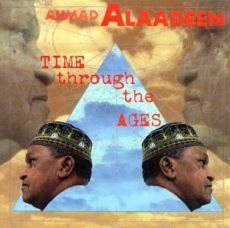
Ahmad Alaadeen was born in Kansas City, on July 24, 1934 and grew up listening to all styles of music not limited to the Philharmonic, Lester Young, T-Bone Walker and Eddie “Cleanhead” Vinson. He began playing the saxophone when he was in sixth grade, in time mastering flute, clarinet and oboe. He studied at R.T. Coles High School under the tutelage of Leo H. Davis, a well respected music instructor reported to have taught Charlie Parker.
Alaadeen debuted as a professional with Davis’ concert band playing e-flat horn when he was 14 and his first major job was playing baritone sax with pianist-bandleader Jay McShann. In later years he would rejoin McShann on tenor. He studied at the Kansas City Conservatory of Music, St. Mary’s University and DePaul University. Serving in the military during 1957-59, being the jazz saxophonist and principal oboist with the 4th Army Band, after his discharge he spent time in Chicago, playing in a program led by pianist-composer Richard Abrams that was the beginning of the AACM – the Association for the Advancement of Creative Musicians that included members Lester Bowie and Malachi Favors.
Returning to Kansas City, Ahmad continued to play, teach and lead the Deans of Swing in the 1990s, and the ensemble was picked in 1996 as Musician Magazine’s Best Unsigned Band. He started the ASR label to document his music, was awarded the Kansas City’s Jazz Heritage Award, the Missouri Humanities Council’s Community Heritage Award, the Missouri Arts Award and Kansas City’s Lifetime Achievement Award. Saxophonist, composer and educator Ahmad Alaadeen, whose swing and hard bop style passed away of cancer on August 15, 2010 at the age of 76.
Sponsored By

More Posts: saxophone
Daily Dose Of Jazz…
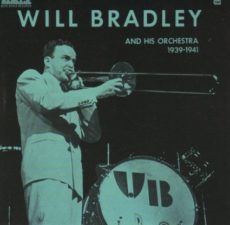
Will Bradley was born Wilbur Schwichtenberg on July 12, 1912 in Newton, New Jersey. He became one of the premier trombonists on the New York swing scene, and he often participated in jam sessions broadcast on The CBS Saturday Night Swing Club. In 1939 he and drummer Ray McKinley formed a big band with pianist Freddie Slack that became well known for boogie-woogie, with hit records Beat Me Daddy, Eight to the Bar and Scrub Me Mama with a Boogie Beat and Down the Road a Piece. The latter song was recorded with Bradley, Ray McKinley, Doc Goldberg, Freddie Slack, with guest vocals by songwriter Don Raye.
He was one of the first band-leaders in the 1940s to appear in Soundies, three-minute musical films made for coin-operated movie jukeboxes. Their wide distribution gave the band valuable exposure with drummer Ray McKinley doing most of the vocals. After McKinley left to form his own band, Bradley joined the United States Air Force, where he played in the Glenn Miller Air Force Band and he disbanded his group due to the problems of wartime. He would go on to record with Ruth Brown and Charlie Parker and he became a studio musician, playing for many years in the The Tonight Show Band during the Johnny Carson era.
He was the band-leader for the Summer Silver Theater on CBS radio in 1941, with Ed Sullivan as the show’s host. Trombonist and bandleader Will Bradley, known for swing, sweet dance music and boogie-woogie songs, passed away on July 15, 1989, three days after his 77th birthday.
Give The Gift Of Knowledge
More Posts: trombone