


Daily Dose Of Jazz…
Alex Welsh was born on July 9, 1929 in Edinburgh, Scotland, Welsh and started playing in the teenage Leith Silver Band and with Archie Semple’s Capital Jazz Band. After a move to London in the early 1950s, he formed a band with clarinetist Archie Semple, pianist Fred Hunt, trombonist Roy Crimmins, and drummer Lenny Hastings. The band played a version of Chicago-style Dixieland jazz and was part of the traditional jazz revival in England in the 1950s.
In the 1960s, Welsh’s band played with Earl Hines, Red Allen, Peanuts Hucko, Pee Wee Russell, and Ruby Braff. During that period and into the early 1970s, Welsh frequently toured, including many visits to the United States. Influenced by his fellow trad jazz bandleader Chris Barber, he built up an extensive musical repertoire, working from popular music, jazz, and a large mainstream following for ensembles.
Welsh recorded under the Decca Record label from 1955 and had four records released that year, I’ll Build A Stairway To Paradise, Blues My Naughtie Sweetie Gives To Me, and What Can I Say After I Say I’m Sorry, and Dixielanders. Although none of these recordings charted, he found some success with the single Tansy from the film No My Darling Daughter.
In 1963 he was part of the biggest trad jazz event in Britain and would go on to tour internationally, playing festivals on both the American and European continents. He was a regular in the early 1970s, playing clubs around London and having continued success as a vocalist and playing Dixieland, and trad jazz. Singer, bandleader, cornetist, and trumpeter Alex Welsh passed away on June 25, 1982 in Hillingdon Hospital in London, England, at the age of 52.

More Posts: bandleader,cornet,history,instrumental,jazz,music,trumpet,vocal
Daily Dose Of Jazz…
Squire Gersh was born William Girsback on May 13, 1913 in Astoria, Oregon. In the Thirties, he played in San Francisco, California with Lu Watters, Bob Scobey, Turk Murphy, and Mutt Carey. He went on to record with Watters in 1942 and with Murphy multiple times between 1950 and 1966.
Gersh’s agile double bass playing may be heard on Some Of These Days, recorded by Darnell Howard’s Frisco Footwarmers in San Francisco in 1950. He replaced bassist Arvell Shaw and accompanied Louis Armstrong on recording sessions with is All-Stars in “The Edsel Show” on October 13, 1957 and went on a tour of South America with Armstrong between 1956–58.
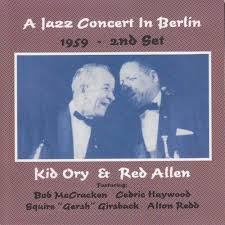
He then went on to play in Europe with Kid Ory and Red Allen in 1959, along with drummer Alton Redd and pianist Cedric Haywood making up the rhythm section. Never leading his own recordings, little is known about the musician from the Sixties until his death. Tubist and double-bassist Squire Gersh, who played in the traditional jazz genre, passed away on April 27, 1983 in San Francisco.

Daily Dose Of Jazz…
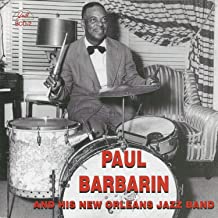
Paul Barbarin was born Adolphe Paul Barbarin on May 5, 1899 in New Orleans, Louisiana into a family of musicians, that included his father, three of his brothers, and his nephew Danny Barker. He was a member of the Silver Leaf Orchestra and the Young Olympia Band.
Moving to Chicago, Illinois in 1917 he worked with Freddie Keppard and Jimmie Noone. For two years beginning in 1925, Paul was a member of King Oliver’s band. The following year, he moved to New York City and played in Luis Russell’s band for about four years. Leaving Russell, he worked as a freelance musician, but he returned to Russell’s band when it backed Louis Armstrong.
For a brief time beginning in 1942, he worked for Red Allen’s sextet, with Sidney Bechet in 1944 and Art Hodes in 1953. Returning to New Orleans in 1955 Barbarin founded the Onward Brass Band where he spent the rest of his life as the leader of that band.
Drummer Paul Barbarin passed away on February 17, 1969, while playing snare drums during a Mardi Gras parade. Record producer Al Rose said that his funeral “attracted one of the great mobs in New Orleans funeral history”.
More Posts: bandleader,drums,history,instrumental,jazz,music
Daily Dose Of Jazz…
Everett Barksdale, born April 28, 1910 in Detroit, Michigan, played bass and banjo before settling on guitar. During early 1930 he moved to Chicago, Illinois where he joined Erskine Tate’s band. He recorded for the first time with violinist Eddie South in 1931, who he remained with until 1939.
A move to New York City saw Everett become a member of the Benny Carter Big Band. Around that same time, he recorded with Sidney Bechet and during the 1940s, he worked for CBS as a session musician.
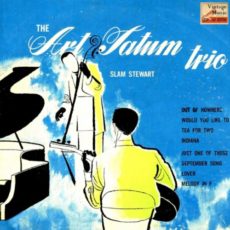
As a sideman, Barksdale played guitar in many genres, working with vocalists Dean Barlow, Maxine Sullivan, the Blenders, and the Clovers. He played on the hit Love Is Strange by Mickey & Sylvia, was the music director for the Ink Spots, and beginning in 1949, he worked with pianist Art Tatum until Tatum died in 1956.
During the Fifties and Sixties, he was part of the ABC house band and played on recordings with a who’s who list of vocalists and musicians not limited to Lena Horne, Sammy Davis Jr., Dinah Washington, Sarah Vaughan, Milt Hinton, Buddy Tate, Chet Baker, Red Allen, Harold Vick, Oscar Brown Jr., J. J. Johnson, Clark Terry, Kai Winding, Louis Armstrong, The Drifters and Ben E. King. He also played guitar in the studio for pop and soul musicians such as.
Guitarist and session musician Everett Barksdale retired from active performance in the 1970s, moved to the West Coast and passed away in Inglewood, California on January 29, 1986.

More Posts: guitar,history,instrumental,jazz,music
Daily Dose Of Jazz…
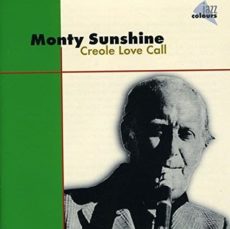
Monty Sunshine was born on April 9, 1928 in Stepney, London, England. Along with Lonnie Donegan, Jim Bray, and Ron Bowden, formed the backline of what was the embryo Chris Barber Band. A few personnel changes between 1953 and ‘54 with the departure of Ken Colyer whose name headed the band for a time until they adopted Baber’s name permanently.
The band quickly gained an international reputation following their inaugural tour of Denmark, before their professional debut in the United Kingdom. Sunshine stayed with the band for several years, until leaving in 1960 and forming his own band, staying true to the original six-man lineup.
In January 1963, the British music magazine NME reported that the biggest trad jazz event to be staged in Britain had taken place at Alexandra Palace. The event included Sunshine, George Melly, Diz Disley, Acker Bilk, Chris Barber, Kenny Ball, Ken Colyer, Alex Welsh, Bob Wallis, Bruce Turner, and Mick Mulligan.
Sunshine returned to play a reunion concert with the original Chris Barber Band at the Fairfield Halls, Croydon in June 1975. This was well-received, and the band reformed once again for an international reunion tour in 1994. Sunshine retired from music around 2001. His discography is extensive, and compact discs have been issued of recordings with Colyer and Barber, as well as with his own band. He has also worked with Beryl Bryden, Johnny Parker, the Crane River Jazz Band, and Donegan’s Dancing Sunshine Band.
Clarinetist Monty Sunshine, who is known for his clarinet solo on the track Petite Fleur, a million-seller for the Chris Barber Jazz Band in 1959, passed away on November 30, 2010, at the age of 82.
More Posts: bandleader,clarinet,history,instrumental,jazz,music