

Daily Dose Of Jazz…
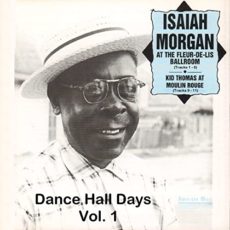
Ike Morgan, born Isaiah Morgan, came into the world on April 7, 1897 in Bertrandville, Louisiana into a musical family. He played in Plaquemines Parish in the early 1910s and then moved to New Orleans.
He led his brothers Al, Sam and Andrew in the Young Morgan Band beginning in 1922, which was later led by Sam and this ensemble recorded for Columbia Records. After Sam suffered a stroke in 1932, Ike resumed the leadership of the group, but it disassembled in 1933.
In the Thirties and Forties, Morgan was a bandleader in the Biloxi, Mississippi area, and played with Andrew there as well. Isaiah recorded in 1955 on an album called Dance Hall Days, Vol. 1, his group at this time featured Freddie Land on piano.
Retiring from music the following year, trumpeter Ike Morgan passed away on May 11, 1966 in New Orleans, Louisiana.

More Posts: bandleader,history,instrumental,jazz,trumpet
Daily Dose Of Jazz…
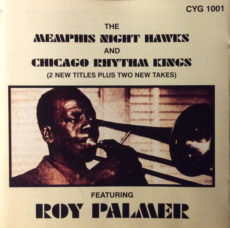
Roy Palmer was born on April 2, 1892 in the Carrollton neighborhood of uptown New Orleans, Louisiana. He learned to play violin, guitar, and trumpet and began his career in 1906 in the Big Easy as a guitarist with the Rozelle Orchestra. Leaving the orchestra he began playing the trombone in Storyville with Papa Celestin, Richard M. Jones, Freddie Keppard, Willie Hightower, during the DepressionTuxedo Brass Band, and Onward Brass Band.
In 1917 he left New Orleans and moved to Chicago, Illinois where he worked with King Oliver, Lawrence Duhe, and Doc Cook. From the 1920s on Palmer recorded with Johnny Dodds, Jelly Roll Morton, Ida Cox, the Alabama Rascals, and the State Street Ramblers. By the 1930s during the Depression, he curtailed his performing worked in a factory and began his career as a music teacher, which included students Preston Jackson and Albert Wynn.
Trombonist Roy Palmer passed away on December 22, 1963, in Chicago, Illinois.
More Posts: history,instrumental,jazz,music,trombone
Daily Dose Of Jazz…
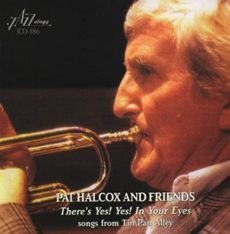
Patrick John Halcox, born March 18, 1930 in Chelsea, London, was originally offered a band spot earlier but elected to continue his studies as a research chemist. Ken Colyer was invited to fill the vacancy in 1953, which became known as the Ken Colyer Jazz Band, playing in a New Orleans style with Chris Barber, Lonnie Donegan and Monty Sunshine.
The band effectively parted company with Colyer in 1954 after a dispute about its musical direction. Halcox took Colyer’s place, in what then become Barber’s group and as the original six-piece band eventually grew to eleven members, he remained present. Although primarily the trumpet player, he had a fine singing voice and led the band’s various renditions of Ice Cream, one of their most popular standards. He also played piano on the Lonnie Donegan recording of Digging My Potatoes.
The Pat Halcox Allstars did make a recording of their own during a Chris Barber Band summer break, now re-released as a Lake Records CD. Trumpeter and vocalist Pat Halcox announced his retirement from the Chris Barber Band at the age of 78, effective in 2008 and passed away on February 4, 2013 at the age of 82.

More Posts: bandleader,hiwstory,instrumental,jazz,music,trumpet,vocal
Daily Dose Of Jazz…
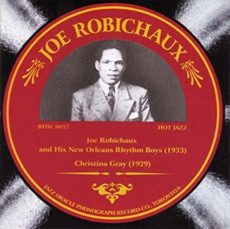
Joseph Robichaux, born March 8, 1900 in New Orleans, Louisiana and played piano from a young age and went on to study at New Orleans University. After working in the O.J. Beatty Carnival, he played with Tig Chambers briefly in 1918 before returning to New Orleans and played with Oscar Celestin, Earl Humphrey, Lee Collins, and The Black Eagles in 1922 and 1923.
He arranged music for and recorded with the Jones-Collins Astoria Hot Eight in 1929 and accompanied Christina Gray on a recording session that same year. In 1931 he formed his own ensemble, featuring Eugene Ware on trumpet, Alfred Guichard on clarinet and alto saxophone, Gene Porter on tenor sax, and Ward Crosby on drums.
They journeyed to New York City to record for Vocalion in August 1933, laying down 22 mostly stomping, uptempo sides and two alternate takes in a marathon 5-day recording schedule. Vocalion issued 10 records over the next year and 2 tracks with vocalist Chick Bullock were issued under his name on Banner, Domino, Oriole, Perfect, and Romeo record labels.
Unfortunately for the musicians and potential audiences problems with the musicians’ union in New York prevented them from being able to play live there, so they returned to New Orleans not long after recording. Robichaux expanded the size of his ensemble over the course of the 1930s and Earl Bostic was among those who joined its ranks.
The band toured Cuba in the mid-1930s and recorded for Decca Records in 1936, recording 4 sides in New Orleans, however, they were all rejected. By 1939 Robichaux’s ensemble disbanded, and he found work performing solo, mostly in New Orleans. He recorded as an accompanist on R&B recordings in the Fifties and played with Lizzie Miles.
Late in his life, he played with George Lewis from 1957 to 1964, Peter Bocage in 1962, and performed at Preservation Hall. Bandleader and pianist Joe Robichaux passed away from a heart attack at the age of 64 in 1965 in his hometown of New Orleans.
More Posts: bandleader,history,instrumental,jazz,music,piano
Daily Dose Of Jazz…
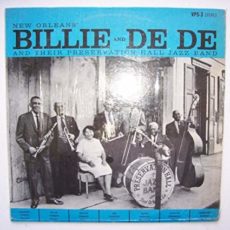
Josiah “Cie” Frazier was born on February 23, 1904 in New Orleans, Louisiana. He studied drums under several New Orleans jazz musicians, including Louis Cottrell, Sr., Red Happy Bolton, and Face-O Woods. He joined the Golden Rule Band with cousin Lawrence Marrero in 1921, and played in Marrero’s Young Tuxedo Orchestra in the 1920s.
He recorded with Papa Celestin’s Tuxedo Brass Band in 1927 and played with A.J. Piron and Sidney Desvigne in the late 1920s and early 1930s. During the Great Depression, Frazier played in WPA bands and in Navy dance bands. In 1945, he recorded with Wooden Joe Nicholas and worked in the 1950s with Celestin, Percy Humphrey, George Williams, and the Eureka Brass Band. He played in the Preservation Hall Jazz Band in the 1960s, working there into the 1980s, and recorded in his last few decades with Kid Howard, De De Burke, George Lewis, Emile Barnes, Captain John Handy, and Don Ewell.
He appeared in the Steve McQueen film The Cincinnati Kid and drummed on a Helen Reddy session. Drummer Cie Frazier passed away on January 10, 1985 in New Orleans.
More Posts: drums,history,instrumental,jazz