

Daily Dose Of Jazz…
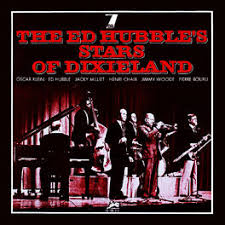
Eddie Hubble was born John Edgar Hubble II on April 6, 1928 in Santa Barbara, California and learned trombone from his father, who was also a professional trombonist in the Los Angeles, California area.
A move to New York City in 1944 and by late in the decade had played with Bob Wilber, Buddy Rich, Doc Evans, Alvino Rey, and Eddie Condon. He played with his own ensemble from the late 1940s, recording for Savoy Records in 1952.
He played with a Dixieland jazz ensemble known as The Six in 1953, and worked with Muggsy Spanier in the 1960s, playing in Ohio and Connecticut. He also worked with the World’s Greatest Jazz Band.
Despite being seriously injured in a car crash in 1979, he was soon back playing, including for international tours.
Trombonist Eddie Hubble died on March 22, 2016, at the age of 91.
More Posts: bandleader,history,instrumental,jazz,music,trombone
Daily Dose Of Jazz…
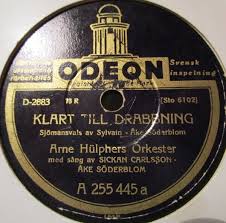
Arne Gunnar Valter Hülphers was born April 4, 1904 in Trollhättan, Sweden. Early in his career he played at the club Felix-Kronprinsen from 1924 to 1927, and played in dance bands into the early 1930s.
He founded his own ensemble in 1934 which became one of Sweden’s most important jazz big bands. They toured Europe and recorded until 1940. Sidemen in his group included Miff Görling, Zilas Görling, and Thore Jederby.
Later in his career, he concentrated more on popular musical styles; he led an orchestra in which Fred Bertelmann played. Pianist and bandleader Arne Hülphers died on July 24, 1978 in Norrköping Municipality, Sweden.
More Posts: bandleader,history,instrumental,jazz,music,piano
Daily Dose Of Jazz…
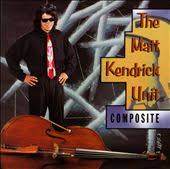
Matt Kendrick, was born in Winston-Salem, North Carolina on April 1, 1957 and attended the University of North Carolina School of the Arts. He moved to New York City in 1977 and for four years performed in numerous avant-garde venues. After studying with jazz educator Jerry Coker at the University of Tennessee, and playing in the Knoxville Symphony, he returned home in 1981.
As a composer, he has released to critical acclaim five compact discs, featuring more than forty of his own compositions. He has scored music for three films, leads the Matt Kendrick Unit,and has performed with Marian McPartland, Tierney Sutton, Archie Shepp and Jaki Byard.
He serves on the board of Music Carolina, is the music director for Carolina Music Ways, and is co-artistic director for Music Carolina, a non-profit arts presenting organization. As an educator Kendrick was on the faculty at Wake Forest University for 25 years.
With four decades under his belt, bassist Matt Kendrick continues to compose, perform, and teach.
More Posts: bandleader,bass,composer,history,instrumental,jazz,music
Daily Dose Of Jazz…
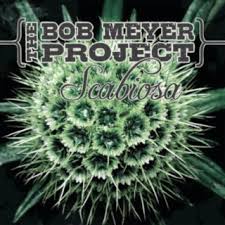
Bob Meyers was born on March 31, 1945 in Courtlandt Manor, New York. His early influences were classical and chamber music. When he was five he first heard the music of Kenny Clarke, Charlie Parker, Dizzy Gillespie and Thelonious Monk. It was at that age he began his music studies.
He attended George Washington University in Washington, DC earning his BA in History with minors in Music and Geology. He went on to study with Jack DeJohnette, Frank Dunlop, Henry Adler and Jim Chapin as well as extensive private study as an adult.
As an educator he has taught on both coasts focusing on technique, mechanics, musical application and interpretation on the drum set. Though specializing in jazz many of his students have gone on to be professionally active in jazz, rock and funk.
He has performed with Joe Lovano, John Abercrombie, Judi Silvano, Sheila Jordan, Ray Nance, Jaki Byard, Julian Priester, Gary Peacock, Diane Schurr, Mal Waldron, Kirk Lightsey, Avishai Cohen, Essiet Essiet, Santi Debriano and Vic Juris among numerous others.
As a leader he has recorded eighteen records. Drummer Bob Meyers continues to teach and perform as a leader and a sideman.

More Posts: bandleader,drums,history,instrumental,jazz,music
Daily Dose Of Jazz…
Born Charles Isaacs on March 28, 1923 in Akron, Ohio, he initially played trumpet and tuba as a child before settling on bass. He served in the Army during World War II, where he took lessons from Wendell Marshall. After the war he played with Tiny Grimes from 1948–50, Earl Bostic from 1951 to 1953, Paul Quinichette in 1953, and Bennie Green in 1956.
Ike, as he was affectionately called, led a local band in Ohio in 1956, then played for two years in the trio behind Carmen McRae, whom he married late in the decade. He went on to work with Lambert, Hendricks and Ross, then with Count Basie, Gloria Lynne, and Erroll Garner in the Sixties,
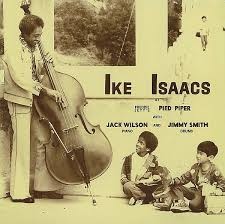
With his own small groups he recorded only once as a leader, At The Pied Piper in 1967 for RGB Records. On this recording he plays in a trio with Jack Wilson on piano and Jimmie Smith on drums. As a coleader he recorded two albums with Maxine Sullivan.
As a sideman he recorded twenty-six albums with Count Basie, Lambert, Hendricks & Ross, Roy Brown, Ray Bryant, Harry Edison, Eddie Lockjaw Davis, Pee Wee Erwin, Ella Fitzgerald, Billie Holiday, Erroll Garner, Bennie Green, Al Grey, Jon Hendricks, Carmen McRae, Big Miller, Esther Phillips, Dan Wall, Jack Wilson, and Joe Williams.
Bassist Ike Isaacs died on February 27, 1981.
More Posts: bandleader,bass,history,instrumental,jazz,music