


Daily Dose Of Jazz…
Luther Thomas was born on June 23, 1950 in St. Louis, Missouri. Known for his free jazz playing and drawing from funk. Coming out of the Black Artists Group (BAG) of St. Louis in the late Sixties, he was one of the original voices from a scene that also bred such names as Oliver Lake, Julius Hemphill, Baikida Carroll, John Zorn and Joseph Bowie.
Luther played in the Human Arts Ensemble with Charles Bobo Shaw in the 1970s, and led a group called Dizzazz in the early 1980s. He played saxophone for James Chance and the Contortions.
As a leader he had recording sessions from the early 1970s he has recorded eleven albums. They have been reissued on CD as part of Atavistic Records’ Unheard Music Series. In 1998 he settled in Denmark and became a cult musician in Christiania Freetown, performing there weekly.
Alto saxophonist and multi-instrumentalist Luther Thomas was a completely intuitive improvisor and a free spirit who reached a level of intensity on the saxophone reached by very few others, transitioned at the age of 59 on September 8, 2009 in Denmark.

More Posts: bandleader,history,instrumental,jazz,music,saxophone

Daily Dose Of Jazz…
Julia Feldman was born on June 22, 1979 in Samara, Soviet Union to Israeli parents and into a family with a large musical background; her father wa ajeweler who played jazz piano, and a grandfather who was an accomplished conductor and a leader of the city philharmonic orchestra. Classically trained by studying the piano from the age of 5 until the family’s immigration to Israel in 1990 where she continued her piano studies along with jazz improvisation at the High School Of Arts in Jerusalem.
Becoming interested in jazz singing in the last year of her high school studies Feldman began studying voice technique and jazz improvisation along with intensive studies of jazz with the saxophonist Arnie Lawrence at the International Music Center of Jerusalem. While there she studied and performed with known American jazz musicians, such as Evelyn Blakey, Larry Goldings, Armen Donelian, Bob Meyer, Sheila Jordan, Judi Silvano and composer Allen Gershwin, performing the latter’s Walk In The Wilderness.
The late Nineties had her continuing her education and performing with a host of musicians. She has put together her self-titled ensemble and quartet with the former releasing a tribute album in 2006 Words Are Worlds inspired and featuring many standards by Billie Holiday. Other projects she has worked on as a vocalist have delved her into progressive rock Musicca Ficta, vocalist in Radical Shlomo, as pianist, vocalist, co-composer and co-lyricist in Ayulyul and collaboration with ethno-core Jerusalem band Shoom.
Vocalist, composer and educator Julia Feldman, whose singing combines elements of multiple jazz genres, free improvisation and modern classical music, continues to explore, perform and record.
More Posts: bandleader,composer,educator,history,instrumental,jazz,music,vocal
Daily Dose Of Jazz…
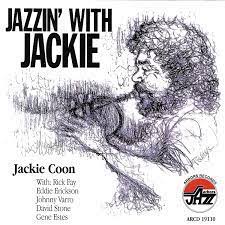
Jackie Coon was born in Beatrice, Nebraska on June 21, 1929 and grew up in Southern California. He was inspired to play trumpet after hearing Louis Armstrong’s West End Blues. He spent a few months with Jack Teagarden’s band and had gigs with Charlie Barnet, Louis Prima, and Earl Hines.
Making his recording debut with Barney Bigard in 1957 and he also played the mellophone on Red Nichols’ version of Battle Hymn of the Republic. Jackie’s decision to stay in California cost him the fame that eluded him, but he worked at Disneyland for nine years, and performed regularly in local clubs and jazz festivals.
It was until 1986 that Coon led his first record session for Sea Breeze. Since 1991 he has recorded fairly often for Arbors. Trumpeter, flügelhornist and cornetist Jackie Coon has become less active in his Eighties.
More Posts: bandleader,cornet,flugelhorn,history,instrumental,jazz,music,trumpet
Daily Dose Of Jazz…
Tamm E. Hunt was born into a musical family in New York City, New York on June 19, 1954. The niece of jazz and blues singer Hannah Sylvester and record company owner Benny Clark, she is the daughter of K.D. Searcy, a tap dancer who danced at the Apollo Theater with Tip Tap & Toe. Growing up around music when she heard Dakota Staton’s The Late Late Show, she knew early on that she wanted to sing jazz.
Despite that prophetic introduction, Hunt started out singing other styles of music. In her childhood she sang with a variety of R&B girl groups. She had some commercial success in the early ’80s singing disco, but then switched to jazz. Inspired by Betty Carter, Sarah Vaughan and pianist Dorothy Donegan, she has sung with such notables as alto saxophonist Gary Bartz, tenor saxophonist Clifford Jordan, pianists Ronnie Matthews and Larry Willis, bassist Buster Williams, and drummer T.S. Monk among others.
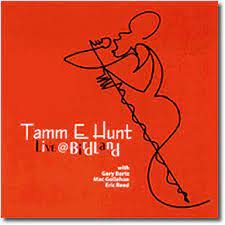
She has performed throughout the U.S. in addition to Europe, Canada, and Japan. Hunt has thus far recorded one CD, Live @ Birdland, for her New Jazz Audience label. She founded the Harlem Jazz Foundation, and has written jazz education programs including Adopt a Kid 4 Jazz and Jazz 4 the Beginner.
She starred in and produced the off-Broadway show Billie Holiday: The Legend, and appeared in a short dramatic film with Bartz called A Jazz Story. Moving to Baltimore, Maryland she has been an important force in the city’s jazz community, both as a singer and behind the scenes. Vocalist Tamm E. Hunt, who is also the executive/artistic director of the Maryland Center for the Preservation of Jazz & Blues, continues to sing, educate and promote jazz.
More Posts: bandleader,educator,history,instrumental,jazz,music,vocal

Daily Dose Of Jazz…
Nancy King was born June 15, 1940 in Springfield, Oregon. She started gigging in 1959 with fellow University of Oregon music students. After moving to San Francisco in 1960, her accomplished scat singing landed her many gigs with various bebop artists. Performing the Playboy Club circuit and Las Vegas, Nevada during the 1960s, it was during Monday night hits at the Jazz Workshop where she met her future husband Sonny King. By the Seventies she took a break from touring, settled in Eugene, Oregon and raised her three sons while doing weekend gigs at Portland’s Benson Hotel.
Known for her masterful scatting and elastic range, Nancy has performed in worldwide tours and recordings, as well as collaborations with such artists as Jon Hendricks, Vince Guaraldi, Ralph Towner, Karrin Allyson and Dave Friesen among others.
King has released ten albums beginning with her 1991 debut release of Impending Bloom and including her 2004 recording of her performance Live At Jazz Standard with pianist Fred Hersch. In 2011 she released her Prennia project on the Ornry Diva label.
Vocalist Nancy King would occasionally pop into jazz loving cities to perform but by 2014, suffering from degenerative hips has limited her ability to travel and perform. Though Covid had postponed the operation he is looking forward to replacement surgery, recovery and getting back onto the stage and recording studio.
More Posts: bandleader,history,instrumental,jazz,music,vocal