


Daily Dose Of Jazz…
Denys Justin Wright was born on May 6, 1924 in Deptford, London, England and grew up in Brockley. His first instrument was the piano but was soon trying to play his brother’s guitar. Known professionally as Denny Wright, he began playing professionally before World War II while at school. He nearly always used his thumb on the top E string and could only play as fast as he could sing.
Wright spent the first part of World War II playing in jazz clubs in the West End of London, doing session work and performing in bands on radio shows. He worked with Stephane Grappelli for the first time in London around 1941. At school he served with the Auxiliary Fire Service in Brockley. Classified medically unfit to serve due to a childhood injury, he joined Entertainments National Service Association (ENSA), entertaining the troops.
In 1945 he started the first bebop club in London where he played piano and guitar. The late 1940s saw him touring Italy and the Middle East with the Francisco Cavez Orchestra. Throughout the 1950s DEnny provided guitar accompaniments for Lonnie Donegan, Johnny Duncan, Humphrey Lyttelton, and Marie Bryant, as well as appearing on Guitar Club on the BBC. In 1952, he accompanied Tex Ritter for a season at the Texas Western Spectacle, and with Joel David on Old Bones and added a guitar solo on Be My Valentine Tonight.
Establishing the Denny Wright Trio with violinist Bob Clarke took skiffle and jazz to the Soviet Union in 1957 for the 6th World Festival of Youth and Students. For four decades from the Forties he worked as a session musician working with the likes of Mary Hopkin, Dusty Springfield and Tom Jones. In the 1960s, he went on to record under The Cooper-Wright Quintet, and during the late Seventies formed the band Velvet with Ike Isaacs, Len Skeat, and Digby Fairweather.
Never one to not be working he continued to put bands together as well as lecturing and giving private lessons. He arranged for and fixed sessions, and was a prolific jazz and orchestra composer. He worked with Latin American, Afro-Cuban and Jamaican bands. Denny was voted the 1980 BBC Jazz Society Musician of the Year.
Guitarist, pianist, arranger and composer Denny Wright transitioned on February 8, 1992 in London after a nine-year battle with bladder cancer.

More Posts: bandleader,guitar,history,instrumental,jazz,music
Daily Dose Of Jazz…
Donald Ernest Friedman was born in San Francisco, California on May 4, 1935 and began playing the piano at the age of four, switching from classical music to jazz after his family moved to Los Angeles, California when he was fifteen. His early jazz piano influence was Bud Powell and he briefly studied composition at Los Angeles City College.
He began playing in Los Angeles and moved to New York City in 1958. During the 1960s, he played with both modern stylists and more traditional musicians. The former included Coleman, Eric Dolphy, Jimmy Giuffre, Booker Little, and Attila Zoller; the latter, Bobby Hackett and Herbie Mann.
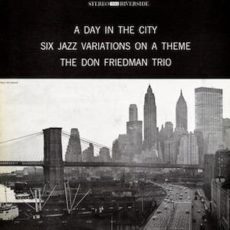
His debut album as a leader was A Day in the City, recorded in 1961. A few of his early albums received top ratings from DownBeat, which also gave him its critics’ poll New Star award. On the West Coast, Friedman performed with Dexter Gordon, Chet Baker, Buddy DeFranco, and Ornette Coleman. He was also a member of Clark Terry’s big band.
Pianist Don Friedman, who was also an educator in New York and had many fans in Japan, transitioned from pancreatic cancer on June 30, 2016 at his Bronx home.

More Posts: bandleader,history,instrumental,jazz,music,piano
Daily Dose Of Jazz…
John Rhea “Yank” Lawson was born May 3, 1911 in Trenton, Missouri. He started playing music on saxophones and piano before settling on the trumpet as a teenager. He played in the University of Missouri Dance Band, and was soon offered a job with Slatz Randall’s group, with whom he made his recording debut on Mom in 1932. Dropping out of college he had a stint with Wingy Manone before being hired to join Ben Pollack in late 1933.
From 1933 to 1935 Yank worked in the Pollack orchestra, then became a founding member of the Bob Crosby Orchestra. He later worked with Benny Goodman and Tommy Dorsey, but also worked with Crosby again in 1941~1942. Later in the decade he became a studio musician leading his own Dixieland sessions.
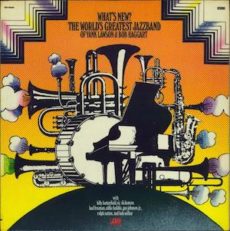
By the 1950s he and Bob Haggart created the Lawson-Haggart band and they worked together in 1968 to form the World’s Greatest Jazz Band, a Dixieland group which performed for the next ten years. He recorded for Atlantic, Audiophile, Decca and Jazzology.
Trumpeter Yank Lawson, best known for Dixieland and swing music, transitioned on February 18, 1995 in Indianapolis, Indiana.
More Posts: bandleader,history,instrumental,jazz,music,trumpet
Daily Dose Of Jazz…
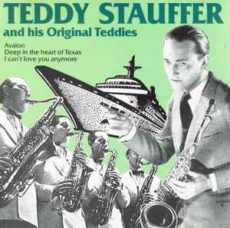
Ernst Heinrich “Teddy” Stauffer was born May 2, 1909 In Murten, Fribourg, Switzerland He was dubbed Germany’s “Swing-King” of the 1930s. He formed the band known as the Teddies, which is also billed as the Original Teddies or the International Teddies, which continued after he left in 1941.
Annual trips to the Swiss cities of St. Moritz, Arosa and also a guest appearance in London, England were responsible for the international fame of the Teddies band. Until 1939, he appeared with his Original Teddies-Band especially in Berlin and Hamburg, Germany. He enjoyed his popularity at the 1936 Olympics, had hits with Goody~Goody, and turned Horst Wessel Lied, the National Socialist’s anthem, into a jazz number in 1938. With his jazzy swing music, however, Stauffer increasingly got in trouble with the Reichsmusikkammer, a Nazi institution that promoted “good German music” which was composed by Aryans and seen as consistent with Nazi ideals.
Returning to Switzerland in 1939, he eventually emigrated to the United States and then to Mexico. His reputation as a playboy and a well~known womanizer who was married to Hedy Lamar, did not sway him from also having affairs with Rita Hayworth and Barbara Hutton.
Violinist, saxophonist and bandleader Teddy Stauffer who was also an actor, nightclub owner, and restaurateur transitioned on August 27, 1991 in Acapulco, Mexico at the age of 82.
More Posts: bandleader,club owner,history,hotelier,instrumental,jazz,music,saxophone,violin

Daily Dose Of Jazz…
Michel Delville was born on April 30, 1969 in Liège, Belgium. He has been performing and composing alternative music since the mid-1980s. His bands include The Wrong Object, douBt, Machine Mass feat. Dave Liebman, Alex Maguire’s Electric 6tet, the New Texture Pan Tonal Fellowship, the Ed Mann Project, and the Moving Tones.
He has worked with Elton Dean, Annie Whitehead, Harry Beckett, Richard Sinclair, Ed Mann, Dagmar Krause, Benoît Moerlen, Karen Mantler, Geoff Leigh, Markus Stauss, Guy Segers, Klaus Blasquiz, Gilad Atzmon, and Dirk Wachtelear.
In 2009 Delville created the trio douBt with Alex Maguire and Tony Bianco and released their debut album, Never Pet a Burning Dog. The following year he was invited to join and coordinate Comicoperando, a tribute to the music of Robert Wyatt. The band toured Europe and Canada as a sextet in 2011, then went on to collaborate with the international collective 48 Cameras and Robin Rimbaud. In 2018 he was voted one of the three best electric guitarists of the year by Arnaldo DeSouteiro’s Annual Jazz Station Poll.
He has authored, edited or co-edited numerous books about comparative poetics and interdisciplinary studies and has been awarded several times for his writings. The rank of Officer of the Order of Leopold I was bestowed upon him in 2009, and he received the 2009 Prix Wernaers for research and dissemination of knowledge. He has recorded more than three dozen albums across the groups he has founded or been a part of.
Guitarist, writer and critic Michel Delville, who composes and performs in the jazz fusion and progressive rock genres, teaches literature at the University of Liège, and continues to compose and perform.
More Posts: bandleader,guitar,history,instrumental,jazz,music