


Daily Dose Of Jazz…
Johnny St. Cyr was born on April 17, 1890 in New Orleans, Louisiana. St. He led several bands in the Crescent City beginning around 1905 and performed on the riverboats with Fate Marable. He played for several leading New Orleans bands including A.J. Piron, the Superior, Olympia and Tuxedo bands before moving to Chicago, Illinois in 1923 with King Oliver.
He is most commonly remembered as a member of Louis Armstrong’s Hot Five and Hot Seven bands. He also played and recorded with Jelly Roll Morton’s Red Hot Peppers. St. Cyr also performed with Don Cook’s Dreamland Orchestra. He composed the popular standard Oriental Strut, noted for its adventurous chord sequence.
In 1930 Johnny returned to New Orleans to make a living as a plasterer while still playing with local bands led by Paul Barbarin or Alphonse Picou. In 1955 he moved to Los Angeles, California and returned to music full time. From 1961 until his death in 1966, he was the bandleader of the Young Men from New Orleans that featured Barney Bigard, performers at Disneyland.
Banjoist and guitarist Johnny St. Cyr passed away on June 17, 1966 in Los Angeles, California.
Sponsored By

Voices From The Community

#preserving genius
Daily Dose Of Jazz…
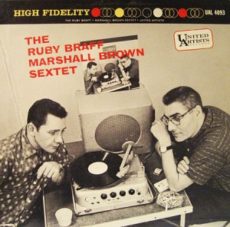
Marshall Brown was born on December 21, 1920 in Framingham, Massachusetts. Little recorded, he devoted most of his career to education, earning a music degree from New York University, as a member of the Zeta Psi Fraternity.
He was also a high school band director leading the Farmingdale New York Daler Band from the early 1950s through 1957. Brown was the first high school band director to initiate a jazz education program, which he did in his tenure at Farmingdale High. By 1956 his stage band, the Daler Dance Band, a jazz big band with an average age of 14 years old, was so formidable and impressive, boasted future jazz stars pianist Michael Abene, saxophonist Andrew Marsala, and whiz drummer Larry Ramsden. One night at the 1957 Newport Jazz Festival, Count Basie, who was late for his appearance as he entered the festival grounds heard the Daler Band performing their set and exclaimed, “Damn, they started already”, mistaking the Dalers for his band.
Marshall received some attention for performing and recording in a quartet with Pee Wee Russell in the early 1960s. While Russell was most often associated with Dixieland or swing, their quartet performed more adventurous, free jazz-oriented pieces, including pieces by Ornette Coleman and John Coltrane.
During the Sixties he was the resident trombonist at Jimmy Ryan’s, a noted dixieland venue. He also club dated with Luke O’Malley’s Irish band during this time. Brown also performed or recorded at one time or another with Ruby Braff, Beaver Harris, Lee Konitz, George Wein and Basie.
Conductor, arranger and educator Marshall Brown, who also played the valve trombone, trumpet, euphonium, electric bass and the banjo, passed away on December 13, 1983 in New York City.

Uplift Someone’s World
More Posts: banjo,bass,euphonium,trombone,trumpet,valve trombone
Daily Dose Of Jazz…
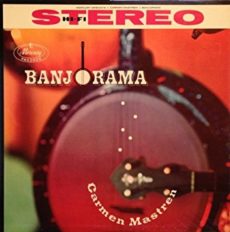
Carmen Mastren was born Carmine Mastrandrea on October 6, 1913 in Cohoes, New York. By 1934 he was playing professionally as a musician when he joined the Wingy Manone and Joe Marsala band. Mastren worked with a variety of musicians during his career, including Raymond Scott, Ray McKinley and Mel Powell.
In the 1940s Mastren recorded with the Sidney Bechet and the Muggsy Spanier “Big Four”. During World War II he played with the Glenn Miller Air Force Band. It was during this period that he worked as musical director and conductor for Morton Downey, and from 1954–1970 he played for The Today Show, The Tonight Show and Say When!! on the NBC television network.
Recording as a sideman, Carmen worked with Dick Hyman And His Orchestra, Bobby Hackett, Quincy Jones, Frank Sinatra, Bud Freeman and the Wolverine Orchestra on such labels as Mercury, Decca, Atlantic, Epic, Universal/MCA, Victor, RCA, Allegro Elite and Gennett.
Guitarist, banjoist and violinist Carmen Mastren passed away at age 68 from a heart attack on March 31, 1981 at his home in Valley Stream on Long Island, New York. He is best remembered for his work from 1936–1941 with the Tommy Dorsey orchestra as a guitarist.
Sponsored By

Daily Dose Of Jazz…
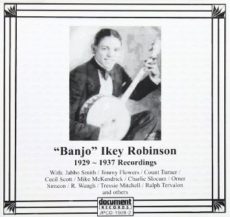
Ikey Robinson also known as Banjo Ikey was born Isaac L. Robinson on July 28, 1904 in Dublin, Virginia. He moved to Chicago, Illinois in 1926, playing and recording with Jelly Roll Morton, Clarence Williams, and Jabbo Smith during 1928-1929.
He went on to put together groups that included Ikey Robinson and his Band with Jabbo Smith, The Hokum Trio, The Pods of Pepper, Windy City Five, and Sloke & Ike.
His jazz style influenced many subsequent players, and his 1929 recording Rock Me Mama is often cited as an early use of the term “rock” as it evolved from black gospel into rock and roll.
Robinson reunited in the 1970s with Jabbo Smith for a global tour and appeared in the 1985 film Louie Bluie, a documentary about fellow musician Howard Armstrong. Having never previously met Armstrong he was initially hesitant to meet him because of their differing musical styles. However, the two got on well and perform together in the documentary. Banjoist and vocalist Ikey Robinson passed away on October 25, 1990.
Inspire A Young Mind

Daily Dose Of Jazz…
Kid Ory was born Edward Ory on December 25, 1886 in Woodland Plantation near La Place, Louisiana. He started playing music with home-made instruments in his childhood but by his teens was leading a well-regarded band in Southeast Louisiana. A banjo player during his youth, it is said that his ability to play the banjo helped him develop “tailgate”, a particular style of playing that has the trombone playing a rhythmic line underneath the trumpets and cornets.
He kept La Place as his base of operations due to family obligations until his twenty-first birthday, when he moved his band to New Orleans. While Kid was living on Jackson Avenue, he was discovered by Buddy Bolden, playing his first new trombone, instead of the old civil war model but his sister said he was too young to play with Bolden. With one of the best-known bands in New Orleans in the 1910s, he hired many of the great jazz musicians of the city, including cornetists Joe “King” Oliver, Mutt Carey, and Louis Armstrong.
In 1919 he moved to Los Angeles and he recorded Ory’s Creole Trombone and Society Blues there in 1921 with a band that included Mutt Carey, Dink Johnson and Ed Garland. They were the first jazz recordings made on the west coast by a Black jazz band from New Orleans. His band recorded with the recording company Nordskog and paying them for the pressings sold them under his own label of Kid Ory’s Sunshine Orchestra at a store in Los Angeles called Spikes Brothers Music Store.
Moving to Chicago in 1925 he was very active working and recording with Louis Armstrong, Jelly Roll Morton, King Oliver, Johnny Dodds, Bessie Smith, Ma Rainey and many others. He mentored Benny Goodman and later Charles Mingus. The Great Depression retired Kid from music, not playing again till 1943. From 1944 to about 1961 he led one of the top New Orleans style bands of the period working with Alvin Alcorn, Teddy Buckner, Darnell Howard, Jimmie Noone, Albert Nicholas, Barney Bigard, George Probert. Buster Wilson, Cedric Haywood and Don Ewell.
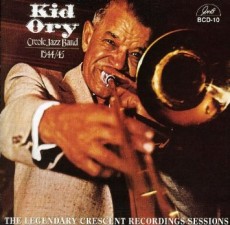
The Ory band was an important force in reviving interest in New Orleans jazz, making popular 1940s radio broadcasts, among them a number of slots on The Orson Welles Almanac program. In 1944–45 the group made a series of recordings on the Crescent Records label, founded by Neshui Ertegun for the express purpose of recording Ory’s band.
Retiring from music in 1966 he spent his last years in Hawaii with the assistance of Trummy Young. Trombonist and bandleader Kid Ory, one of the most influential trombonists of early jazz, passed in Honolulu on January 23, 1973.
Put A Dose In Your Pocket