

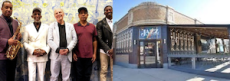
THE HEADHUNTERS
The Headhunters, the legendary jazz-funk ensemble co-led by percussionist Bill Summers and drummer Mike Clark with NEA Jazz Master Donald Harrison on alto saxophone, celebrated the band’s 50th anniversary in 2023, having formed around Herbie Hancock’s classic recordings, Head Hunters, in 1973, Thrust in 1974 and Man-Child in 1975. The band continued without Mr. Hancock and has released 8 albums under the Headhunters name starting with Survival of the Fittest in 1975 and on Straight from the Gate in 1977 (featuring the smash hit “God Make Me Funky” sampled on over 350 hip hop and pop songs), and most recently Speakers In the House in 2022 and Live From Brooklyn Bowl in 2023. The band’s new album The Stunt Man comes out October 11th, 2024 on Ropeadope recorded at the legendary Hyde Street Studios.
Few bands can boast a history as fortuitous and storied as The Headhunters. What each member brings to the table forged a history that most bands can only dream of. Their blend of jazz with funk and rock would go on to sell over a million albums worldwide, while the band’s legacy would inspire musicians of every genre for years to come, be sampled by hundreds of hip-hop artists throughout the ’80s and ’90s, and influence countless musicians’ playing today. The Headhunters’ impact remains a global phenomenon, and their time with Hancock proved to be a life changing experience.
Bill Summers – percussion
Mike Clark – drums
Donald Harrison – saxophone
Chris Severin – bass
Kyle Roussel – piano
Cover Chaege: $25.00 – $50.00 + $3.50 fee
More Posts: adventure,bandleader,bass,club,drums,genius,instrumental,jazz,music,percussion,piano,preserving,saxophone,travel
The Jazz Voyager
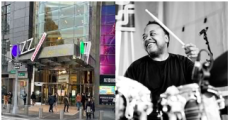
The Jazz Voyager will be landing in the Big Apple tonight heading to Broadway to help kick off the New Year at Dizzy’s by celebrating with drummer Jeff “Tain” Watts on his 65th birthday. The club sits high above Columbus Circle with a backdrop of Central Park and the Manhattan vistas. It’s a view to remember.
This multi-Grammy winner and Guggenheim fellow leads an all-star band for a high-energy, four-night run, featuring saxophonist Ravi Coltrane, pianist James Francies, James Genus on the double bass, and guitarist Paul Bollenback. Tain’s distinct blend of swing, innovation, and soul, honed through collaborations with legends like Wynton Marsalis and McCoy Tyner, is sure to set the stage afire and raise the roof.
Tickets range from $25.00~$60.00 and some performances Sold Out , so check availability before you go.
Dizzy’s is located at 10 Columbus Circle, New York City, NY 10019. For more information visit https://jazz.org/dizzys.

More Posts: adventure,bass,club,drums,genius,guitar,jazz,music,piano,preserving,saxophone,travel
Daily Dose Of Jazz…
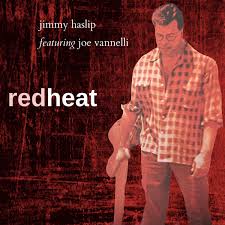
James Robert Haslip was born December 31, 1951 in the Bronx, New York City to Puerto Rican immigrants. Spanish was his first language but he learned to speak English in kindergarten. Moving to Huntington, New York when he was four years old, by age seven he was playing drums then trumpet and tuba until landing on the bass at 15.
Surrounded in the home with music that included classic and orchestra jazz, Latin, and pop vocals, he and his peers also visited nightclubs and concert venues. Jimmy took music lessons and attended a private music school, but considers himself self-taught. He went to a local music shop with his father, purchased a right-handed bass though he is left-handed, and learned to play it upside down without restringing.
During his high school years Haslip formed his first band called Soul Mine with his classmates, playing soul music at school dances and parties. The early 1970s saw him playing with New York glam band Street Punk, then moved to Los Angeles, California in 1976, where he played with guitarists Tommy Bolin and Harvey Mande.
A founding member of the jazz fusion group Yellowjackets in 1977, a relationship that lasted until 2012, he has also worked with Jeff Lorber, Eric Marienthal, Bruce Hornsby, Rita Coolidge, Gino Vannelli, Kiss, Tommy Bolin, Allan Holdsworth, Marilyn Scott, Chaka Khan, Al Jarreau, Donald Fagen, and Anita Baker.
Bassist Jimmy Haslip is currently taking a break from performance to concentrate on family and producing independent projects.

More Posts: bandleader,bass,history,instrumental,jazz,music
Daily Dose Of Jazz…
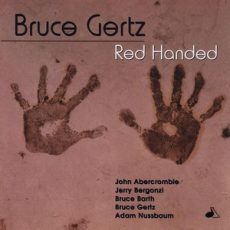
Bruce David Gertz was born on December 15, 1952 in Providence, Rhode Island. He first learned to play guitar, then switched to bass guitar as a teenager, playing with local blues and rock groups.
He studied music formally at New England College and Berklee College of Music in the 1970s. After graduating from Berklee in 1976 he taught music there; he is now a professor of music. He worked with George Garzone in the Overtones in the late Seventies and was a co-leader of ensembles with Jerry Bergonzi from 1978 to 1989.
He has worked with Mike Stern both in the Bergonzi ensembles and with Stern’s own quartet. From 1982 to 1985 he was house bassist for the Willow Jazz Cafe in Somerville, Massachusetts. In the 1990s he worked with John Abercrombie, Joey Calderazzo, Ken Cervenka, Adam Nussbaum, Danilo Perez, Dan Reiser, Kurt Rosenwinkel, George Schuller, and others.
Double and electric bassist Bruce Gertz continues to perform.

BILL CHARLAP TRIO
The Bill Charlap Trio – with bassist Peter Washington and drummer Kenny Washington – is a jazz super-group with three brilliant, accomplished talents.
Their dazzling interplay and near-telepathic communication has earned a Grammy Award and multiple nominations, plus raves from audiences everywhere. Downbeat gave their new live recording, And Then Again, 4 ½ stars, placing them among “the best of the best ensembles in jazz history” playing at “the epitome of their creative powers.”
Two Shows ~ 7:00pm & 9:30pm | Friday 12.13 ~ 7:00pm Sold Out
Tickets: $40.00 + $3.00 fee
More Posts: adventure,bandleader,bass,club,drums,genius,instrumental,jazz,music,piano,preserving,travel