


Jazz Poems
MAY 12
From The Daily Mirror
A book could be written on the moment swing turned into bop the moment Lester Young, Roy Eldridge, and Teddy Wilson gave way to Bird, Dizzy, Miles, Bud and Monk in fact it would be a great movie at least the sound track would be “beyond category” as Duke Ellington would have put it the life of a jazz musician (about which I know so little) is the life for me I felt on the afternoon Jamie and I visited his father who sat at the piano and talked and played I was tongue-tied and wanted him to play a song as if Helen Merrill were there and her voice and his fingers were about to have an intimate talkDAVID LEHMAN | 1948
from Jazz Poems ~ Selected and Edited by Kevin Young

More Posts: book,classic,collectible,history,jazz,library,poet

Requisites
Repetition ~ Clifford Jordan Quartet | By Eddie Carter
This morning’s record from the library, Repetition (Soul Note SN 1084), is a delightful album by the Clifford Jordan Quartet. Clifford Jordan began playing the piano at a young age, then picked up the tenor sax at thirteen. Early in his career, he played with Max Roach and Sonny Stitt and was a member of a few rhythm and blues groups. He later moved to New York City, recorded three albums for Blue Note, and toured overseas in Africa and Europe. Jordan recorded thirty-six albums as a leader and was featured on many others as a sideman; his most appearances were with Art Farmer, Charles Mingus and Cedar Walton. The superb rhythm section accompanying him on this album is Barry Harris on piano, Walter Booker on bass, and Vernel Fournier on drums. My copy is the 1984 Italian Stereo release.
Side One kicks off with a trip to Third Avenue by Clifford Jordan. The trio sets a lively pace with their introduction before the saxophonist joins in for the melody. Clifford’s initial statement bursts with joyful exuberance, followed by Cedar’s swift and swinging interpretation. A delightful conversation between the leader and Vernel culminates in a reprise of the theme and a satisfying conclusion. Fun is a collaborative creation by Jordan, Harris, Booker, and Fournier. Vernel starts with a short, lively introduction preceding the quartet’s vivacious theme. Clifford sets the stage by diving into an energetic first solo. Barry takes a high-spirited interpretation next, and then Vernel shines in a short statement, leading to an abrupt yet perfect closing chorus.
The tempo slows down for Neal Hefti’s Repetition, a beautiful song where the trio’s introduction begins at a mid-tempo beat before the saxophonist completes the theme. Clifford is up first and whets the listener’s appetite for the following solo. Barry demonstrates how the right choice of notes can tell a compelling story preceding the closing chorus and a climatic finish. The pace remains at a moderate level for Thelonious Monk’s Evidence. The foursome dives straight into the theme, then Barry gets the nod for a first solo as refreshing as a cool breeze on a hot day. Clifford contributes to the outdoorsy feeling with a bluesy statement, and Walter wraps up the solos with an attractive portrait before the group exits.
The second side begins with a melody of Nostalgia by Fats Navarro and Casbah by Tadd Dameron. The quartet embarks on a lovely theme that would fit perfectly in a love story. Walter takes the opening solo and caresses each note delicately. Barry follows with a statement that is equally skillful and caring, and then Clifford closes with a warm, relaxed reading into the restatement of the theme and a velvety climax. The ensemble pays a House Call by Clifford Jordan next. Vernel’s drums introduce the song, segueing to the quartet’s melody. Vernel, Barry, and Walter each have a short word ahead of Clifford, who shares a conversation with Barry. The pianist takes over for a lengthy solo before the theme returns.
Clifford Jordan’s Quit ‘n Time ends the album on an upbeat note, with the rhythm section’s introduction leading to the foursome’s brisk theme. Clifford launches the opening statement with ease and mastery. Barry follows with a display of extreme agility. The leader returns to engage in a lively exchange with Vernel before the drummer gets the final spotlight until the quartet takes the song out. Giovanni Bonandrini produced Repetition, and Dave Baker was the man behind the dials of the recording. This is a beautiful pressing, and the album has a stunning sound. The vibrant soundstage allows the musicians to come alive in your listening room as if playing before you. The record is also silent until the music starts.
Clifford Jordan performed throughout the seventies, eighties, and nineties and was one of the best tenor saxophonists in the annals of jazz. Whether in the studio or when performing live, his music has given jazz fans great pleasure over the years. He led a big band and regularly performed at Eddie Condon’s in Greenwich Village and 52nd Street. He died from lung cancer at age sixty-one on March 27, 1993. If you’re a Clifford Jordan fan or enjoy the tenor sax’s sound, I invite you to consider Repetition by the Clifford Jordan Quartet on your next record hunt. It’s an outstanding album that has aged well, scores on all accounts, and no library should be without it!
© 2025 by Edward Thomas Carter

More Posts: choice,classic,collectible,collector,history,instrumental,jazz,music,saxophone

JAZZ POEMS
ONE O’CLOCK JUMP
Still tingling with Basie’s hard cooking
between two sets I stood at the bar
when the man next to me ordered
scotch and milk. I looked to see who had
this stray taste and almost swooned
when I saw it was the master.
Basie knocked his shot back,
then, when he saw me gaping,
raised his milk to my peachy face
and rolled out his complete smile
before going off with friends
to leave me in that state of grace.
A year later I was renting rooms
from a woman named Tillie who wanted
no jazz in her dank, unhallowed house.
Objecting even to lowest volume of solo piano,
she’d puff upstairs to bang on my door.
I grew opaque, unwell,
slouched to other apartments,
begging to play records.
Duked, dePrezed, and unBased, l
onging for Billy, Monk, Brute, or Zoot,
I lived in silence through
that whole lost summer.
Still, aware of divine flavor, I bided time
and waited for the day of reckoning.
My last night in Tillie’s godless house,
late—when I knew she was hard asleep—
I gave her the full One O’Clock Jump,
having Basie ride his horse of perfect time
like an avenging angel over top volume,
hoisting his scotch and milk as he galloped
into Tillie’s ear, headlong down her throat
to roar all night in her sulphurous organs.
PAUL ZIMMER | 1934
American Society of Journalists and Authors Open Book Award
from Jazz Poems ~ Selected and Edited by Kevin Young
More Posts: book,classic,collectible,history,jazz,library,poet
Requisites
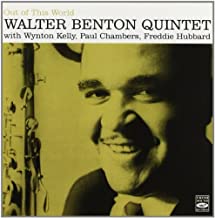
Out Of This World ~ Walter Benton Quintet | By Eddie Carter
Up next from the library is a recent acquisition by a musician I first heard on two Clifford Brown albums, Best Coast Jazz (1955), and Clifford Brown All-Stars (1956). Out of This World (Jazzland JLP 28/928S) is the only album tenor saxophonist Walter Benton recorded as a leader but is brilliant swinging jazz with a stellar cast. Freddie Hubbard (listed as Freddy, tracks: A1, A2, B1, B2) on trumpet, Wynton Kelly on piano, Paul Chambers on bass, Jimmy Cobb (tracks: A2, A3, B2), and Albert Heath (tracks: A1, A4, B1, B3) on drums. Walter began playing the saxophone in high school, he’s also worked with John Anderson, Clifford Brown, Kenny Clarke, Eric Dolphy, Victor Feldman, Slide Hampton, Quincy Jones, Abbey Lincoln, Perez Prado, Max Roach, and Gerald Wilson. My copy used in this report is the 1993 Japanese Stereo reissue (Jazzland VIJJ-30049).
Side One opens with the title song, Out of This World was written in 1944 by Harold Arlen and Johnny Mercer. It grabs hold from the beginning of the collective midtempo melody and doesn’t let go until Freddie’s deceptively easy swing before picking up the pace for a bristling first reading. Walter comes in next exhibiting an optimistic spirit on the next solo, and Wynton works out a few logical ideas on the closer preceding the coda and fadeout. Walter’s Altar is the first of five originals by the leader, and an easy-going blues giving everyone solo space except Cobb who takes over on drums. Benton kicks off the solos leisurely but builds his tone into a delightful interpretation. Hubbard makes a terrific impression on the second solo. Kelly is superbly articulate on the third reading and Chambers takes the bass for some tuneful walking on the final statement ahead of the closing chorus and climax.
Iris is a tender ballad by Benton beginning with a brief intro by Freddie before Walter takes over on the gentle theme. The first of the leader’s two solos is slow, easy, and meaningful possessing a soulful tone. Wynton’s second solo is richly creative, then Walter returns for a few final softly, soothing comments before the close. Night Movement is an uptempo romp by Benton with a brief appearance by Hubbard during the melody, and Heath returning to the drums. The saxophonist gives two brief readings of ferocious intensity with a short speedy statement by Kelly in-between.
Side Two opens with Benton’s A Blue Mood. This tune is a midtempo blues starting with the rhythm section’s brief introduction into the ensemble’s melody. The solo order is Hubbard, Benton, Kelly, Chambers, and each man applies some down-home cooking to each of their solos, making them quite appetizing. Walter’s Azil is fast and swinging, returning the quintet to uptempo speed on the swift-footed melody. Benton begins the solos with a scintillating conversation, then Hubbard comes in for a vigorously energetic reading. Kelly closes with an electrically charged interpretation with Chambers and Cobb supplementing the power into the quintet’s ending.
Lover Man by Jimmy Davis, Roger Ramirez, and James Sherman is a timeless standard from The Great American Songbook. It ends the album with a sensuous performance by the quartet with Heath back behind the drums. Kelly and the trio begin the introduction blossoming into the foursome’s opening chorus. Walter opens with a delicately tasteful first statement. Wynton adds intimate lyricism to the second reading, then Paul performs so warmly you could bask in its glow like a sunbath. Walter wraps up the song with a beautifully phrased chorus into the coda.
Six years after recording this album, Benton retired from music altogether, becoming a real estate agent. He passed away on August 14, 2000, at the age of sixty-nine. Out of The World was originally produced by Orrin Keepnews and engineered by Ray Fowler. Victor Entertainment (formerly Victor Musical Industries) has done an exceptional job with the mastering of the album from the original tapes. The music emerges from your speakers as if the group is playing right in front of your favorite chair. If you’re looking for an excellent Hard-Bop album for your library, and have not heard Walter Benton before, I submit for your consideration, Out of This World by The Walter Benton Quintet. It’s a stellar album of the genre that’s a treat for your ears!
~ Best Coast Jazz (EmArcy MG-36039), Clifford Brown All-Stars (EmArcy MG-36102) – Source: Discogs.com ~ Lover Man – Source: JazzStandards.com ~ Out of This World – Source: Wikipedia.org
More Posts: choice,classic,collectible,collector,history,instrumental,jazz,music

Jazz Poems
ALMOST BLUE
Chet Baker, 1929-1988
If Hart Crane played trumpet
he’d sound like you, your horn’s dark city
miraculous and broken over and over,
scale-shimmered, every harbor-flung hour
and salt-span of cabled longing,
every waterfront, the night-lovers’ rendezvous
This is the entrance
to the city of you, sleep’s hellgate,
and two weeks before the casual relinquishment
of your hold—light needling
on the canal’s gleaming haze
and the buds blaming like horns—
two weeks before the end, Chet,
and you’re playing like anything,
singing stay little valentine
stay
and taking so long there are worlds sinking
between the notes, this exhalation
no longer a voice but a rush of air,
brutal, from the tunnels under the river,
the barges’ late whistles you only hear
when the traffic’s stilled
by snow, a city hushed and
distilled into one rush of breath,
your, into the microphone
and the ear of that girl
in the leopard-print scarf,
one long kiss begun on the highway
and carried on dangerously,
the Thunderbird veering
on the coast road glamor
of a perfectly splayed fender,
dazzling lipstick, a little pearl of junk,
some stretch of road breathless
and traveled into… Whoever she is
she’s the other coast of you,
and just beyond the bridge the city’s
long amalgam of ardor and indifference
is lit like a votive
then blown out. Too many rooms unrented
in this residential hotel,
and you don’t want to know
why they’re making that noise in the hall;
you’re going to wake up in any one of the
how many ten thousand
locations of trouble and longing
going out of business forever everything must go
wake up and start wanting.
It’s so much better when you don’t want:
nothing falls then, nothing lost
but sleep and who wanted that
in the pearl this suspended world is,
in the warm suspension and glaze
of this song everything stays up
almost forever the long
glide sung into the vein,
one note held almost impossibly
almost blue and the lyric takes so long
to open, a little blood
blooming: there’s no love song finer
but how strange the change
from major to minor
everytime
we say goodbye
and you leaning into that warm
haze from the window, Amsterdam,
late afternoon glimmer
a blur of buds
breathing in the lindens
and you let go and why not
MARK DOTY
from Jazz Poems ~ Selected and Edited by Kevin Young
More Posts: book,classic,collectible,history,jazz,library,poet