

Daily Dose Of Jazz…
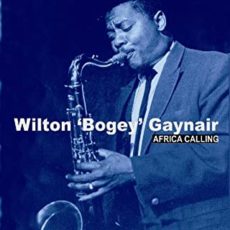
Wilton “Bogey” Gaynair was born on January 11, 1927 in Kingston, Jamaica, Gaynair was raised at Kingston’s Alpha Boys School, where fellow Jamaican musicians Joe Harriott, Harold McNair and Don Drummond were also pupils of a similar age.
Beginning his professional career playing in Kingston’s clubs backing such performers as George Shearing and Carmen McRae, he traveled to Europe in 1955, basing himself in Germany because of the plentiful live work that was offered. Bogey recorded only three times as a bandleader and two of those recordings came during visits to England, 1959’s Blue Bogey and Africa Calling in 1960, on Tempo Records but the latter went unreleased until 2005 due to the label’s demise.
Gaynair returned to Germany shortly after recording these sessions where he remained based for the rest of his life. He concentrated on live performance with such bands as the Kurt Edelhagen Radio Orchestra and played at the opening ceremony of the 1972 Summer Olympics in Munich. He was involved in extensive session work and was a guest artist on Ali Haurand’s Third Eye in 1977 but only recorded one more jazz album under his own name, Alpharian 1982. Among the numerous artists he performed with included Gil Evans, Freddie Hubbard, Shirley Bassey, Manhattan Transfer, Horace Parlan, Bob Brookmeyer, and Mel Lewis.
In September 1983, he suffered a stroke during a concert, and from then until his death, he was unable to play the instrument. Tenor saxophonist Wilton Bogey Gaynair passed away on February 13, 1995 in Cologne, Germany, aged 68.

More Posts: bandleader,composer,history,instrumental,jazz,music,saxophone

Daily Dose Of Jazz…
Carol Stearns Sudhalter was born on January 5, 1943 in Newton, Massachusetts and grew up in a musical family. Her father Albert played the alto saxophone in the New England area, a brother played baritone saxophone and one brother who played trumpet, cornet and wrote award-winning books on jazz.
In the early Sixties, Sudhalter began to play the flute while majoring in biology at Smith College. She continued to study flute with private teachers in Washington DC, New York, Boston, Israel, and Italy until 1978. She studied theory and Third Stream music with Ran Blake and Phil Wilson at the New England Conservatory of Music. From the 1970s on she has been teaching piano, saxophone, and flute privately, at Mannes College, and for the New York Pops Salute to Music Program.
1975 saw Carol deciding to take up the saxophone, and by 1978 relocated from Boston to New York City to join the first all-women Latin band, Latin Fever, produced by Larry Harlow. In 1986 she founded the Astoria Big Band, and she has performed with Sarah McLawler, Etta Jones, Chico Freeman, Jimmy McGriff, Duffy Jackson, and others around the New York jazz clubs, as well as domestic, Italian and British jazz festivals.
She initiated the Jazz Monday concerts at Athens Square Park between 1989 and 2001, along with several other local festivals in Queens where she resides.
A member of the Jazz Journalists Association, Sudhalter also has a chapter in Leslie Gourse’s Madame Jazz and in W. Royal Stokes’ Growing Up With Jazz. In 2012 she was nominated for the 2012 International Down Beat Readers’ Jazz Poll, and was voted 9th place in the category “Best Jazz Flutist”. She has recorded eight albums as a leader, one as a sideman, and the tenor and baritone saxophonist, flutist and pianist Carol Sudhalter continues to perform and educate.

More Posts: bandleader,composer,flute,history,instrumental,jazz,music,piano,saxophone
Daily Dose Of Jazz…
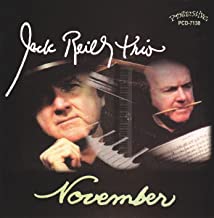
Jack Reilly, also known as Sean Petrahn was born on January 1, 1932, in Staten Island, New York. At age 7, he began classical piano and gave his first recital while still in grammar school. In high school, during his teen years, he formed a jazz band that proved to be pivotal in his choice of jazz as the major musical force in his life.
From 1951 to 1953 he played in a U.S. Navy band while stationed in Puerto Rico and it was there that he met Bill Evans. After military duty, Jack received a four-year scholarship to the Manhattan School of Music majoring in piano and composition. There he met Bill Russo, Phil Woods, Zoot Sims, John Lewis, John LaPorta, and Hall Overton. The year he graduated from MSMJohn LaPorta hired Jack to perform at the Newport Jazz Festival in 1958.
The critics gave high praise for the quartet’s performance and raves for Jack’s playing. During this time he also worked with Warren Covington, George Russell, Lennie Tristano, and Jerry Wald. He moved to California briefly in the mid-1960s to study Indian classical music with Ali Akbar Khan, and returned to Manhattan where he composed the large-scale piece Requiem Mass for Chorus and Jazz Quartet. This work was performed in New York with Sheila Jordan, Jack Six, Norman Marnell, Joe Cocuzzo, and the contemporary chorale with Carol Lian conducting.
In 1967, Jack presented an entire evening of his solo and trio works at Carnegie Recital Hall. His Liturgical Jazz ~ The Psalms, sung by Sheila Jordan was a true synthesis of the blues and classical music. A second choral work, commissioned by the National Endowment for the Arts, was titled The Light of The Soul. The jazz musicians included Jimmy Giuffre~flute and tenor sax, Jack Six~bass, and Joe Cocuzzo~drums.
Reilly served on the faculties of New York University, Berklee College of Music, The Mannes College of Music, and the New School for Social Research. He was chairman of the Department of Jazz Studies at the New England Conservatory of Music as well as the Jazz Program at La Musica A Villa Scarsella in Diano Marina, Italy. He presented lecture/recitals at numerous universities in Europe and in North America including a presentation at the prestigious International Piano Festival and Competition at the University of Maryland.
Pianist Jack Reilly released nine albums during his career and passed away on May 18, 2018, at the age of 86.

More Posts: bandleader,composer,history,instrumental,jazz,music,piano
Three Wishes
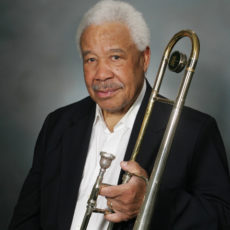
Tom McIntosh had only one wish when asked by Pannonica:- “To be exactly as the Creator wished me to be. Then everything else would have to be alright.”

More Posts: arranger,baroness,composer,conductor,history,instrumental,jazz,music,pannonica,three,trombone,wishes

Requisites
The album by Claus Ogerman and His Orchestra, Watusi Trumpets, was recorded and released in 1965 on the RCA Victor label. All the compositions were arranged, written and conducted by Ogerman, produced by Andy Wiswell and the session engineer was Mickey Crofford. The liner notes were written by Arnold Falleder.
The tracklist includes It’s Not Unusual, Stingray, Watusi Trumpets, El Watusi, Downtown and Right Now on Side A. Along with the B side featuring Harlem Watch, One Step Above, The Joker, Poinciana, La Bamba and Land Of 1,000 Dances. Filled with jazz, rock, soul, lounge and Latin rhythms this is an inspired look at a number of pop, rock, Brazilian and a classic tunes.
Steeped in the music of the Sixties this finger-popping disc may not change your life but just may take you back to those mod years and have you shaking on the dance floor.

More Posts: arranger,choice,classic,collectible,collector,composer,conductor,history,instrumental,jazz,music