

Daily Dose Of Jazz…
Joe Bishop was born November 27, 1907 in Monticello, Arkansas and learned piano, trumpet, and tuba when he was young. He also played flugelhorn and mellophone. He attended Hendrix College and played professionally with the Louisiana Ramblers in 1927, including in Mexico.
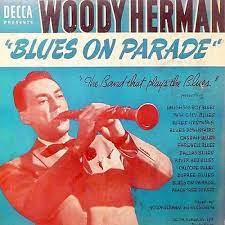
Bishop played with Mart Britt, Al Katz, and Austin Wylie before joining the Isham Jones band for five years. He was a founding member of Woody Herman’s band in the 1930s, but he contracted tuberculosis in 1940 and had to leave the group. He was rehired by Herman as a staff arranger later in the 1940s, and his arrangements and compositions were recorded frequently by Herman, appearing on some 50 of Herman’s albums.
As a performer, Joe played with Cow Cow Davenport and Jimmy Gordon’s Vip Vop Band, but retired from studio work due to his health in the 1950s. Joe quit music and opened a store in Saranac Lake, New York, and later retired to Texas. His compositions include Midnight Blue, Woodchopper’s Ball, and Blue Prelude with Gordon Jenkins.
Tubist, pianist and composer Joe Bishop, whose work has been covered by musicians as diverse as Ten Years After and Lawrence Welk, transitioned on May 12, 1976.

More Posts: composer,history,instrumental,jazz,music,piano,tuba
Daily Dose Of Jazz…
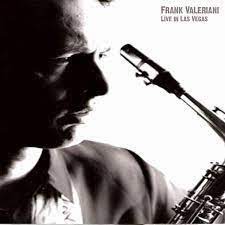
Frank J. Valeriani was born in Newark, New Jersey on November 26, 1966. He started studying saxophone at age of 15. When his family moved to Italy he put together his first mediterranean blues oriented band. While living in Italy he graduated magna cum laude from the music conservatory in Naples. After the conservatory years he started several bands, including jazz, fusion and latin jazz, and peformed at several festivals before moving north to Milano, Italy.
In Milano He studied songwriting, arranging and jazz at the alternative contemporary music school, Professional Music Center, graduating with excellent scores. During his Italian years he performed with Wess, Rocky Roberts, Cristiano Malgioglio, Peppino Gagliardi, Nello Daniele and others. He was music coordinator and conductor of the folk show Quanno Tramonta ‘o Sole that toured all over Italy for several years. He also toured with Maestro Gianni Mazza and performed on Italian tv networks.
Deciding to move back to the states he chose Las Vegas, Nevada for its musical activity. He performed with some of the best musicians in town, such as The Platters, The Drifters, jazz singers Nancy Kelly and Tony Bennett. Frank also performs with the Frank Valeriani Band all over the town.
He plays jazz, smooth jazz, and pop, doubles on percussion, rhythm guitar & keyboards and enjoys back up singing when required. As an educator he teaches saxophone and harmony in music schools. Saxophonist Frank Valeriani is also a composer and arranger and continues to perform and teach.
More Posts: arranger,bandleader,composer,history,instrumental,jazz,music,saxophone
Daily Dose Of Jazz…
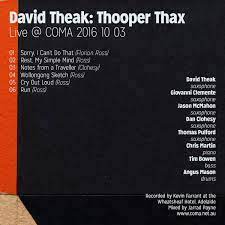
David Theak was born on November 10, 1970 in Sydney, New South Wales, Australia and was raised in a house of impromptu parties. His childhood found him listening to his downstairs neighbor teaching piano every afternoon which led to lessons and a piano for Christmas. His bandmistress at Mona Vale PS introduced him to the saxophone but paid his dues on the baritone horn for a couple of years. After a brief stint at the Conservatorium High School, he returned to the local high school with some enthusiastic music teachers. They encouraged us to improvise and created opportunities for us to play in jazz and rock bands.
he following years saw David practicing, composing, gigging, releasing his own albums and organizing tours of Australia & Europe for his quartet, theak-tet, but with limited opportunities in the 90’s, he became involved with a musician led organization, the Jazzgroove Association, which received NSW and Federal government funding that allowed presentation of new music every week as well as create a record label and form an original creative jazz orchestra, The Jazzgroove Mothership Orchestra.
He went on to become involved with SIMA, WAYJO and the formation of the Australian National Jazz Orchestra and ANJO Youth Big Band. David has been running a boutique international jazz festival for the past five years, is currently a Senior Lecturer in Jazz at the Sydney Conservatorium of Music, Artistic Director of the Australian National Jazz Orchestra, an advisory panel member of the Western Australian Youth Jazz Orchestra, President of the Sydney Improvised Music Association and Artistic Director of the Sydney Con Jazz Festival.
Jazz saxophonist, composer, bandleader, educator, festival director and jazz protagonist, David Theak, who continues to compose, perform and tour, is the artistic director of the Jazzgroove Mothership Orchestra and collaborates with a who’s who of international jazz musicians.
More Posts: bandleader,composer,educator,history,instrumental,jazz,music,saxophone
Daily Dose OF Jazz…
Mark Kramer was born November 3, 1945 in Philadelphia, Pennsylvania. His prelimonary tutelage came from members of the Philadelphia Orchestra who mentored him on violin from the age of five. His early jazz performances in his teens and twenties included Michael and Randy Brecker, Charles Fambrough, Stanley Clarke, and Eric Gravatt.
Over the next decades his trio went on to record a series of specialty productions including the largest known body of jazz renditions of complete Broadway shows, jazz versions of principal themes from the John Williams score of Harry Potter and the Sorcerer’s Stone, and a compilation of jazz renditions of the music of The Rolling Stones.
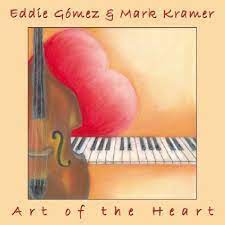
Kramer has mainly been an arranger and leader of his own trios throughout his career. His numerous recordings/productions are often listed under The Mark Kramer Trio. Many works from the late Eighties with bassist Eddie Gómez are listed under Eddie Gómez and Mark Kramer or simply Eddie Gómez.
A far-ranging catalog of duo and trio recordings included the Art of the Heart on Art of Life Records. Pianist, composer, arranger, and producer/engineer Mark Kramer continues to pursue his creativity in music.
More Posts: arranger,bandleader,composer,engineer,history,instrumental,jazz,music,piano,producer
Daily Dose Of Jazz…
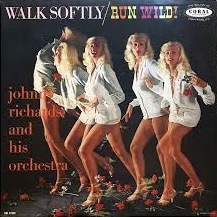
Johnny Richards was born Juan Manuel Cascales on November 2, 1911 in Toluca, Mexico to a Spanish father and a Mexican mother. He came to the United States in 1919 through Laredo, Texas along with his mother, three brothers and a sister. The family first lived in Los Angeles, California and then in San Fernando, California, where he and two brothers attended and graduated from San Fernando High School.
1930 saw Richards living in Fullerton, California where he attended Fullerton College. Working in Los Angeles from the late 1930s to 1952, before moving to New York City. He had been arranging for Stan Kenton since 1950 and continued to do so through the mid-1960s. He also arranged for Charlie Barnet and Harry James.
He led his own bands throughout his career and composed the music for the popular song Young at Heart in 1953. The song was made famous by Frank Sinatra and was covered by numerous others.
Arranger and composer Johnny Richards transitioned on October 7, 1968 in New York City of a brain tumor.
More Posts: arranger,bandleader,composer,history,instrumental,jazz,music