

Daily Dose Of Jazz…
Jan Leder was born in Queens, New York on May 20, 1944 and showed musical talent from an early age, tapping out melodies on the family piano at the age of three. Quickly surpassing her older siblings, at the age of five, she began six years of piano lessons with her classically trained mother. It was not until junior high school that she first picked up the flute. Formally she studied classical flute but in her free time, she taught herself to improvise rock & roll and pop/R&B tunes alongside local guitarists in New York’s Central Park.
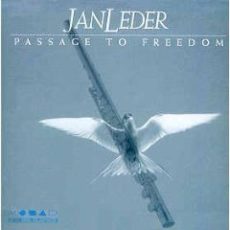
At 17 years old Leder began studying with jazz pianist Lennie Tristano, with whom she continued until his death in 1978. Although crediting Tristano with helping her come into her own as a musician, real recognition and commercial success eluded her until the late 1990s. Her first big break came when Buddy Scott and colleagues from Monad records heard her playing in 1994 at The Dockside in Tarrytown, New York. Her tape of a live date with Art Lillard and others at the Five Spot in New York so impressed Scott, that he signed her to a Monad Records contract and released the live recording intact as the CD Passage to Freedom.
Unfortunately, Passage to Freedom, which includes some really nice work by drummer Lillard, pianist Jon Davis, bassist Yosuke Inoue, and guitarist Mark McCarron, was released just as Monad Records met its demise, leaving Leder’s debut effort largely unavailable and unnoticed for close to two years. In 1998 and 1999, exposure via the internet brought her to the attention of a wider audience and earned her very favorable reviews for Passage to Freedom.
1998 saw A-Records vocalist Diane Hubka recorded Leder’s original composition “Thinking of You” on her own debut CD, Haven’t We Met, which was nominated for a Jazz Award in the Best Debut CD category. Her contribution to Hubka’s CD ultimately led to her signing a recording contract with A-Records, a division of the Dutch label, Challenge Records. The following year she released her second CD, Nonchalant, on which she added the talents of bassist Sean Smith, percussionist Daniel Moreno, and vocalists Angela DeNiro, Mary Foster Conklin, and Cleve Douglass to the already strong instrumental talents of Passage to Freedom collaborators Lillard, McCarron, and Davis. Flutist Jan Leder continues to perform and record.

More Posts: bandleader,composer,flute,history,instrumental,jazz,music
Daily Dose Of Jazz…
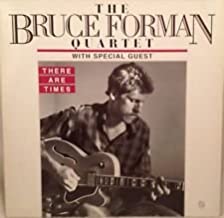
Bruce Forman was born in Springfield, Massachusetts on May 14, 1956 and first took piano lessons at an early age before picking up the guitar at age thirteen. In 1971, his family moved to San Francisco, California where he led his own groups in the area and performed with local jazz musicians, such as Eddie Duran, Vince Lateano, and Eddie Marshall.
He would go on to perform and record with nationally renowned musicians, such as Ray Brown, George Cables, Joe Henderson, Freddie Hubbard, Bobby Hutcherson, and Woody Shaw.
He performed regularly at the Monterey Jazz Festival and played with Richie Cole from 1978 to 1982. Bruce recorded his first of sixteen albums to date, Coast To Coast, in 1981. His most successful album as a leader was 1992’s Forman on the Job, which hit #14 on the U.S. Billboard Top Jazz Albums chart.
As a sideman he has recorded with Richie Cole, Clint Eastwood, Dan Hicks, Roger Kellaway, Mark Murphy, Charlie Shoemake, Lanny Morgan, Tom Harrell, Rare Silk, Dave Eshelman, Lorez Alexandria, Geoff Muldaur, Les DeMerle, Tony Monaco, Molly Ringwald, Chuck Deardorf. Guitarist Bruce Forman continues to perform, record and tour.
More Posts: bandleader,composer,guitar,history,instrumental,jazz,music
Daily Dose Of Jazz…
Diego Maroto was born on May 9, 1968 in Mexico City, Mexico. He started taking private lessons in 1985 from Larry Roussell and Alfonso Martinez. He enrolled in the Universidad Iberoamericana in 1987 and the following year joined a jazz workshop at Escuela Superior de Musica where he learned improvisation, arrangement, and composition. He went on to continue private lesson and became an active member of the IAJE, participating in several workshops.
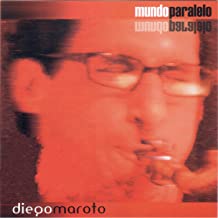
2004 saw Diego putting together a sextet and recording his first album as a leader titled Mundo Paralelo and later in the year shared the stage with Antonio Sanchez at Dizzy’s Club at Lincoln Center. The following year he formed a trio with Gabriel Puentes on drums and Jorge Luri Molina on upright bass and spent the next couple of years performing at festivals, clubs, and paying tribute to Mexican jazz musicians.
As an educator, Maroto has been giving lessons, clinics, and seminars at including Tonica in Guadalajara, Jal alongside saxophonist Donny McCaslin. He is currently in post-production on his soon to be released album Diego Maroto Band Live at the Black Horse.
More Posts: bandleader,composer,history,instrumental,jazz,music,saxophone

Daily Dose Of Jazz…
Krzysztof Komeda was born Krzysztof Trzciński on April 27, 1931 in Poznań, Poland and grew up in Częstochowa and Ostrów Wielkopolski. He took music lessons from early childhood and became a member of the Poznań conservatorium at the age of eight, but World War II thwarted his plans. He explored the theory of music, and learned to play piano during this period.
While attending the Liceum for Boys, where he graduated from in 1950, he participated in the Music and Poetry Club. After high school he entered the Medical Academy in Poznań to study medicine. He finished his six-year-long studies and obtained a medical doctor diploma in 1956. He chose to specialize as a head and neck surgeon.
Komeda was interested in light and dance music and met Witold Kujawski, a graduate of the same school and already a well-known swinging bass player. He introduced him to jazz and took him to Kraków where the romantic period of Polish jazz, called the catacombs, was in the spotlight. Jam sessions with famous musicians as Matuszkiewicz, Borowiec, Walasek, and Kujawski took place in Witold’s legendary small apartment in Kraków.
Fascinated with be-bop performed by Andrzej Trzaskowski, his fascination with jazz and the friendship with famous musicians strengthened his connections with the music. He worked for some time with the first, postwar, pioneer Polish jazz band called Melomani. Later, he played with various pop groups, a Dixieland band before turning his attention to modern jazz and the creation of the Komeda Sextet.
Trzciński used the stage name ‘Komeda’ for the first time to protect his medical profession from the scutiny of those of Polish society who regarded jazz as a cheap suspicious music of night clubs. The sextet became the first Polish jazz group playing modern jazz, and its pioneering performances opened the way for jazz in Poland. He played jazz that related to European traditions and which was the synthesis of the two most popular groups at that time: The Modern Jazz Quartet and the Gerry Mulligan Quartet.
He would go on to tour Moscow, Grenoble, Paris, Copenhagen, Stockholm, Prague, Blend, Koenigsberg, Bulgaria and both West and East Germany. He was a part of a show called Jazz and Poetry, began scoring films and overall, Komeda composed more than 70 soundtracks. While staying in Los Angeles, California in 1968 he composed the film music for Roman Polanski’s Rosemary’s Baby and Kulik’s The Riot.
In 1968, in Los Angeles, while having a friendly rough-and-tumble with writer Marek Hłasko he was pushed over an escarpment and suffered a haematoma of the brain. Medical treatment in the US hospital did not save his life. After being transported home to Poland in a coma and in a terminal state. Pianst Krzysztof Komeda, who is credited with creating an original style, often described as the Polish school of jazz, hung on until passing away on April 23, 1969 at the age of 37.

More Posts: bandleader,composer,history,instrumental,jazz,music,piano
Daily Dose Of Jazz…
Lou Stein was born on April 22, 1922 in Philadelphia, Pennsylvania. By 1942 he had joined Ray McKinley’s band in 1942. While serving military service he played with Glenn Miller’s Army Airforce Band stateside during World War II but never went overseas.
After the war, he worked with Charlie Ventura in 1946 and 1947 and became a session musician. Lou performed with the Lawson-Haggart Band, Benny Goodman, Sarah Vaughan, the Sauter-Finegan Orchestra, Louie Bellson, Red Allen, Coleman Hawkins, and Lester Young.
Recording as a bandleader, in 1957 Stein had a U.S. Top 40 hit with Almost Paradise, which peaked at No. 31 on the Billboard Hot 100. His cover version of Got a Match made the Cashbox Top 60 in 1958. His most famous composition was East of Suez.
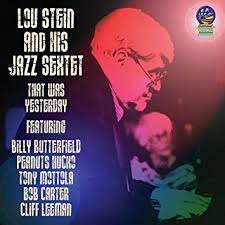
He played with Joe Venuti and Flip Phillips from 1969 to 1972. From 1954 to 1994 he recorded sixteen albums as a leader and through the Fifties, he recorded with Louis Bellson, Woody Herman, Lee Konitz, Joe Newman, Charlie Parker, Cootie Williams. Pianist and composer Lou Stein, who was comfortable in swing, bop, Dixieland, and commercial settings, passed away on December 11, 2002.
More Posts: bandleader,composer,history,instrumental,jazz,music,piano