

Daily Dose Of Jazz…
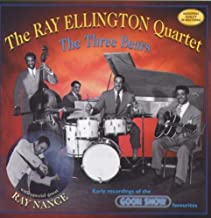
Ray Ellington was born Henry Pitts Brown on March 17, 1916 in Kennington, London, England, the youngest of four children of a Black father and Russian Jew mother. His father died when he was four years old, and was raised as a strictly Orthodox Jew, attending the South London Jewish School before entering show business at the age of twelve, when he appeared in an acting role on the London stage.
Ellington’s first break came in 1937 when he joined Harry Roy and His Orchestra as the band’s drummer, replacing Joe Daniels. His vocal talents were put to good use, from the time of his first session when he recorded Swing for Sale. Called up in 1940 he joined the Royal Air Force as a physical training instructor where he served throughout the war. He played in various service bands including RAF Blue Eagles.
Post military service, Ray resumed his career, fronting his own group, playing at The Bag O’Nails club. By early in 1947, he rejoined the Harry Roy band for a few months, later forming The Ray Ellington Quartet the same year. Specializing in jazz, he experimented with many other genres throughout the show’s history and his musical style was heavily influenced by the comedic jump blues of Louis Jordan.
His band was one of the first in the UK to feature the stripped-back guitar/bass/drums/piano format that became the basis of rock and roll. His band was also one of the first groups in Britain to prominently feature the electric guitar and use an amplified guitar produced and introduced by their guitar player, Lauderic Caton.
Drummer, singer, bandleader Ray Ellington, best known for his appearances on The Goon Show from 1951 to 1960, passed away of cancer on February 27, 1985.

More Posts: bandleader,drums,history,instrumental,jazz,music,vocal
Daily Dose Of Jazz…
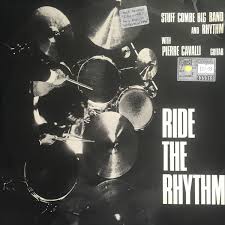
Stuff Combe was born Etienne Stephen Jean Gustave Combe in Bern, Switzerland on March 12, 1924 and initially pursued schooling in art during World War II, but ultimately decided on a career in music instead.
During the 1940s Combe played in Switzerland in the 1940s with Philippe Brun, Eddie Brunner, Ernst Hollerhagen, and Hazy Osterwald. In the 1950s he traveled extensively throughout Europe and played frequently with visiting American musicians. Near the end of the decade he recorded with Paul Kuhn and Fats Sadi. In 1957 he began playing with Kurt Edelhagen, an association that would continue into the mid-1960s.
Stuff formed his own large ensemble in Geneva, Switzerland in 1966, and the following year worked with the Radio Suisse Romande jazz band. He was Lucky Thompson’s drummer during Thompson’s 1969 Swiss tour. In the 1970s he worked with Francy Boland and Benny Bailey, and played in the western United States with Groupe Instrumental Romand.
Drummer Stuff Combe, who wrote a treatise on percussion improvisation, passed away on December 27, 1986 in Morges, Switzerland.
More Posts: bandleader,drums,history,instrumental,jazz,music
Daily Dose Of Jazz…
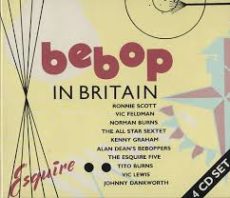
Norman Burns was born in London, England on March 11, 1920. Closely associated with the pianist George Shearing, together they worked the West End nightclub circuit in the mid 1940s, before Shearing made his fame and fortune in the USA.
Though he recorded with Alan Dean Beboppers and others in 1948, he never was a bop musician. He was a regular figure on the modern jazz scene and from 1951, he led a quintet whose format and repertoire were based on the successful George Shearing Quintet formula. From the time of their first gig they were an instant hit and for two and a half years the quintet toured the UK jazz venues with great success. They added vocalists Eileen Draper and Johnny Green in 1954 but the group disbanded in 1955.
Esquire decided to record the quintet in 1952 by which time a number of personnel changes had taken place. Victor Feldman, the highest profile jazz musician working with the group had left prior to the recordings. A later move to Australia, saw drummer Norman Burns residing for many years until he passed away in June 1994.
More Posts: bandleader,drums,history,instrumental,jazz,music
Daily Dose Of Jazz…
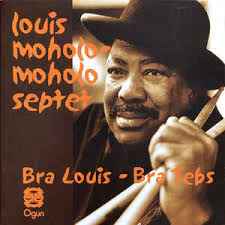
Louis Tebogo Moholo was born on March 10, 1940 in Cape Town, South Africa. He formed The Blue Notes with Chris McGregor, Johnny Dyani, Nikele Moyake, Mongezi Feza and Dudu Pukwana, and at the age of twenty-four, emigrated to Europe with them. He eventually settled in London, England where he formed part of a South African exile community that made an important contribution to British jazz.
In 1966, he toured Buenos Aires, Argentina, where he performed at the Theatron with Steve Lacy, Johnny Dyani and Enrico Rava and recorded the album The Forest and the Zoo with the same musicians. During the 1970s he was a member of the Brotherhood of Breath, a big band comprising several South African exiles and leading musicians of the British free jazz scene in the 1970s. He is the founder of Viva la Black and The Dedication Orchestra.
His first album under his own name, Spirits Rejoice on Ogun Records, is considered a classic example of the combination of British and South African players. In the early 1970s, Moholo was also a member of the afro-rock band Assagai.
He has played with, among others, Derek Bailey, Steve Lacy, Evan Parker, Enrico Rava, Roswell Rudd, Irène Schweizer, Cecil Taylor, John Tchicai, Archie Shepp, Peter Brötzmann, Mike Osborne, Keith Tippett, Elton Dean and Harry Miller.
Moholo returned to South Africa in September 2005, performing with George Lewis at the UNYAZI Festival of Electronic Music in Johannesburg, South Africa. Now going by the name Louis Moholo-Moholo because the name is more ethnically authentic, the drummer continues to perform and record.
More Posts: bandleader,drums,instrumental,jazz,jistory,music
Daily Dose Of Jazz…
Irving “Irv” Cottler was born February 13, 1918 in Brooklyn, New York. He would become a sometime member of Los Angeles, California based The Wrecking Crew, who recorded with Nat King Cole, Louis Armstrong, Bing Crosby, Dinah Shore, Ella Fitzgerald, and many others.
Best known as the drummer for Frank Sinatra, with whom he worked for over 30 years beginning in 1955, Irv’s first recording session with Sinatra was in October 1955 on ‘Love Is Here To Stay’ and he played on many of the remaining Songs For Swingin’ Lovers tracks, alternating with Alvin Stoller.
From 1956 on, Irv was Sinatra’s preferred drummer and played a world tour with Sinatra during 1962, as well as on his many TV recordings. He also performed for twelve years with The Dinah Shore Show house band.
Drummer Irv Cottler passed away of a heart attack on August 8, 1989 in Templeton, California at the age of 71.

More Posts: drums,history,instrumental,jazz,music