

The Jazz Voyager
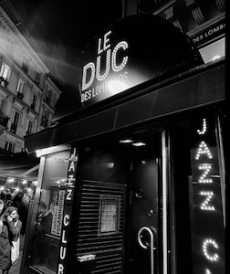
From Italy to the Czech Republic to France is a journey that has led this Jazz Voyager to the long-running jazz club Le Duc des Lombards where American pianist Bobby Few opened the venue, then called the Bar de l’Etoile. With an upright piano under the stairs they have been hosting diverse artists for nearly 40 years.
The venue has been the essential club in Paris offering an intimate setting with drinks & nibbles. Decorated by the American designer Elliot Barnes, the club has become the Parisian reference for jazz clubs. Performances are Monday to Saturday and its free entry Jams every Friday and Saturday beginning at 11:30 p.m.
This week I will be in the 10:00pm audience to partake of the talents of drummer and vocalist Roni Kaspi and her trio with Oxy on Keyboards & synthesizer and bassist Noé Berne. Later that night the jam session commences where musicians, young and old come to improvise, explore and learn.
Located at 42, rue des lombards 75001 Paris, more information can be attained by calling 01.42.33.22.88.

More Posts: adventure,album,club,drums,festival,genius,jazz,museum,music,preserving,restaurant,travel
Daily Dose Of Jazz…
Joseph “Kaiser” Marshall was born on June 11, 1902 in Savannah, Georgia and was raised in Boston, Massachusetts. There he studied under George L. Stone, and played with Charlie Dixon before moving to New York City, New York in the early 1920s. After playing with violinist Shrimp Jones, he joined Fletcher Henderson’s band at the Club Alabam, remaining in Henderson’s retinue from 1922 until 1929.
He played with many noted jazz artists in the 1930s and 1940s, including Duke Ellington, Cab Calloway, Art Hodes, Wild Bill Davison, Sidney Bechet, Bunk Johnson, and Mezz Mezzrow. He also recorded with Louis Armstrong in the late 1920s, being the drummer on Armstrong’s 1929 recording of Knockin’ a Jug.
Between 1928-1930, he recorded with Benny Carter, Fats Waller and Coleman Hawkins in McKinney’s Cotton Pickers. Shortly after Kaiser recorded with the Four Bales of Hay, featuring Wingy Manone, Dickie Wells, Artie Shaw, Bud Freeman, Frank Victor, John Kirby and either Teddy Wilson or Jelly Roll Morton.
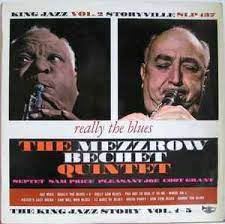
He went on to record as a member of the Mezzrow-Bechet Quintet featuring Sidney Bechet, Mezzrow, Fitz Weston, and Pops Foster. Drummer Kaiser Marshall transitioned on January 2, 1948 in New York City, New York.

More Posts: drums,history,instrumental,jazz,music
Daily Dose Of Jazz…
Michael Stephans was born in Miami, Florida on June 9, 1945. He has performed and recorded with artists including Dave Liebman, Bennie Maupin, Joe Lovano, Bob Brookmeyer, Don Menza, and Alan Broadbent.
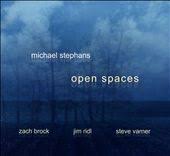
Stephans’ first solo recording, Om ShalOM, was critically lauded in 2007 by UK critic Tom Barlow as an album of the year in the December 2007 – January 2008 issue of Jazzwise.
He has received multiple composition grants from the National Endowment for the Arts. In 1974, this association afforded him the opportunity to write the large ensemble composition Shapes and Visions for vibraphonist Karl Berger, which was performed at the Smithsonian Museum of Natural History in Washington, D.C.
In his role as a poet Michael has been published in The Note and Inscape, and received the Rachael Sherwood Poetry Prize by the English department at Cal State Northridge. He is the author of Experiencing Jazz: A Listener’s Companion, and Experiencing Ornette Coleman: A Listener’s Companion.
He is a professor who has taught at Pasadena City College, the University of Miami, and Bloomsburg University of Pennsylvania. Drummer Michael Stephans continues to pursue his career in jazz.
More Posts: bandleader,drums,educator,history,instrumental,jazz,music,poet,writer

JAN KORINEK TRIO
During the two and a half hour cruise I will be dining on salmon and potato gratin with apple strudel topped with ice and whipped creams for dessert while listening and enjoying three sets of music with bassist Jan Kořinek and his trio.
The cover is 38€ and dinner will run 25€. Boarding begins at 8:00pm, departure at 8:30pm, return at 11:00pm. More
More Posts: adventure,album,bass,club,drums,festival,genius,jazz,keys,museum,music,preserving,restaurant,travel
Daily Dose Of Jazz…
Ronnie Bedford was born in Bridgeport, Connecticut on June 2, 1931. He started early on the drums, taking lessons from Fred Albright of the NBC Orchestra when he was ten. Later he started listening to radio airchecks of the great big bands on the radio which, among other things, resulted in Gene Krupa becoming his idol. Although he was already in jazz, the defining moment when he fully committed to the jazz life came in 1970 while he was with the Morris Nanton Trio.
He went on to perform with Broadway shows, big bands, small groups, TV, and the recording studio. A very short list of those he has sat in at drums are Hank Jones, Sylvia Sims, Arnett Cobb, Benny Carter, Walter Norris, and Bill Watrous. The drummer has also performed at key jazz festivals and major concert halls including the Newport Jazz Festival, Royal Albert Hall in London and New York’s Avery Fisher Hall, both with Benny Goodman, and the Smithsonian Museum with Benny Carter.
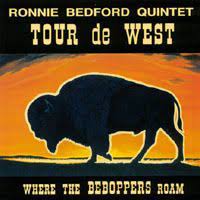
In 1993 he released a self-published album titled Tour de West. He later produced three more albums before the turn of the century on the Progressive Records label. As a sideman he recorded with Carter, Cobb, Jones, Chris Connor, Buddy DeFranco, Don Friedman, Rod Levitt, Pee Wee Russell, Derek Smith and Chuck Wayne.
He was one of the founders of the Yellowstone Jazz Festival held annually in Cody, Wyoming, and was the recipient of the 1993 Wyoming Governor’s Award for the Arts. Living in Powell, Wyoming he taught percussion at Northwest College. Drummer and professor Ronnie Bedford transitioned on December 20, 2014.
More Posts: bandleader,drums,educator,history,instrumental,jazz,music