

Daily Dose Of Jazz…
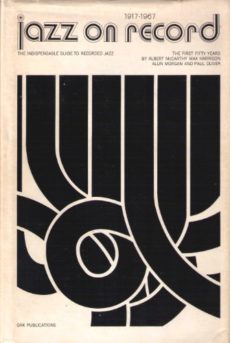
Alun Morgan was born on February 24, 1928 in Pontypridd, Wales and became interested in jazz as a teenager during World War II. Charlie Parker was a significant influence on him in the late 1940s.
Morgan began to write on jazz from the early 1950 for Melody Maker, Jazz Journal, Jazz Monthly and Gramophone, and for 20 years from 1969 a weekly jazz column in a local Kent newspaper.
Over his writing career he completed liner notes for over 2,500 albums, initially for Vogue Records. From 1954 he contributed to music programs for BBC Radio. Morgan was the author of a book on modern jazz in England and the co-author of several books on jazz records. They were Jazz On Record: A Critical Guide, Jazz On Record: A Critical Guide To The First 50 years, Modern Jazz-The Essential Records, Modern Jazz – A Survey Of Developments Since 1939, Count Basie, and The Gramophone Jazz Good CD Guide.
He lectured on jazz at the Guildhall School of Music and Drama and the Royal Academy of Music in London, England. Additionally, he was a full-time architect until 1991.
Shortly after retiring from his other occupation, he emigrated to Australia to live out his life. Author and critic Alun Morgan transitioned on November 11, 2018.

Daily Dose Of Jazz…
Harold “Money” Johnson was born in Tyler, Texas on February 23, 1918 and didn’t start playing trumpet until he was fifteen. Moving to Oklahoma City, Oklahoma in 1936, he jammed with Charlie Christian and Henry Bridges before joining Nat Towles’s band.
He played with Horace Henderson and Bob Dorsey before returning to Towles’s band in 1944 in Chicago, Illinois. He also played with Count Basie, Cootie Williams, Lucky Millinder, and Bull Moose Jackson during the decade.
In the 1950s Money’s associations included Louis Jordan, Lucky Thompson, Sy Oliver, Buddy Johnson, Cozy Cole, Mercer Ellington, Little Esther, and Panama Francis.
The Sixties saw Johnson played in the house band at the Apollo Theater in Harlem, and recorded with King Curtis in 1962. He toured the USSR with Earl Hines in 1966. From 1968 he played in the Duke Ellington Orchestra and also worked again with Hines and Oliver.
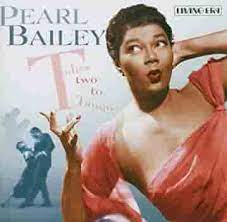
He recorded with Buck Clayton, Pearl Bailey, Red Prysock, Barbara Lews, Jack McDuff, Houston Person, and Jesse Stone. Trumpeter Money Johnson, whose last performance was on the night before, transitioned from a heart attack on March 28, 1978 in New York City.
More Posts: history,instrumental,jazz,music,trumpet
Three Wishes
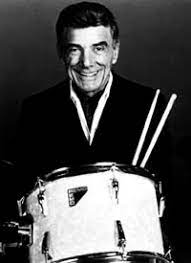
Louis Bellson was talking with Nica and during the conversation she asked him what three wishes he would ask for if they could be given and this was his answer:
-
-
“That jazz music would become an integral part of all music. And I hope that the American people would consider it a part of American creative art. Because I feel that its music potential has a place alongside all other great music of the world. And also it should be respected and the musicians should be respected too, because I feel in the future there is going to be a greater tie~in with symphony music.”
-
“I hope that all the young fine musicians today who are interested in jazz as a creative art have the opportunity to express themselves. By this I mean there are no clubs or places where the youngster can gain knowledge and learn his craft. It is shameful to know that there are many gigantic industries in every other form, but our creative form suffers the most.”
-
“I am hoping that music will mend the entire world. It has been proven that our relations with other countries has been one hundred percent pure in friendship because of music. I feel that music will blossom into a flower, and that flower will express one great thought, and that is: We belong to the human race and we all learn the same notes.”
-
*Excerpt from Three Wishes: An Intimate Look at Jazz Greats ~ Compiled and Photographed by Pannonica de Koenigswarter
More Posts: baroness,drums,history,instrumental,jazz,music,pannonica,three,wishes
Daily Dose Of Jazz…
James Reese Europe was born on February 22, 1881 in Mobile, Alabama and in 1891 his family moved to Washington, D.C. In 1904 he moved to New York City and six years later he organized the Clef Club, a society for Black Americans in the music industry. In 1912, the club, with its 125 members who played in various configurations, made history when they became the first band to play a proto-jazza concert at Carnegie Hall for the benefit of the Colored Music Settlement School.
The importance of this historic concert is that it took place 12 years before the Paul Whiteman and George Gershwin concert at Aeolian Hall, and 26 years before Benny Goodman’s famed concert at Carnegie. The Clef Club’s performances played music written solely by Black composers, including Harry T. Burleigh and Samuel Coleridge-Taylor.
In 1913 and 1914 Jim made a series of phonograph records for the Victor Talking Machine Company. These recordings are some of the best examples of the pre-jazz hot ragtime style of the U.S. Northeast of the 1910s, predating and protecting the idea that the Original Dixieland Jass Band recorded the first jazz pieces in 1917 for Victor.
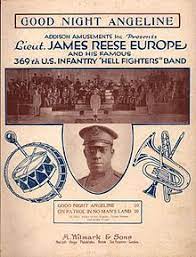
Europe was known for his outspoken personality and unwillingness to bend to musical conventions, particularly in his insistence on playing his own style of music. During World War I, Europe obtained a commission in the New York Army National Guard, where he fought as a lieutenant with the 369th Infantry Regiment otherwise known as the “Harlem Hellfighters” when it was assigned to the French Army. He went on to direct the regimental band to great acclaim. They made their first recordings in France for the Pathé Brothers.
Returning home in 1919 he made more records for Pathé with Noble Sissle and continued to lead his band. During a talk backstage with two of his drummers, Steve and Herbert Wright about their stage behavior, Herbert got agitated and stabbed Europe in the neck with a pen knife. The show went on, Jim went to the hospital but doctors were unable to stem the flow of blood.
Arranger, composer and bandleader Jim Europe, who also played piano and violin, and was the leading ragtime and early jazz figure on the Negro music scene of New York City in the 1910s, transitioned on May 9, 1919.
More Posts: arranger,bandleader,composer,history,instrumental,jazz,music,piano,violin
Daily Dose Of Jazz…
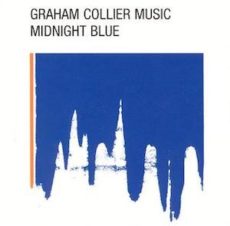
James Graham Collier OBE was born on February 21, 1937 in Tynemouth, Northumberland, England. After leaving school he joined the British Army as a musician, spending three years in Hong Kong, China. He subsequently won a Down Beat magazine scholarship to the Berklee School of Music, in Boston, Massachusetts studying with Herb Pomeroy.
After graduating in 1963 he returned to Britain and founded the first version of an ensemble devoted to his own compositions, Graham Collier Music, which included Kenny Wheeler, Harry Beckett and John Surman. Later configurations included Karl Jenkins, Mike Gibbs, Art Themen and many other notable musicians.
As the first recipient of an Arts Council bursary for jazz, Graham was commissioned by festivals, groups and broadcasters across Europe, North America, Australia and the Far East. He recorded nineteen albums, worked on stage plays, musicals, documentary and fiction film, and radio drama productions.
Collier was an author and educator, writing seven books on jazz, giving lectures and workshops around the world. He launched the jazz degree course at London’s Royal Academy of Music and was its artistic director until he resigned in 1999, so he could concentrate on his own music.
Bassist, composer and bandleader Graham Collier, who along with a group of jazz educators formed the International Association of Schools of Jazz, transitioned from heart failure on September 9, 2011.
More Posts: bandleader,bass,composer,history,instrumental,jazz,music