

Daily Dose Of Jazz…
Ernest “Bass” Hill was born on March 14, 1900, Pittsburgh, Pennsylvania. He played from 1924 with Claude Hopkins, and remained with him on a tour of Europe with Josephine Baker the following year. He collaborated with Hopkins numerous times over the next few years and again in the 1940s. In 1928 he played with Leroy Smith & His Orchestra and Bill Brown & His Brownies, and the following year worked in the Eugene Kennedy Orchestra.
The 1930s saw Bass playing with Willie Bryant, Bobby Martin’s Cotton Club Serenaders, Benny Carter, Chick Webb, and Rex Stewart. He was in Europe late in the decade when World War II broke out and he fled to Switzerland. There he played with Mac Strittmacher before returning to the United States in 1940.
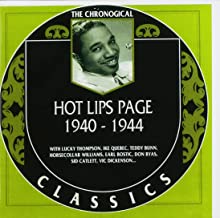
In that year, he recorded with violinist Eddie South and trumpeter Hot Lips Page. Following this, he played with Maurice Hubbard, Hopkins again, Zutty Singleton, Louis Armstrong, Cliff Jackson, Herbie Cowens, and Minto Kato throughout the decade. In 1949 he returned to Europe, where he played in Switzerland and Italy with Bill Coleman and then in Germany with Big Boy Goudie until 1952.
Upon his return to the States he worked in New York City with Happy Caldwell, Henry Morrison, and Wesley Fagan. Double bassist Ernest “Bass” Hill, who worked in the musicians’ union in the last decade of his life, passed away on September 16, 1964 in New York City.

More Posts: bass,history,instrumental,jazz,music
Daily Dose Of Jazz…
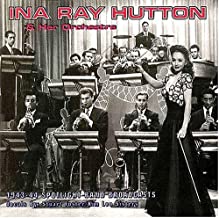
Ina Ray Hutton was born Odessa Cowan on March 13, 1916 in Chicago, Illinois into a family whose mother was a pianist. She began dancing and singing on stage professionally at the age of eight. By 15, she starred in the Gus Edwards revue Future Stars Troupe at the Palace Theater, and Lew Leslie’s Clowns in Clover. On Broadway she performed in George White’s revues Melody, Never Had an Education and Scandals, before joining the Ziegfeld Follies.
1934 saw her being approached by Irving Mills and vaudeville agent Alex Hyde to lead an all-girl orchestra, the Melodears. As part of the group’s formation, Mills asked Odessa to change her name. The group included trumpeter Frances Klein, Canadian pianist Ruth Lowe Sandler, saxophonist Jane Cullum, guitarist Marian Gange, trumpeter Mardell “Owen” Winstead, and trombonist Alyse Wells.
The Melodears appeared in short films and in the movie Big Broadcast of 1936. They recorded six songs, sung by Hutton, before disbanding in 1939. Soon after, she started the Ina Ray Hutton Orchestra (with men only) that included George Paxton and Hal Schaefer. The band appeared in the film Ever Since Venus in 1944, recorded for Elite and Okeh, and performed on the radio. After this band broke up, she started another male band a couple years later. During the 1950s, Hutton again led a female big band that played on television and starred on The Ina Ray Hutton Show.
Although she and some members of her family are known to have been white, historians have theorized that she and her family were of mixed white and African-American ancestry. In 1920, Hutton herself was listed in the US Census as “mulatto” and in 1930 as “negro”. Hutton was also mentioned under her original name in the black Chicago newspaper The Chicago Defender several times in articles describing the early years of her career. A photograph of her as a 7-year-old dancer appeared in a 1924 issue of the paper.
Retiring from music in 1968, Ina Ray Hutton, who led one of the first all-female big bands, passed away on February 19, 1984 from complications due to diabetes at the age of 67 in Ventura, California.
More Posts: bandleader,history,instrumental,jazz,music,vocal
Daily Dose Of Jazz…
Stuff Combe was born Etienne Stephen Jean Gustave Combe in Bern, Switzerland on March 12, 1924 and initially pursued schooling in art during World War II, but ultimately decided on a career in music instead.
During the 1940s Combe played in Switzerland in the 1940s with Philippe Brun, Eddie Brunner, Ernst Hollerhagen, and Hazy Osterwald. In the 1950s he traveled extensively throughout Europe and played frequently with visiting American musicians. Near the end of the decade he recorded with Paul Kuhn and Fats Sadi. In 1957 he began playing with Kurt Edelhagen, an association that would continue into the mid-1960s.
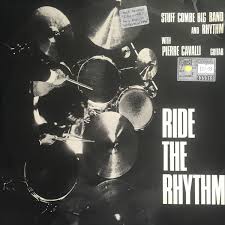
Stuff formed his own large ensemble in Geneva, Switzerland in 1966, and the following year worked with the Radio Suisse Romande jazz band. He was Lucky Thompson’s drummer during Thompson’s 1969 Swiss tour. In the 1970s he worked with Francy Boland and Benny Bailey, and played in the western United States with Groupe Instrumental Romand.
Drummer Stuff Combe, who wrote a treatise on percussion improvisation, passed away on December 27, 1986 in Morges, Switzerland.
More Posts: bandleader,drums,history,instrumental,jazz,music

Conversations About Jazz & Other Distractions
Conversations About Jazz Welcomes René Marie & VINX on March 11
On Thursday, March 11 at 7:30 pm (EST) Hammonds House Digital invites you to join us for Conversations About Jazz & Other Distractions with host Carl Anthony. His special guests will be world-renowned songwriters and vocalists René Marie and VINX. They will talk about their careers and sample some of their music. This free virtual program will stream on Hammonds House Museum’s Facebook and YouTube channels. Our tip jar will be open if you’d like to make a donation to support our programming. For more information about this and upcoming virtual events visit hammondshouse.org.
In a span of two decades, 11 recordings and countless stage performances, vocalist René Marie has cemented her reputation not only as a singer but also as a composer, arranger, theatrical performer,and teacher. Guided by powerful life lessons and rooted in jazz traditions laid down by Ella Fitzgerald, Dinah Washington, and other leading ladies, she borrows elements of folk, R&B and even classical and country to create a captivating hybrid style. René’s latest CD, Sound of Red, released by Motéma Music in 2017, is her first album of all-original material. Featuring clever songcraft and sensual vocal delivery, the CD has wowed critics and followers and won over new fans. Her work continues to be an exploration of bright and dark corners of the human experience, and an affirmation of the power of the human spirit. For more info: renemarie.com.
VINX is one of the most gifted improvisational vocalists performing today. With songs that range from jazz to funk, bossa nova to blues and back again, each audience takes a world tour with VINX as their private guide. Soaring vocals, intricate layered melodies and grooves, and his primal hand drum holding it all together, mark his signature style. Although he is often joined by a range of stunning musicians, his fine-tuned composition skills, mastery of vocal looping and razor-sharp instincts infuse his solo performances with the lushness of a full symphony orchestra. VINX has recorded and toured with some of the music industry’s greatest icons: Stevie Wonder, Sting, Herbie Hancock, Sheryl Crow, Branford Marsalis, Taj Mahal, Ricki Lee Jones, Darius Rucker, Cassandra Wilson, and Cher. His songwriting credits range from Tom Jones and Will Downing to The Lion King and Sprite™. Dreamsicle Arts & Entertainment Group is home to his production company, studios, and acclaimed workshop series. For more info: vinx.com.
Hammonds House Museum is generously supported by the Fulton County Board of Commissioners, Fulton County Arts and Culture, the City of Atlanta Mayor’s Office of Cultural Affairs, The Community Foundation for Greater Atlanta, The National Performance Network, AT&T and WarnerMedia.
Hammonds House Museum’s mission is to celebrate and share the cultural diversity and important legacy of artists of African descent. The museum is the former residence of the late Dr. Otis Thrash Hammonds, a prominent Atlanta physician and a passionate arts patron. A 501(c)3 organization which opened in 1988, Hammonds House Museum boasts a permanent collection of more than 450 works including art by Romare Bearden, Robert S. Duncanson, Benny Andrews, Elizabeth Catlett, Jacob Lawrence, Hale Woodruff, Amalia Amaki, Radcliffe Bailey and Kojo Griffin. In addition to featuring art from their collection, the museum offers new exhibitions, artist talks, workshops, concerts, poetry readings, arts education programs, and other cultural events throughout the year.
Located in a beautiful Victorian home in Atlanta’s historic West End, Hammonds House Museum is a cultural treasure and a unique venue. During the COVID-19 pandemic, they continue to observe CDC guidelines, but look forward to welcoming in-person visitors soon! For more information about upcoming virtual events, and to see how you can support their mission and programming, visit their website: hammondshouse.org.
MEDIA: For more information, contact Karen Hatchett at Hatchett PR, karen@hatchettpr.com.
More Posts: agents,conversations,history,instrumental,jazz,musicians,producers,vocalists
Daily Dose Of Jazz…
Norman Burns was born in London, England on March 11, 1920. Closely associated with the pianist George Shearing, together they worked the West End nightclub circuit in the mid 1940s, before Shearing made his fame and fortune in the USA.
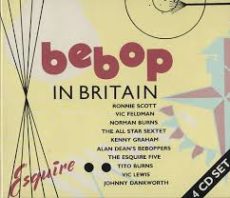
Though he recorded with Alan Dean Beboppers and others in 1948, he never was a bop musician. He was a regular figure on the modern jazz scene and from 1951, he led a quintet whose format and repertoire were based on the successful George Shearing Quintet formula. From the time of their first gig they were an instant hit and for two and a half years the quintet toured the UK jazz venues with great success. They added vocalists Eileen Draper and Johnny Green in 1954 but the group disbanded in 1955.
Esquire decided to record the quintet in 1952 by which time a number of personnel changes had taken place. Victor Feldman, the highest profile jazz musician working with the group had left prior to the recordings. A later move to Australia, saw drummer Norman Burns residing for many years until he passed away in June 1994.
More Posts: bandleader,drums,history,instrumental,jazz,music