

Daily Dose Of Jazz…
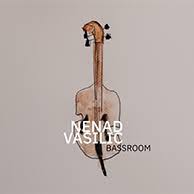
Nenad Vasilic was born on May 8, 1975 in Niš, Serbia and started playing piano at the age of 5. By twelve he received his first bass guitar and at the age of 15 he enrolled in the Secondary Music School in Niš. When he was 19 he studied contrabass and bass guitar at the Jazz Academy in Graz, Austria.
In 1998 he formed his own band Vasilić Nenad Balkan Band and 1999 saw him in Austria recording his debut album as a leader titled Jugobasija. Since that first outing he has produced albums as a band leader, double bass player and composer, collaborating with jazz singers Mark Murphy and Sheila Jordan, as well as Ritchie Beirah, Peter Ralchev, Vlatko Stefanovski, Wolfgang Puschnig, Bojan Zulfikarpasic, John Hollenbeck, Martin Lubenov, Stjepko Gut, Bilja Krstić, Tamara Obrovac, Lori Antonioli, Amira Medunjanin and others.
Bassist, composer and bandleader Nenad Vasilic continues to explore the possibilities of his music creativity.

More Posts: bandleader,bass,history,instrumental,jazz,music
Daily Dose Of Jazz…
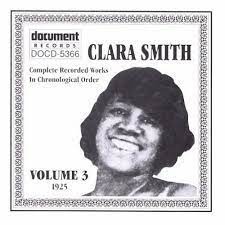
Leon Alexander Anthony Abbey was born in Minneapolis, Minnesota on May 7, 1900 to Luther James Robert Abbey and Eva Lee Alexander. He started his career in 1920 as a classical violinist with the orchestra of J. Rosamond Johnson. Five years later, he recorded with Clara Smith on If You Only Knowed and You Better Keep The Home Fires Burning.
By 1926, Leon was leading the Savoy Bearcats and toured with the band the next year in Argentina, Brazil, and Uruguay. For a decade, he toured throughout Europe and performed in India two times.
Abbey led a band with blues singer Ethel Waters. In Chicago, Illinois he led a trio until 1964. His sideman during his career included Fletcher Allen, Emile Christian, Bill Coleman, Peter DuConge, and Crickett Smith. He recorded Jazz and Hot Dance in Denmark as a leader in 1938 on Harmony Records in Copenhagen, Denmark. It was also issued under the name Whoa Babe.
Violinist and bandleader Leon Abbey transitioned in September 1975.
More Posts: bandleader,history,instrumental,jazz,music,violin

Daily Dose Of Jazz…
Denys Justin Wright was born on May 6, 1924 in Deptford, London, England and grew up in Brockley. His first instrument was the piano but was soon trying to play his brother’s guitar. Known professionally as Denny Wright, he began playing professionally before World War II while at school. He nearly always used his thumb on the top E string and could only play as fast as he could sing.
Wright spent the first part of World War II playing in jazz clubs in the West End of London, doing session work and performing in bands on radio shows. He worked with Stephane Grappelli for the first time in London around 1941. At school he served with the Auxiliary Fire Service in Brockley. Classified medically unfit to serve due to a childhood injury, he joined Entertainments National Service Association (ENSA), entertaining the troops.
In 1945 he started the first bebop club in London where he played piano and guitar. The late 1940s saw him touring Italy and the Middle East with the Francisco Cavez Orchestra. Throughout the 1950s DEnny provided guitar accompaniments for Lonnie Donegan, Johnny Duncan, Humphrey Lyttelton, and Marie Bryant, as well as appearing on Guitar Club on the BBC. In 1952, he accompanied Tex Ritter for a season at the Texas Western Spectacle, and with Joel David on Old Bones and added a guitar solo on Be My Valentine Tonight.
Establishing the Denny Wright Trio with violinist Bob Clarke took skiffle and jazz to the Soviet Union in 1957 for the 6th World Festival of Youth and Students. For four decades from the Forties he worked as a session musician working with the likes of Mary Hopkin, Dusty Springfield and Tom Jones. In the 1960s, he went on to record under The Cooper-Wright Quintet, and during the late Seventies formed the band Velvet with Ike Isaacs, Len Skeat, and Digby Fairweather.
Never one to not be working he continued to put bands together as well as lecturing and giving private lessons. He arranged for and fixed sessions, and was a prolific jazz and orchestra composer. He worked with Latin American, Afro-Cuban and Jamaican bands. Denny was voted the 1980 BBC Jazz Society Musician of the Year.
Guitarist, pianist, arranger and composer Denny Wright transitioned on February 8, 1992 in London after a nine-year battle with bladder cancer.
More Posts: bandleader,guitar,history,instrumental,jazz,music
Daily Dose Of Jazz…
Frank Carlson was born May 05, 1914 in New York City, New York. Starting to learn at an early age, there were occasional early rhythm sections that featured a form of sibling musical rivalry between him and his bassit brother Anthony that some bandleaders swear produces the tightest-possible timekeeping. Starting his career during the swing era of the big band, he held down the drums in the Woody Herman Orchestra from 1937 to 1942. During the Forties he was chosen by Fred Astaire to play drums on his movie soundtracks in the 40’s.
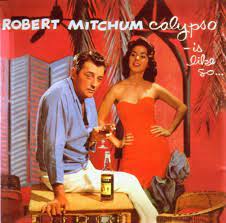
Coming out of the big band era Carlson became a busy studio-session drummer who played on a huge number of hit records, including those by Doris Day, Bing Crosby, and Elvis Presley. His cache with hipsters comes mostly from getting the studio call to back the brilliant actor, hellraiser, and occasional recording artist Robert Mitchum.
The drummer also collaborated early on with leaders such as Gene Kardos and Clyde McCoy. Tiring of the pounding required for his drums to be heard above the roaring stampede of Herman’s herd, Frank headed to the West Coast and a freelance career. His phone would ring with a variety of offers, from the aforementioned studio activity to percussion responsibilities with the Los Angeles Philharmonic.
He played on film soundtracks, and supposedly pointed out the chariot race in Ben Hur as one of the few experiences playing behind something that was louder than the Herman band. The height of his busy years were the ’50s and early ’60s. By the time pop groups began playing drums on their own records, drummer Frank Carlson retired to Hawaii. At present, there is no information as to the current status of his living or death.
More Posts: drums,history,instrumental,jazz,music
Daily Dose Of Jazz…
Donald Ernest Friedman was born in San Francisco, California on May 4, 1935 and began playing the piano at the age of four, switching from classical music to jazz after his family moved to Los Angeles, California when he was fifteen. His early jazz piano influence was Bud Powell and he briefly studied composition at Los Angeles City College.
He began playing in Los Angeles and moved to New York City in 1958. During the 1960s, he played with both modern stylists and more traditional musicians. The former included Coleman, Eric Dolphy, Jimmy Giuffre, Booker Little, and Attila Zoller; the latter, Bobby Hackett and Herbie Mann.
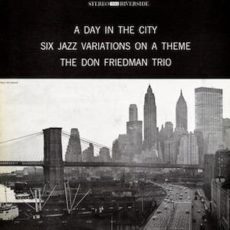
His debut album as a leader was A Day in the City, recorded in 1961. A few of his early albums received top ratings from DownBeat, which also gave him its critics’ poll New Star award. On the West Coast, Friedman performed with Dexter Gordon, Chet Baker, Buddy DeFranco, and Ornette Coleman. He was also a member of Clark Terry’s big band.
Pianist Don Friedman, who was also an educator in New York and had many fans in Japan, transitioned from pancreatic cancer on June 30, 2016 at his Bronx home.

More Posts: bandleader,history,instrumental,jazz,music,piano