


EMMETT COHEN
Emmet Cohen has emerged as one of his generation’s pivotal figures in music and the related arts. A recognized prodigy, Cohen began Suzuki method piano instruction at age three. He quickly became a mature player, melding musicality, technique, and concept. Downbeat observed that his “nimble touch, measured stride and warm harmonic vocabulary indicate he’s above any convoluted technical showmanship.”
In the same spirit, Cohen himself notes that playing jazz is “about communicating the deepest levels of humanity and individuality; it’s essentially about connections,” both among musicians and with audiences. Moreover, he leads his namesake ensemble, the Emmet Cohen Trio, is a vibrant solo performer, and is in constant demand as a sideman. Also, he possesses a fluid technique, an innovative tonal palette, and an extensive repertoire. Further, Cohen plays with the command of a seasoned veteran and the passion of an artist fully devoted to his medium.
Emmet Cohen’s exacting keyboard artistry has garnered numerous accolades from the international jazz community. To that end, he placed first in both the American Jazz Pianists competition (2014) and the Phillips Piano Competition (2011). Additionally, he was a finalist in the prestigious American Pianists Association’s Cole Porter Fellowship (2015, 2011) and the Thelonious Monk International Piano Competition (2011).
Besides leading the Emmet Cohen Trio, Cohen has appeared regularly with Ron Carter, Christian McBride, Benny Golson and Jimmy Cobb. Further, he’s worked with George Coleman, Jimmy Heath, Tootie Heath, Houston Person, Kurt Elling, Billy Hart and Brian Lynch.
Finally, Cohen commits fully to the intergenerational transfer of artistic knowledge, history, and traditions. His Masters Legacy Series is a celebratory set of recordings and interviews honoring legendary jazz musicians.
COVER: $35.00~$40.00
More Posts: adventure,bandleader,club,instrumental,jazz,music,piano,preserving,travel
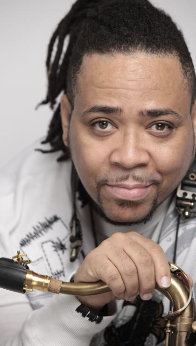
EDDIE BACCUS JR.
As a touring member of Pieces of a Dream for a decade and a half he had the opportunity to perform with and alongside a virtual who’s who in the traditional jazz, urban jazz and R&B worlds: Luther Vandross, Jeffrey Osborne, George Duke, War, Candy Dulfer, Rick Braun, Grover Washington Jr, Bobby Watson, Greg Abate, Lester Bowie, EWF(Earth, Wind and Fire), Regina Carter, Dianne Reeves, Vesta Williams, Norman Conners, India Arie, George Benson, Miki Howard, Jean Carne, David Sanborn, Brian McKnight, Will Downing, Phil Perry, Najee, Gerald Albright, Kirk Whalum, Marcus Belgrave, Benny Golson, Russell Ferrante, Bobby Lyle, Jeff Lorber, Ricky Lawson, Aaron Graves (Piano “Little Jimmy Scott”), Lenny Castro, Rachelle Ferrelle, Lil’ John Roberts, Phil Davis, Chris Coleman, Andre Gouche’, Giovanni Hildago, Eric Marienthal, James Carter, Curtis Fuller, Regina Belle, Miki Howard, Allyson Williams, Norman Connors, Atlantic Starr, Ronny Jordan, Rhonda Smith (Prince’s Bass Player), Gerald Veasley, Average White Band, Stevie Wonder, Peter White, Walter Beasley and more recently Four80East, Brian Simpson, Lindsey Webster, Cameo, Brother 2 Brother, Glenn Jones, Cabo Frio, Groove Frequencies, Christian De Mesones, Bene Music, Utopian Dreams and Joe Lovano.
Cover: $48.25
More Posts: adventure,bandleader,club,genius,instrumental,jazz,music,preserving,saxophone,travel
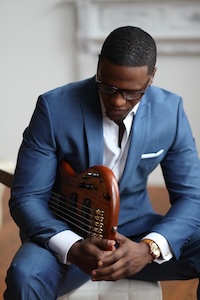
JULIAN VAUGHN
A dynamic lead bass player from Kansas City, bassist Julian Vaughn is rapidly becoming a major player in the contemporary jazz genre. Vaughn has made a name for himself as bassist in the smooth jazz genre which is dominated by saxophone players.
Vaughn grew up in the church where his grandfather pastored until turning over the reins to Vaughn’s father. Like other kids at the church, he began his music career playing the drums, but says, “Trying to play the drums at church was like ten football players going after a fumble. Everyone wanted to play.” Years went by and the fight over the drums got old. At 15 Vaughn decided to try a different instrument. He picked up a bass guitar that another man in his church was playing and immediately fell in love. This was truly love at first sight. Vaughn taught himself how to play and soon realized he had the ability to play by ear. He soon discovered how to play songs and special techniques. When Vaughn was 19 his grandfather bought him a 6-string bass guitar. It was black with gold trim. He discovered the art of bass soloing and knew at that point it was more than just a hobby but was his life’s passion. “My friends use to get on me because I would stop playing the bass line and start soloing,” he remembers.
Julian Vaughn has toured all over the U.S. playing at some of the largest jazz festivals and abroad in places like Dubai, Nairobi, Italy, and Germany. As an artist, he debut on the scene in 2010 with his CD titled “The Purpose Project” an album that would later pave the way to his 2012 album “Breakthrough”. Vaughn has had 2 number ones on the Bilboards.
COVER: $53.50
More Posts: adventure,bandleader,bass,club,genius,instrumental,jazz,music,preserving,travel
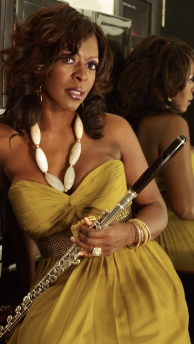
ALTHEA RENE
Detroit soul jazz flutist & Billboard chart-topping sensation brings her red hot band back to the Rubber City in a sizzlin’ return to BLU!
Althea was born December 25th in Detroit, Michigan and began her musical journey at the tender age four. She studied classical music while attending Howard University in Washington D.C. and later gained further musical inspiration from the accomplishments of Yusef Lateef, Ian Anderson, and her father, one of Motown’s original Funk Brothers, Dezie McCullers.She has since developed her own creative style.
For more than 10 years she was employed as a Wayne County Deputy Sheriff (Detroit, Michigan). Today, she is a full-time performing/recording artist and some regard her as a “master of her craft” and one of the world’s most exciting solo improvisational flutists.
In May 2013, she released her fifth project “In The Flow”. Collaborating with Grammy award winning producer Michael Broening, (producer for legendary icons George Benson and Paul McCartney) she cowrote the title track. That single became her biggest hit and reached number one ranking on both the Billboard Chart and the Smooth Jazz Chart. Althea Rene made history by becoming the first flute player in the history of Billboard Chart to reach the number one spot.
In April 2015, Althea Rene recorded her first live project. She and her rhythm section annihilated the stage of the beautiful Detroit Public Library with a free concert. Music fans from all over Michigan enjoyed a scorching hot performance. A compilation of some of her greatest hits, “Live in Detroit” is arguably her strongest work to date.
Cover: $48.25
More Posts: adventure,bandleader,club,flute,genius,instrumental,jazz,music,preserving,travel
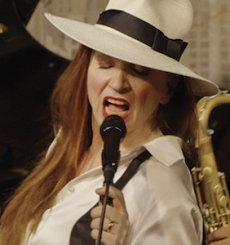
JUDITH OWEN
Judith Owen is a performer whose stylistic range spans rock, pop, classical, jazz, blues, and musical theatre. Owen is also a comedic actress and master storyteller. Judith grew up in London surrounded by classical music, ballet, theatre, and the fine arts. Further, she was also exposed to many jazz icons and Broadway musicals that her parents loved. Thus, this mixture would become her signature sound.
Owen quickly began performing at a variety of different venues around London. Her unique hybrid of classical/jazz-influenced styled sound soon affirmed a regular slot at the legendary Ronnie Scott’s.
Her new live album, 2024’s Comes Alive, follows her hugely successful 2022 album Come On & Get It. That album received over 2.6 million album streams and more than a million YouTube views. Judith Owen Comes Alive features sixteen tracks recorded live over a weeklong residency in Bern, Switzerland at Marians Jazzroom.
Owen conceived of the project because of her childhood fascination with the music of the pioneering but oft forgotten women of jazz and blues. For example, Julia Lee, Blossom Dearie and Nellie Lutcher. She discovered these women hidden in her father’s record collection alongside Oscar Peterson and Jelly Roll Morton. There, Owen became captivated and enchanted by these “unapologetic” chanteuses of the 40’s/50’s. They were singing about sex and enjoying it, at a time when women were meant to sing about romance. Then, Owen made it her mission to dig deep and find out more from both a musical and historical perspective. The result is a joyful, uplifting, and empowering project. Moreover, she honors these entertaining women who broke the glass ceiling with their stiletto heels and were proud of it!
Cover: $30.00~$40.00
More Posts: adventure,club,instrumental,jazz,music,preserving,travel,vocal