


JOHN PIZZARELLI
Grammy winning producer, guitarist and vocalist John Pizzarelli celebrates the centennial of iconic singer Tony Bennett with a pair of heartfelt tributes Dear Mr. Bennett, to be released March 3, 2026, which features Pizzarelli’s trio performing timeless songs made famous by Bennett.
For world-renowned guitarist and vocalist John Pizzarelli, Tony Bennett was more than simply an influence. Pizzarelli’s late father, the revered guitarist Bucky Pizzarelli, was a frequent sideman for the legendary singer, appearing on albums including 1960’s To My Wonderful One and 1969’s I’ve Gotta Be Me. John got his own opportunity to accompany Bennett for a radio broadcast that also featured pianist Ralph Sharon and bassist Jay Leonhart. The admiration was mutual – Bennett could be found in the audience for a number of Pizzarelli’s performances, and sketched his likeness on two occasions. The charming artwork that graces the cover of Pizzarelli’s heartfelt new tribute album, Dear Mr. Bennett, was rendered during an engagement at Feinstein’s nightclub at New York’s Loews Regency hotel.
John Pizzarelli ~ guitar and vocals
Isaiah J. Thompson ~ piano
Mike Karn ~ double bass
Tickets: Streaming $15.00 +fee | GA $45.00 ~ $55.00 +fee
More Posts: adventure,bandleader,club,genius,guitar,instrumental,jazz,music,preserving,travel,vocal

Daily Dose Of Jazz…
Tiny Parham was born Hartzell Strathdene Parham on February 25, 1900 in Winnipeg, Canada. The pianist and bandleader grew up in Kansas City and worked at The Eblon Theatre, mentored by ragtime pianist and composer James Scott. He would later tour with territory bands in the Southwest before moving to Chicago in 1926.
He is best remembered for the recordings he made in Chicago between 1927 and 1930 working with Johnny Dodds along with several female blues singers and with his own band. Most of the musicians Parham played with are not well known in their own right, though cornetist Punch Miller, banjoist Papa Charlie Jackson, saxophonist Junie Cobb and bassist Milt Hinton are exceptions.
His entire recorded output for Victor are highly collected and appreciated as prime examples of late 1920’s jazz. Tiny favored the violin and many of his records have a surprisingly sophisticated violin solos, along with the typical upfront tuba, horns and reeds.
After 1930 he found work in theater houses, especially as an organist and his last recordings were made in 1940. The cartoonist R. Crumb included a drawing of Parham in his classic 1982 collection of trading cards and later book “Early Jazz Greats” of which Parham was the only non-American born so included in addition to the book’s bonus cd containing a Parham track.
Tiny Parham passed away on April 4, 1943 in Milwaukee, Wisconsin.
More Posts: bandleader,history,instrumental,jazz,music,piano
Requisites
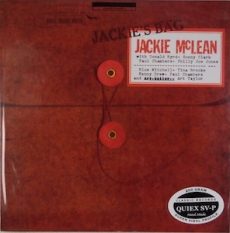
Jackie’s Bag ~ Jackie McLean | By Eddie Carter
Alto saxophonist, Jackie McLean, enters this morning’s spotlight with an excellent 1961 hard bop album, Jackie’s Bag (Blue Note BLP 4051/BST 84051). It comprises two sessions from 1959 and 1960, and two all-star ensembles join him. Donald Byrd (tracks: A1-A3), Blue Mitchell (B1 to B3) on trumpet, Tina Brooks (B1 to B3) on tenor sax, Sonny Clark (A1 to A3), Kenny Drew (B1 to B3) on piano, Paul Chambers on bass, Philly Joe Jones (A1 to A3), and Art Taylor (B1 to B3) on drums. The copy I own is the 2008 Classic Records mono audiophile deep groove reissue, sharing the original catalog number.
Side One opens with Quadrangle, the first of five originals by Jackie McLean. It takes off straight into the stratosphere from the start of the quintet’s brisk melody. Jackie takes a sharp corner into an energetic opening solo, then Donald continues navigating traffic in the next lively statement. Philly Joe tackles the final solo vigorously, leading back into the closing chorus. Blues Inn begins with the ensemble’s relaxed theme. McLean opens with an easygoing solo, then Byrd compels the listener to leave their troubles behind in the following statement. Clark has an enjoyable interpretation next, and Paul’s short walk leads the group back into the theme’s restatement and close.
Fidel gets going with Philly Joe’s introduction to the group’s upbeat melody. Donald has the first solo and makes the most of every note. Jackie takes over and swings so passionately that the listener is sure to be tapping his toes and snapping his fingers. Sonny’s rhythmic agility in the closer flows efficiently into the closing chorus and ending. Appointment in Ghana starts the second side with the front line’s introduction segueing into the sextet’s lively melody. McLean leads off and shows he can cook with the best of them. Mitchell adds some bite to the second solo, then Brooks ignites the next reading with plenty of heat. Drew gets the last word ahead of the group’s tasty finale.
A Ballad For Doll is a heartfelt tribute from Jackie to his wife, Dolly. The sextet gently slows things down for a warm and affectionate opening chorus. Kenny shines in the solo spotlight with a delicately beautiful interpretation that builds into the group’s touching climax. Isle of Java by Tina Brooks brings the album to a close, picking up the tempo one last time for Brooks, setting the spirited melody in motion against the sextet. McLean comes out swinging first with a lively interpretation. Mitchell maintains the groove with an effervescent solo. Brooks responds with a statement full of zest. Drew is on the trail of the front line in the following reading, and Chambers gets a moment to shine, preceding the theme’s reprise and fadeout.
Alfred Lion produced Jackie’s Bag, and Rudy Van Gelder managed the recording console. The album’s sound quality is clean and crisp, leaping from the speakers with stunning fidelity and absolutely no background noise. Bernie Grundman mastered the audiophile reissue, and the record was pressed on 200-gram Quiex SV-P Hand Made Super Vinyl. The record is also silent until the music starts. If you’re in the mood for an excellent hard bop album, Jackie’s Bag, by Jackie McLean, is an outstanding entry point to his artistry and discography. The album also offers a vivid picture of the music landscape in the late 1950s and early 1960s, and should make a welcome addition to any jazz fan’s library!
© 2026 by Edward Thomas Carter

More Posts: choice,classic,collectible,collector,history,instrumental,jazz,music,saxophone

KENNY WILLIAMS
In his acclaimed 25-year musical career, vocalist Kenny Williams has lit up stages nationally and internationally, and spent nearly a decade performing on Broadway in New York City, making his Broadway debut in Disney’s hit musical The Lion King. A tornado of talent and charisma, Williams possesses an impressive vocal range and a light-from-within aura. The Austin native studied voice at the University of Texas, and cut his teeth as an actor and an entertainer in clubs on the city’s famed 6th Street and at ZACH Theatre.
Williams was born to entertain, and his star shines brightly. He is a truly gifted vocalist, while his spirit, energy, and passion will bring you back for more. This show will also be available via livestream at parkerjazzclub.com/livestream. Online donations welcome. All proceeds benefit local nonprofit Texas Jazz Society.
Tickets: $41.19 ~ $52.19 (fee included)
More Posts: adventure,bandleader,club,genius,instrumental,jazz,music,preserving,travel,vocal

COUNT BASIE ORCHESTRA
The Count Basie Orchestra, a living testament to the enduring influence of legendary pianist and bandleader William James “Count” Basie, thrives under the direction of Scotty Barnhart. Its members continue to uphold the orchestra’s unparalleled reputation.
The ensemble has garnered acclaim from every corner of the globe, conquering esteemed jazz polls and amassing an impressive collection of 18 Grammy® Awards. Their performances have graced the presence of royalty, captivated audiences in movies and television shows, and graced the stages of major jazz festivals and renowned concert halls worldwide.
Tickets: $107.19 fee included ~ 7:00pm Nealy Sold Out| 9:30pm Show ~ Sold Out
More Posts: adventure,bandleader,club,genius,instrumental,jazz,music,preserving,travel,trumpet