

The Quarantined Jazz Voyager
Contrary to the announcement that the pandemic is over and the unmasking the country has clearly exhibited, a variant is still present and this Jazz Voyager is getting out remains distant from crowds and enclosed spaces. So we will continue to listen to great music.
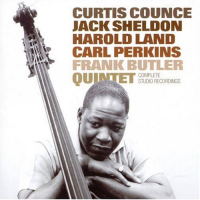
My selection this week is the Complete Studio Recordings, a two compact disc set whose songs were recorded between 1956 and 1958 by the Curtis Counce Quintet composed of Counce, Jack Sheldon, Harold Land, Carl Perkins and Frank Butler went into the studio of Contemporary Records and recorded twenty-four songs. Though the group was short~lived, their impact produced a powerhouse two-disc set of music comprising the main recordings on the Contemporary label.
The group’s expressed purpose was to develop a West Coast answer to the soulful, hard-bop East Coast sound. Each of the musicians was among the most gifted on his instrument, yet the focus was always on a collaborative result that would reflect undiscovered possibilities within a familiar post-bop idiom. Seldom does a group of musicians come together and play so seamlessly that they sound like one voice speaking. The contribution of each of the five principals, therefore, invites close scrutiny.
The beauty of the recorded disc is that it is a lasting tribute to the musicians who performed on this recording. Lester Koenig at Contemporary Records was known for extremely high audio standards and turned out some of the best-sounding records of the day thanks to the expertise of engineer Roy DuNann. The audio on these Contemporary dates is rich in depth and detailing, allowing the listener to pick out each of the subordinate motifs and subtle moving harmonies. The engineering created a naturally ambient soundscape inviting the listener to partake of the worthy.
The caveat is that this music appeared on previously released albums by Curtis Counce and this is an opportunity to pick up the excellence of 24 tracks of music in a one~stop shop. This represents African-American indigenous art of the highest order. Released by Gambit Records in 2007 and definitely one for the collector.
Track Listing | 150:00+
Disc 1- Landslide (Harold Land) ~ 8:37
- Time After Time (Sammy Cahn/Jule Styne) ~ 6:32
- Mia (Carl Perkins) ~ 4:55
- Sarah (Jack Sheldon) ~ 11:38
- Fifth For Frank (Gerald Wiggins/Cal Tjader) ~ 7:14
- Big Foot (Charlie Parker) ~ 9:07
- Sonar (Kenny Clarke/Gerald Wiggins) ~ 7:28
- Stranger In Paradise (Robert Wright/George Forrest) ~ 7:04
- Woody’n You (Dizzy Gillespie) ~ 6:18
- Pink Lady (Jack Sheldon) ~ 4:41
- Councelation (Curtis Counce) ~ 6:05
- Love Walked In (George Gershwin/Ira Gershwin) ~ 4:56
- Too Close For Comfort (Larry Holofcener) ~ 5:38
- How Deep Is The Ocean (Irving Berlin) ~ 6:37
- Complete (Curtis Counce) ~ 5:52
- Nica’s Dream (Horace Silver) ~ 8:00
- How Long Has This Been Going On (George Gershwin/Ira Gerswin) ~ 3:18
- Mean To Me (Fred E. Ahlert/Roy Turk) ~ 4:31
- I Can’t Get Started (Vernon Duke/Ira Gershwin) ~ 8:01
- Larue (Clifford Brown) ~ 5:04
- Carl’s Blues (Carl Perkins) ~ 5:54
- Night In Tunisia (Dizzy Gillespie/Frank Paparelli) ~ 8:17
- Love Walked In (George Gershwin/Ira Gershwin) ~ 2:55
- Sophisticated Lady (Duke Ellington) ~ 4:10
- Fifth For Frank (Gerald Wiggins/Cal Tjader) ~ 1:56
- The Butler Did It (Frank Butler) ~ 4:39
Personnel
- Jack Sheldon ~ trumpet
- Harold Land ~ tenor saxophone
- Carl Perkins ~ piano
- Curtis Counce ~ bass
- Frank Butler ~ drums
- Gerald Wilson ~ trumpet (replaces Sheldon on three tracks of disc 2)

More Posts: adventure,album,bass,club,drums,genius,jazz,museum,music,piano,preserving,restaurant,saxophone,travel,trumpet
Daily Dose Of Jazz…
Frank Carlson was born May 05, 1914 in New York City, New York. Starting to learn at an early age, there were occasional early rhythm sections that featured a form of sibling musical rivalry between him and his bassit brother Anthony that some bandleaders swear produces the tightest-possible timekeeping. Starting his career during the swing era of the big band, he held down the drums in the Woody Herman Orchestra from 1937 to 1942. During the Forties he was chosen by Fred Astaire to play drums on his movie soundtracks in the 40’s.
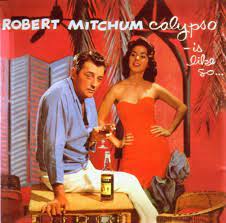
Coming out of the big band era Carlson became a busy studio-session drummer who played on a huge number of hit records, including those by Doris Day, Bing Crosby, and Elvis Presley. His cache with hipsters comes mostly from getting the studio call to back the brilliant actor, hellraiser, and occasional recording artist Robert Mitchum.
The drummer also collaborated early on with leaders such as Gene Kardos and Clyde McCoy. Tiring of the pounding required for his drums to be heard above the roaring stampede of Herman’s herd, Frank headed to the West Coast and a freelance career. His phone would ring with a variety of offers, from the aforementioned studio activity to percussion responsibilities with the Los Angeles Philharmonic.
He played on film soundtracks, and supposedly pointed out the chariot race in Ben Hur as one of the few experiences playing behind something that was louder than the Herman band. The height of his busy years were the ’50s and early ’60s. By the time pop groups began playing drums on their own records, drummer Frank Carlson retired to Hawaii. At present, there is no information as to the current status of his living or death.
More Posts: drums,history,instrumental,jazz,music
Daily Dose Of Jazz…
Donald Ernest Friedman was born in San Francisco, California on May 4, 1935 and began playing the piano at the age of four, switching from classical music to jazz after his family moved to Los Angeles, California when he was fifteen. His early jazz piano influence was Bud Powell and he briefly studied composition at Los Angeles City College.
He began playing in Los Angeles and moved to New York City in 1958. During the 1960s, he played with both modern stylists and more traditional musicians. The former included Coleman, Eric Dolphy, Jimmy Giuffre, Booker Little, and Attila Zoller; the latter, Bobby Hackett and Herbie Mann.
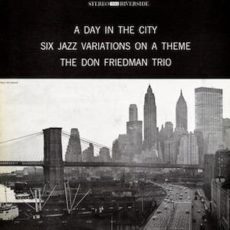
His debut album as a leader was A Day in the City, recorded in 1961. A few of his early albums received top ratings from DownBeat, which also gave him its critics’ poll New Star award. On the West Coast, Friedman performed with Dexter Gordon, Chet Baker, Buddy DeFranco, and Ornette Coleman. He was also a member of Clark Terry’s big band.
Pianist Don Friedman, who was also an educator in New York and had many fans in Japan, transitioned from pancreatic cancer on June 30, 2016 at his Bronx home.

More Posts: bandleader,history,instrumental,jazz,music,piano
Three Wishes
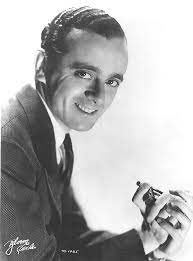
The Baroness asked Larry Adler, if three wishes were grantable, what would they be and he replied this:
-
-
“I don’t know there is anything I want that badly. I live very much in the present and so my wishes are pretty damn well gratified. I’d like to write a show. Because all I’ve written so far are film scores, and you can’t tell by them if you’re a good composer or not. Even though one of my film scores got an Academy Award ~ my first film score, in fact! But you only really know when you write a show, and the music carries the show, and has an independent life outside the show. Gershwin is a good example of that..””And help a chick. You know: We have a common understanding.”
- “I’d like to be the best father it’s possible to be.”
- “I’d like to be emotionally where I am chronologically. Chronologically, I’m forty-eight. Emotionally, I’m nineteen ~ if I am nineteen!”
-

More Posts: baroness,harmonica,history,instrumental,jazz,music,pannonica,three,wishes
Daily Dose Of Jazz…
John Rhea “Yank” Lawson was born May 3, 1911 in Trenton, Missouri. He started playing music on saxophones and piano before settling on the trumpet as a teenager. He played in the University of Missouri Dance Band, and was soon offered a job with Slatz Randall’s group, with whom he made his recording debut on Mom in 1932. Dropping out of college he had a stint with Wingy Manone before being hired to join Ben Pollack in late 1933.
From 1933 to 1935 Yank worked in the Pollack orchestra, then became a founding member of the Bob Crosby Orchestra. He later worked with Benny Goodman and Tommy Dorsey, but also worked with Crosby again in 1941~1942. Later in the decade he became a studio musician leading his own Dixieland sessions.
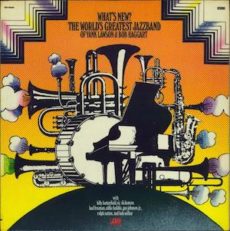
By the 1950s he and Bob Haggart created the Lawson-Haggart band and they worked together in 1968 to form the World’s Greatest Jazz Band, a Dixieland group which performed for the next ten years. He recorded for Atlantic, Audiophile, Decca and Jazzology.
Trumpeter Yank Lawson, best known for Dixieland and swing music, transitioned on February 18, 1995 in Indianapolis, Indiana.
More Posts: bandleader,history,instrumental,jazz,music,trumpet