

Daily Dose Of Jazz…
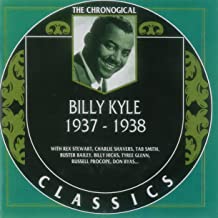
William Osborne Kyle was born on July 14, 1914 in Philadelphia, Pennsylvania and began playing the piano in school. By the early 1930s, he was working with Lucky Millinder, Tiny Bradshaw, and later the Mills Blue Rhythm Band. In 1938, he joined John Kirby’s sextet but was drafted in 1942. After the war, he worked with Kirby’s band briefly and also worked with Sy Oliver. He then spent thirteen years as a member of Louis Armstrong’s All-Stars, performing in the 1956 musical High Society.
A fluent pianist with a light touch, Kyle never achieved much fame, but he always worked steadily. He had a few opportunities to record as a leader, seventeen songs in all, just some octet and septet sides in 1937, two songs with a quartet in 1939, and outings in 1946 with a trio and an octet.
He is credited as the co-author of the song Billy’s Bounce recorded by the Modern Jazz Quartet in 1992 with Bobby McFerrin on the album MJQ and Friends. He didn’t record during his Armstrong years, however, he recorded with Al Hibbler and Buck Clayton.
Pianist Billy Kyle, best known as an accompanist, passed away on February 23, 1966 in Youngstown, Ohio.

More Posts: bandleader,composer,history,instrumental,jazz,music,piano
Daily Dose Of Jazz…
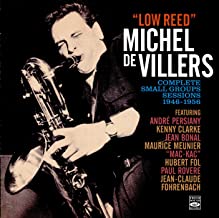
Michel De Villers was born July 13, 1926 in Villeneuve-sur-Lot, France and learned to play alto saxophone as a teenager. He would later expand to clarinet and baritone saxophone. Playing in the latter half of the 1940s with Jean-Claude Fohrenbach, Django Reinhardt and Rex Stewart, he then joined the Edward VII Theatre band in Paris.
In the 1950s he worked in the bands of Geo Daly, Jack Diéval, André Persiany, and Gérard Pochonet. He also played with touring American musicians such as Buck Clayton, Bill Coleman, Jonah Jones, and Lucky Thompson. The Seventies saw De Villers as less active as a musician, working as a jazz writer and radio screenwriter. In the 1980s he became active again as an educator and performer, working later in his career with Christian Garros, Pierre Michelot, Roger Guérin, and Marc Fosset.
Saxophonist, clarinetist, and bandleader Michel De Villers October 25, 1992, Mont St. Aignan, France.
More Posts: bandleader,clarinet,history,instrumental,jazz,music,saxophone
Requisites
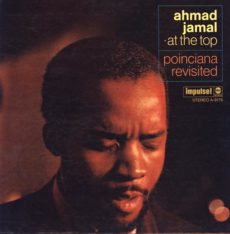
Ahmad Jamal at The Top: Poinciana Revisited ~ Ahmad Jamal | By Eddie Carter
I first saw Ahmad Jamal live in 1995 at Spivey Hall on the campus of Clayton State University in Morrow, Georgia. I’d been a fan of his since the age of ten after hearing his 1958 album, Ahmad Jamal at The Pershing: But Not For Me. That night, the trio characterized their creative energy and gracious lyricism into a mesmerizing performance bringing the capacity crowd to its feet.
This morning’s choice from the library is a 1968 live album, Ahmad Jamal at The Top: Poinciana Revisited (Impulse!–ABC Records AS-9176). It’s one of my favorite LP’s by the renowned pianist and his bandmates are Jamil Sulieman on bass and Frank Gant on drums. My copy used in this report is the 1969 Stereo reissue and the set opens with Have You Met Miss Jones? This song by Richard Rodgers and Lorenz Hart is from the 1937 musical comedy, I’d Rather Be Right. The audience’s applause and a short solo introduction by Ahmad segue into a lively Latin-flavored theme. Jamal gives a vigorous interpretation that’s tremendously rewarding propelled by Jamil and Frank’s lively backing.
The jazz standard Poinciana by Nat Simon and Buddy Bernier was written in 1936 and is based on a Cuban folk tune, La canción del árbol (The Song of The Tree). The Glenn Miller Army Air Force Band made the first recording in 1943 and it was featured in two films, Dreamboat (1952) and The Bridges of Madison County (1995), performed by Ahmad Jamal. The trio gives an inspired interpretation showcasing the pianist on a lengthy reading running the gamut of his extraordinary range.
Lament, Jamal’s lone contribution begins with a cascading solo introduction by Ahmad that blossoms into a marvelous melody. As the song’s only soloist, the pianist ascends to a peak of pure pleasure, before descending gradually back for the rousing climax. Call Me by Tony Hatch starts Side Two and was written for Pop vocalist Petula Clark who featured it as the title tune for her 1965 album. The ensemble transforms the easy listening song into a torrid scorcher on the melody, and Jamal gives a passionately brisk solo of radiant intensity before the reprise and abrupt stop.
The pace slows down for a beautiful version of Theme From Valley of The Dolls, composed for the 1967 film by André Previn and his wife Dory. Ahmad and Jamil begin with a gentle dialogue that grows into a tender theme. The pianist infuses tender emotion, depth, and beauty into the song’s only solo with exceptional detail leading to a subtle coda. Frank’s Tune by Frank Strozier swings easily to a medium beat on the opening and closing chorus affording Ahmad, Jamil, and Frank each solo space. The 1961 Bossa Nova standard,
How Insensitive (known in Brazil as Insensatez) was written by Antônio Carlos Jobim, and Vinícius de Moraes who penned the Portuguese lyrics, and Norman Gimbel, the English lyrics. The ensemble begins the melody rapidly setting the mood for Ahmad who opens with an exhilarating reading. Jamil takes the next reading aggressively, and Frank closes with a swift, zealous statement preceding the group’s out-chorus and crowd’s show of appreciation. The sound quality of the album by engineer Carlos Olms captures the spirit of the trio’s performance exceptionally well for maximum enjoyment in your listening room.
At ninety-years young, Ahmad Jamal shows no signs of slowing down. His most recent release is a 2019 French album titled Ballades. If you’re a fan of piano jazz, or in the mood for a live album possessing an elegant and infectious groove, I submit for your consideration Ahmad Jamal at The Top: Poinciana Revisited. It’s a great introduction to his music for newcomers and an impressive showcase for seasoned fans that handsomely repays the effort to seek it out for your library!
~ Ahmad Jamal at The Pershing: But Not For Me (Argo LP-628); Ballades (Jazz Village–Jazzbook Records JV3357015758); Call Me (Pye Records NEP 24237); – Source: Discogs.com
~ Have You Met Miss Jones? – Source: JazzStandards.com
~Call Me, How Insensitive, Poinciana, Theme From The Valley of The Dolls – Source: Wikipedia.org
~© 2020 by Edward Thomas Carter
Synopsis
Ahmad Jamal at the Top: Poinciana Revisited is a live album by pianist Ahmad Jamal featuring performances recorded at The Village Gate in 1968 and released on the Impulse! label.
Track List | 42:04
- Have You Met Miss Jones (Lorenz Hart, Richard Rodgers) – 3:47
- Poinciana (Buddy Bernier, Nat Simon) – 9:19
- Lament – 8:05
- Call Me (Tony Hatch) – 4:51
- (Theme from) Valley of the Dolls (André Previn, Dory Previn) – 4:23
- Frank’s Tune (Frank Strozier) – 5:50
- How Insensitive (Antônio Carlos Jobim, Vinícius de Moraes) – 5:52
Personnel
- Ahmad Jamal – piano
- Jamil Sulieman – bass
- Frank Gant – drums

More Posts: choice,classic,collectible,collector,history,instrumental,jazz,music,piano

Daily Dose Of Jazz…
Kiwzo Fumero was born on July 12, 1972 in Marianao, Havana, Cuba. A trumpeter from his youth, he began his professional career in 1991 with the creation of the first youth mariachi band in Cuba, of which he was its creator and director, and who is currently El Mariachi Real Jalisco De La Habana.
In 2000 Kiwzo settled in Miami, Florida. where he has participated with several orchestras and has accompanied Gilberto Sta Rosa, Huey Dumbar, Thalia, Tito Nieves, Rey Ruiz, Jose Jose, and many more. He has performed with the Willy Chirino Orchestra, La Sonora Carruseles, the tour “Embrace Me Very Strong”, Tropicana All-Stars, Celia Cruz, and Cachao.
As an educator Fumero has also had the honor of sharing a lectern with world-class musicians such as Arturo Sandoval, Paquito D’Rivera, John Fadis, Israel López Cachao, Jimmy Bosch, Andy García, Chocolate Armenteros, Patato Valdez among many others.
Winner of 2 Grammy Awards with 6 nominations, he has performed for President Bush in 2007, and has recorded nine albums. Kiwzo Fumero, one of the most recognized and influential Cuban trumpeters of his generation, continues to perform, record and tour.
More Posts: bandleader,history,instrumental,jazz,music,trumpet
Hollywood On 52nd Street
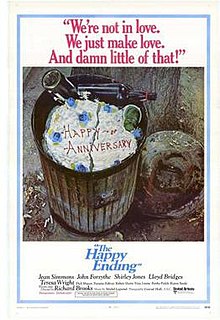
What Are You Doing the Rest of Your Life? is a song with lyrics written by Alan Bergman and Marilyn Bergman and original music written by Michel Legrand for the 1969 film The Happy Ending. The song was nominated for an Academy Award For Best Original Song but lost out to Raindrops Keep Fallin’ on My Head.
Alan Bergman would recall that after Michel Legrand had written eight melodies that were somehow not viable for the film, Marilyn Bergman suggested the opening line “What are you doing the rest of your life?”, and Legrand then completed the song’s melody based on that phrase.
Marilyn Bergman would later comment on the double meaning of the phrase “What are you doing the rest of your life?” within its parent film: as the romantic theme song’s title the question overtly references the marriage proposal Mary Spencer (played by Jean Simmons) received and accepted sixteen years earlier but, as Mary’s present-day angst becomes apparent, “What are you doing the rest of your life?” is recast as a question Mary must ask herself.
What Are You Doing the Rest of Your Life? was sung in The Happy Ending by Michael Dees whose version was included on the film’s soundtrack album. The Story
1953: Through the course of a Colorado autumn and winter, Mary Spencer (Simmons) and Fred Wilson (Forsythe) lead an idyllic existence. Mary drops out of college (with 6 months to go) to marry Fred. Their perfect wedding mirrors the happy endings of the films Mary loves. However, there are no fairytale happy endings and sixteen years later Mary is off to find her happiness, leaving behind her husband and daughter, which she eventually does despite her mother and her husband’s pleas.
