

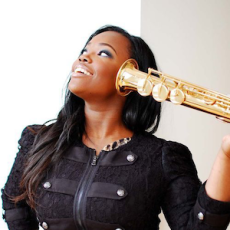
CAMILLE THURMAN | DARRELL GREEN QUARTET
As a composer, multi-instrumentalist, vocalist, and unique interpreter of the jazz tradition, she is quickly becoming one of the standard bearers for the form, making a considerable and dynamic contribution to the legacy of jazz while paying tribute to its heroes. Fluid and powerful on the tenor saxophone and highly inventive as a vocalist, she also plays bass clarinet, flute, and piccolo. Her rich sax sound has been compared to Joe Henderson and Dexter Gordon, while her vocal approach—including an impressive scatting ability—has been classified alongside those of Ella Fitzgerald and Betty Carter.
In a few short years, Thurman has shared stages with Janelle Monáe, Alicia Keys, Lalah Hathaway, Jill Scott, Erykah Badu, Roy Haynes, Dianne Reeves, Kenny Barron, Dr. Lonnie Smith, Terri Lyne Carrington, Jon Batiste, Diana Krall, Patti LaBelle, Gladys Knight, Chaka Khan, Nicholas Payton, The Jazz at Lincoln Center Orchestra (JALCO) featuring Wynton Marsalis, and Buster Williams, among many others.
The New York City native has already amassed several distinctive honors for her musicianship: runner up in the 2013 Sarah Vaughan International Vocal Competition, two-time winner of the ASCAP Herb Alpert Young Jazz Composers Award and a winner of the Fulbright Scholars Cultural Ambassador Grant, The Chamber Music of America Performance Plus Grant (Sponsored by the Dorris Duke Charitable Foundation) and the Jazz Coalition Composers Grant among others. Thurman also has four full-length recordings as a leader to her credit.
Her compositions were featured and performed by her quartet in the ASCAP/The Kennedy Center Songwriters: The Next Generation showcase as well as the Greenwich School of Music’s Uncharted Series. Camille has appeared on BET’s Black Girls Rock as the saxophonist and flutist in the All-Star Band. Equally adept as a player and a singer, and recognized for her compositional abilities as well, Thurman has also earned accolades from the media, from JazzTimes to Downbeat, All About Jazz to the New York Times, NPR to Sirius XM Satellite Radio, BET to Jazz Night In America.
Thurman was chosen by the State Department under the Fulbright Scholarship grant to perform in Paraguay and Nicaragua with her band. She and Darrell Green were selected by American Music Aboard to travel and perform in various African nations including Cameroon, Mozambique, Nigeria, Senegal, and Mauritania.
More Posts: adventure,club,genius,jazz,music,preserving,saxophone,travel,vocal
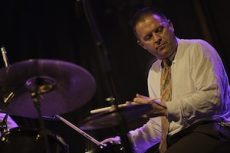
JOE FARNSWORTH QUARTET
Joe Farnsworth was one of five sons born to trumpeter and bandleader Roger Farnsworth, one of the brothers played saxophone in Ray Charles’s band. He attended high school in Jakarta International School in Jakarta, Indonesia. He studied at William Paterson College, studying under Harold Mabern and Arthur Taylor and receiving his Bachelor of Music in 1990. During the 1990s he played with Junior Cook, Jon Hendricks, Jon Faddis, George Coleman, Cecil Payne, Annie Ross, and Benny Green.
He has played in the group One for All since 1995 with David Hazeltine and Jim Rotondi, and worked with Benny Golson, Steve Davis, and Eric Alexander in the second half of the 1990s. During that period he also played with Alex Graham, Michael Weiss, the Three Baritone Saxophone Band, and Diana Krall. He has been a member of Pharoah Sanders’ band.
More Posts: adventure,club,drums,genius,jazz,music,preserving,travel
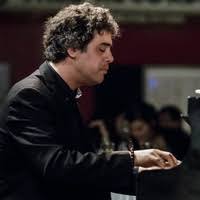
SPIKE WILNER, PAUL GILL & ANTHONY PINCIOTTI
Michael “Spike” Wilner was born in New York City and started playing piano at an early age. He was inspired by a television program about the life of Scott Joplin to learn to play Ragtime Music. He perused this art form throughout high school and performed Joplin’s “Maple Leaf Rag” at the St. Louis Ragtime Festival. Although it was an informal appearance it, nonetheless, profoundly affected him and drove him to peruse a career in music. In his high school jazz program he met pianist Peter Martin who introduced him and inspired him to learn more modern jazz.
Wilner decided to enter into the New School For Social Research’s Jazz and Contemporary Music department, which was then in it’s first year. Headed by the late saxophonist Arnie Lawrence, this was an experimental forum where young jazz musicians were introduced to masters and left on their own to interact and play together. In this fertile musical environment Wilner met and became friends with many of today’s leading jazz musicians. Students at that time included: Peter Bernstein, Jesse Davis, Larry Goldings, Brad Mehldau, Roy Hargrove, Sam Yahel, Joe Strasser and many others. It was there that Wilner had the good fortune to become the student of the late pianist Walter Davis Jr. as well as the late great Jaki Byard. At this same time Wilner became involved at the Jazz Cultural Theater under the direction a Barry Harris and spent several years studying there.
It was also at this time that Wilner began to work professionally on the New York City jazz scene. He began to play gigs in the various clubs and throughout the years has held down many steady engagements in well-known clubs. Wilner was a house pianist at the legendary, now defunct, Village Gate as well as other long-gone clubs such as Visiones, The Angry Squire and The Village Corner. In 1995, Wilner became involved with the jazz club Smalls under the direction of owner Mitch Borden. At Smalls, Wilner has developed his music and his career. He recorded a live record there “Late Night: Live At Smalls (Freshsound Records)” and now currently performs there each Sunday evening with his sextet, Planet Jazz.
During his last 15 years, Wilner has played with many names now well known in jazz such as: Peter Bernstein, Joe Magnarelli, Grant Stewart, Jesse Davis, Eric Alexander, Jim Rotundi, Joe Farnsworth, Bob Mover, Ian Hedrickson-Smith, Ryan Kisor, Steve Davis, Ralph Lalama, Paul Gill, Neal Miner, Joe Strasser, Ari Roland, Chris Byars, Sherman Irby, Joel Frahm, Omer Avital, Stephon Harris and many others. Other professional work has included tours with the Artie Shaw Orchestra, the Glenn Miller Orchestra and a European tour with Maynard Furgeson’s ”Big Bop Nouveu” band. Wilner has toured extensively in France as part of the Xavier Richardeau quintet. In Paris he has also worked with bassist Pierre Boussaguet and trombonist Sarah Morrow. Wilner participated in two Thelonious Monk Piano Competitions, one in 1989 as a finalist and one in 1993 as a semi-finalist. Wilner has worked with Wynton Marsalis on a ballet piece composed by Wynton and choreographed by Zhongmei Li that was performed at the Library of Congress. Wilner currently works and records with Washington D.C. vibraphone legend Lennie Cuje. He has also worked as rehearsal pianist with singer Tony Bennett and has recorded with Duke Ellington alumni Milt Grayson.
Sets: 7:30pm & 9:00pm
More Posts: adventure,club,genius,jazz,music,piano,preserving,travel,vocal
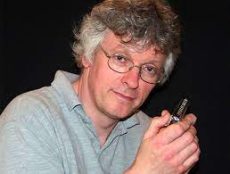
HENDRIK MEURKENS QUINTET
Hendrik Meurkens, a virtuoso on both the chromatic harmonica and the vibraphone, is the most important jazz harmonica player since Toots Thielemans. German-born but now based in New York, Meurkens’ recordings and performances garner worldwide acclaim because the transcendent beauty of his music has universal appeal.
A two-mallet player in the tradition of Milt Jackson and Bobby Hutcherson, Hendrik Meurkens was en-route to being an instantly recognizable vibraphonist when he heard Toots Thielemans. Inspired by the sound of Thielemans’ harmonica, he taught himself the difficult-to-master instrument.
Hendrik Meurkens’ other life-changing musical experience was his introduction to samba and bossa nova. He was so moved by Brazilian music that after perfecting his unique musical voice at Berklee, as a vibraphone major, he moved to Rio in the early 80s to totally immerse himself in music and culture of Brazil.
More Posts: adventure,club,genius,harmonica,jazz,music,preserving,travel

JOSHUA REDMAN
Celebrating his “where are we” tour with us at Keystone Korner Baltimore this February,Joshua Redman is one of the most acclaimed and charismatic jazz artists to have emerged in the decade of the 1990s. The early influences of John Coltrane, Ornette Coleman, Cannonball Adderley, and his father, Dewey Redman, as well as The Beatles, Aretha Franklin, the Temptations, Earth, Wind and Fire, Prince, The Police, and Led Zeppelin drew Joshua more deeply into music. Although he loved playing the saxophone, academics were always his first priority, and he never seriously considered becoming a professional musician. After graduating from Harvard College with a B.A. in Social Studies, he had already been accepted by Yale Law School, but deferred entrance for what he believed was only going to be one year to join friends in Brooklyn. Redman almost immediately he found himself immersed in the New York jazz scene. In November 1991, five months after moving to New York, Redman was named the winner of the prestigious Thelonious Monk International Saxophone Competition.
Sets: 7pm & 9:30pm
Joshua Redman ~ tenor saxophone
Gabrielle Cavassa ~ voice
Paul Cornish ~ piano
Philip Norris ~ bass
Nazir Ebo ~ drums
More Posts: adventure,club,genius,jazz,music,preserving,saxophone,travel,vocal