

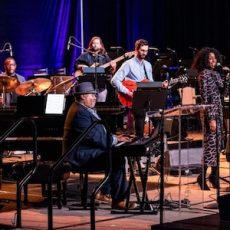
TYRONE JACKSON QUINTET
Dr. Tyrone Jackson brings his electric band to Eddie’s Attic. The quintet will explores the innovative edges of jazz and creativity. F.T.M.O. (From The Mind Of) is drawn from his critically acclaimed album From the Mind of Tyrone Jackson, where genres blur but the improvisational aspects of jazz remain central.
The Quintet:
Tyrone Kackson ~ Piano
Lavahi~vocals
Patrick Arthur ~ guitar
Joel Powell ~ bass
Robert Boone ~ drums | Grammy Winner
Cover: $23.37
More Posts: adventure,bandleader,bass,club,drums,genius,guitar,history,instrumental,jazz,music,piano,preserving,travel,vocal
Daily Dose Of Jazz…
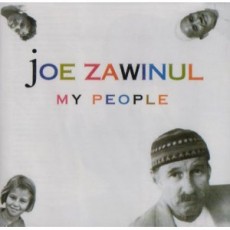
Joe Zawinul was born Josef Erich Zawinul on July 7, 1932 grew up in Vienna, Austria. Classically trained at the Konservatorium Wien, he played in various broadcasting and studio bands before emigrating to the U.S. in 1959 on a music scholarship to Berklee College of Music in Boston.
He went on to play with trumpeter Maynard Ferguson, where he first met Wayne Shorter after having had an influence in hiring him. Shorter left soon thereafter for Art Blakey’s group and Joe departed ways to tour and record with Dinah Washington for two years.
First coming to prominence in 1961 with saxophonist Cannonball Adderley, and during his nine-year stint composed the hit songs “Mercy, Mercy, Mercy”, “Walk Tall” and “Country Preacher”, the latter a tribute to Jesse Jackson
In the late 60s Zawinul played with Miles Davis, becoming one of the creators of jazz-fusion and one of the first to use electric pianos and synthesizers. He composed the title track on the album In A Silent Way and “Pharaoh’s Dance” on the landmark album Bitches Brew that occupied the whole of side one.[1]
In 1970, Zawinul co-founded Weather Report with Wayne Shorter bringing relatively open group improvisation with their fourth album Mysterious Traveller being their breakthrough. For the next fifteen years they would experience unparallel success with his composition “Birdland” being covered by the likes of Quincy Jones and the Manhattan Transfer and Jefferson Starship among others and winning him three Grammy awards.
Joe recorded 74 albums as a leader, sideman and collaborator; has been named Keyboardist” 28 times by the readers of Down Beat magazine, had several musicians honor him in song, written symphonies and performed and toured up until his hospitalization for a rare skin cancer where he died on September 11, 2007.
More Posts: piano
Daily Dose Of Jazz…
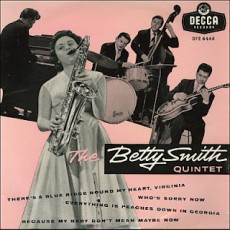
Betty Smith was born on July 6, 1929 in Sileby, Leicestershire, England. She studied the saxophone as a young child and began playing the alto saxophone when she was nine in Archie’s Juveniles, not concentrating on jazz until her early teens.
1947 saw Smith touring the Middle East with pianist Billy Penrose, and then with Ivy Benson’s evening gown clad Girls’ Band, playing for off duty Nuremberg trials officials, and in 1948 with Rudy Starita’s All Girls Band to play for the troops.
Women jazz musician were rare in the Fifties, but Betty, by then playing tenor, proved herself in Freddy Randall’s Dixieland/Chicago styled band. She would be heard swinging, improvising and playing hotter jazz than her colleagues as they toured around Britain.
Following a tour of the U.S. the breakup of Randall’s band, and Betty forming a quintet in 1957, she returned to the States and toured with Bill Haley’s Comets. She worked fronting the Ted Heath Orchestra as a vocalist, got numerous radio and television jobs and had her own program on Radio Luxembourg.
She would meet trumpeter Kenny Baker, form the sextet “Best of British Jazz” and be the band’s only saxophonist for the remainder of her career until she got sick in 1985. She continued to sing and play the piano until a week before her death on January 21, 2011 in Kirby Muxloe, Leicestershire, England.
Requisites
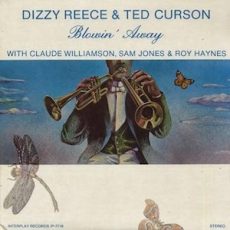
Blowin’ Away ~ Dizzy Reece and Ted Curson | By Eddie Carter
This morning’s album from the library is an obscure gem from 1978. Blowin’ Away (Interplay Records IP-7716) is a terrific hard bop session that unites two outstanding musicians of the 50s and 60s, Dizzy Reece on trumpet (tracks: A1, A3, B2, B3) and Ted Curson on flugelhorn (track: A2) and trumpet (tracks: A3, B2, B3). They’re joined by an exceptional rhythm section: Claude Williamson on piano; Sam Jones on bass; and Roy Haynes on drums. The copy I own is the 1978 U.S. Stereo release. Dizzy and the trio open the album with Stella By Starlight by Victor Young and Ned Washington. The trumpeter gets things going with a solo introduction leading to the quartet’s medium melody. Dizzy opens and closes with two readings that are as smooth as glass. Claude contributes a fine solo in between them propelled by Sam’s and Roy’s peppy support.
Ted steps in next to lead the trio on flugelhorn for the ageless chestnut, All The Things You Are by Jerome Kern and Oscar Hammerstein II. Curson launches the first solo with a bouncy, up-tempo swing. Next up, Williamson delivers a captivating interpretation, gracefully darting around the rhythm section like fleeting shadows. Ted and Haynes close out the solos with an engaging conversation before the foursome’s exit. Bass Conclave by Dizzy Reece begins with Roy’s introduction ahead, both trumpets taking the spotlight with the mute on for the quintet’s easy beat theme. Dizzy takes the opening statement with the mute off, making every note count with surgical precision. Ted moves in next to tell a swinging story, then Claude shows youthful exuberance next. Sam makes a quick comment preceding the reprise and a quick stop.
The second side’s spotlight shines on the trio for Charlie Parker’s Moose The Mooche. Roy opens the door to this bebop classic leading to the ensemble’s swinging melody. Claude takes the opening solo for a sizzling ride, then Sam takes a short vibrant walk. The pianist and Roy share a concise conversation leading to the closing chorus. The quintet returns as the beat slows down for Marjo by Ted Curson. Claude starts things off with a pretty introduction to both horns taking charge as the theme unfolds. Ted has the first say, and gives a delicately tender opening statement. Claude is up next and delivers his message with gentle beauty, then Ted returns for a few final thoughts setting up the quintet’s restatement of the theme and the finish!
The album wraps up with the quintet turning the temperature up with the rhythm section’s introduction to Walkin’ by Richard Carpenter. The front line takes over and drives the melody. Dizzy leads the way with enough high voltage to charge a city, then Claude builds on the rising intensity in the following solo. Ted turns up the heat further in the following reading, followed by both horns chasing each other into the theme’s reprise and climax. Toshiya Taenaka produced Blowin’ Away and Mike Ewasko managed the recording console. The album delivers an exceptional soundstage in the highs, midrange, and bass with superb fidelity that makes it feel as though the quintet is performing right in front of your sweet spot. The chemistry between Reece and Curson on the three quintet tunes are a perfect complement to the rhythm section’s superb support.
If you’re in the mood for a terrific hard bop album and enjoy the music of Dizzy Reece and Ted Curson, I enthusiastically recommend Blowin’ Away the next time you’re out record-shopping. It’s a memorable entry in both their discographies, and is sure to delight novice and seasoned fans alike!
~ All The Things You Are, Stella By Starlight – Source: JazzStandards.com ~ Moose The Mooche – Source: Wikipedia.org © 2026 by Edward Thomas Carter

More Posts: choice,classic,collectible,collector,history,instrumental,jazz,music,piano,trumpet
Requisites
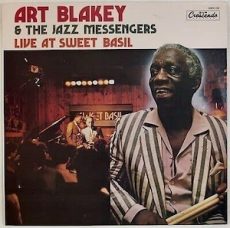
Live At Sweet Basil Art Blakey and The Jazz Messengers | By Eddie Carter
This morning’s column came about when the alarm went off, and I woke up to Jodi by Art Blakey and The Jazz Messengers on my phone. It got my day started on a jazzy note, and I went to the shelf and picked out Live at Sweet Basil (Paddle Wheel K28P 6357) to discuss. It was initially released in Japan, and the album combines two March 24, 1985, sets of the sextet’s last night at the jazz club. The lineup consists of Terence Blanchard on trumpet, Donald Harrison on alto saxophone, Jean Toussaint on tenor saxophone, Mulgrew Miller on piano, Lonnie Plaxico on bass, and Art Blakey on drums. The copy I own is the 1985 U.S. Stereo release (GNP Crescendo GNPS 2182).
Side One opens with Art’s introduction to the ensemble’s speedy melody of Jodi by Walter Davis. Jean ignites the first exhilarating interpretation. Donald responds energetically next, then Terence carves out a brilliant statement, and Mulgrew makes the most of the following reading. After the theme’s reprise, Art has the last word and gives a vigorous workout, into the close. Benny Golson’s Blues March settles into a comfortable medium tempo for Blakey’s marching introduction, leading to the ensemble’s theme. Harrison and Toussaint get things going in the first two solos, shadowed by the front line as they unfold. Blanchard goes to work next, continuing the easy beat as he explores a few musical ideas. Miller brings out his soulful charm in the next reading, and Plaxico walks leisurely toward the sextet’s closing chorus and finale.
Side Two takes off at a brisk clip with Art’s vigorous introduction to the rapid-fire theme of Mr. Babe by Donald Harrison. Terence is off and running at a furious pace. Donald continues the rapid acceleration in the second statement, then Jean keeps the momentum going with spirited choruses next. Mulgrew closes with a high-speed performance ahead of the melody’s reprise and an abrupt stop. Miller’s introduction brings Bobby Timmons’ classic Moanin’ to life, segueing into the group’s bluesy melody. The solo order is Blanchard, Harrison, Toussaint, Miller, and Plaxico, and all five members of the sextet get into a good groove that flows efficiently back into the closing chorus, a vibrant ending, and the audience’s approval.
Horst Liepolt and Shigeyuki Kawashima produced Live at Sweet Basil, and Kazunori Sugiyama was the recording engineer. Akira Makino was the mastering engineer, and Hatsuro Takanami was the remix engineer. The album was remixed and mastered at King Studios in Tokyo, Japan. The sound quality is excellent and transports the listener to a front row seat at Sweet Basil to enjoy the music. Live at Sweet Basil is an underrated treasure within the Jazz Messengers’ discography, showcasing one of the finest groups Art Blakey ever assembled. If you’re a long-time fan of hard bop or a newcomer, I encourage you to check out Live at Sweet Basil by Art Blakey and The Jazz Messengers on your next record shop visit. It’s a terrific release that I’m proud to own, and I highly recommend it for a spot in your library!
~ Moanin’ – Source: JazzStandards.com
~ Blues March – Source: Wikipedia.org
© 2026 by Edward Thomas Carter
More Posts: choice,classic,collectible,collector,drums,history,instrumental,jazz,music,piano