

Requisites
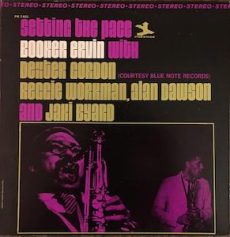
Setting The Pace ~ Booker Ervin | By Eddie Carter
I love a good blowing session, especially one featuring a tenor sax. I became a fan of Booker Ervin after hearing That’s It! (1961), Exultation! (1963), and Back From The Gig (1976). This morning’s album submitted for your approval is a 1967 release by the saxophonist, Setting The Pace (Prestige PR 7455/PRST 7455). Booker was born in Denison, Texas, and began playing the trombone as a youngster. He taught himself the tenor sax while serving in the Air Force and stationed in Okinawa. He later attended Berklee College of Music after completing his service and began playing with trombonist Ernie Fields. Ervin moved to New York a few years later and worked with Charles Mingus. Sharing the spotlight with him on this date is Dexter Gordon on tenor sax, Jaki Byard on piano, Reggie Workman on bass, and Alan Dawson on drums. My copy used in this report is the 1973 US Stereo reissue (Prestige PRT-7455).
The quintet dives straight into the first of two tunes by Dexter Gordon. Setting The Pace occupies the entire first side and both horns begin with an ear-opening introduction evolving into the ensemble’s lively melody. Dexter is up first with a lengthy performance of high-spirited delight. Booker keeps his foot on the pedal with long phrases soaring ambitiously to the stratosphere. Reggie makes a brief bass comment, then Jaki gets into something interesting on the next reading. Dex and Book return to share a brisk conversation. Alan concludes the solos with a short workout into the song’s climax. Side Two takes off with the rhythm section’s introduction and quintet’s theme to Dexter’s Deck. Booker starts things off vigorously in his opening statement. Dexter takes charge next on an enthusiastic nine-and-a-half-minute reading. Reggie responds with an inspired bit of bass walking preceding the song’s conclusion.
Setting The Pace was produced by Don Schlitten and Willy Schmidt was the man behind the dials. This reissue is a gorgeous recording possessing a very impressive soundstage. The instruments emerge from your speakers with crystal-clear clarity. Booker recorded a total of nine albums for Prestige, and seven more for Bethlehem, Blue Note, Candid, Pacific Jazz, and Savoy. He also made quite a few recordings as a sideman working with some of the best jazz musicians. He passed away at age thirty-nine from kidney failure on August 31, 1970. If you’re a fan of either Booker Ervin or Dexter Gordon and are in the mood for some adventurous Hard-Bop, I invite you to check out Setting The Pace on your next vinyl shopping spree. It’s forty-two-and-a-half minutes of splendid jazz that’s sure to have the listener hungering for more!
~ Back From The Gig (The Blue Note Reissue Series BN-LA488-H2), Exultation! (Prestige PRLP 7293/PRST 7293), That’s It! (Candid CJM-8014/CJS-9014) – Source: Discogs.com ~ Booker Ervin – Source: Wikipedia.org © 2022 by Edward Thomas Carter

More Posts: choice,classic,collectible,collector,history,instrumental,jazz,music,saxophone

Daily Dose Of Jazz…
Olivia Meyer was born on July 15, 1990 in Rochester, New York and first encountered her father’s tenor saxophone when looking under his bedroom dresser. There she discovered a large black case covered with dust containing a Mark VI. Her fathe rnot only gifted her the saxophone but once she played it was smitten and the decision to pursue the saxophone was cemented. They would go to the public library, check out the maximum number of cds and listen to them together.
At the age of nine, Olivia played and studied in the programs provided by the inner city schools she attended. She began private lessons in classical and jazz piano and ultimately jazz and classical saxophone. By fifteen, she was splitting her time between the School of the Arts and the Eastman School of Music, studying music history, theory, jazz composition, and classical and jazz saxophone.
As a member of the Eastman Youth Jazz Orchestra, she also worked and studied regularly with visiting artists Eric Alexander, Peter Bernstein, Paquito D’Rivera, Victor Goines, Wycliffe Gordon, Vincent Herring, Pat Labarbera, Ralph Lalama, Joe Locke, Gerry Niewood, and Grant Stewart.
After graduating from the School of the Arts, she received a scholarship to attend the Berklee College of Music in Boston, Massachusetts. She has played gigs in and around Rochester, and while in Boston she headlined a quartet as a part of the new “Birth of La Femme” series at Wally’s Jazz Café in Boston. Tenor saxophonist Olivia Meyer, has yet to record her debut album, is currently a Brand, Sales and Marketing Associate at Jazz At Lincoln Center.

More Posts: bandleader,history,instrumental,jazz,music,saxophone
Requisites
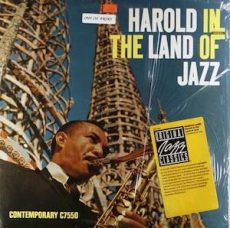
Harold In The Land of Jazz ~ Harold Land | By Eddie Carter
Harold Land steps into the spotlight this morning with his 1958 album, Harold In The Land of Jazz (Contemporary Records C7550/S7550). Harold was one of the best West Coast tenor saxophonists with fifteen albums as a leader and an extensive discography as a sideman to his credit. He was on track for more success in some of the best small jazz groups when an illness in his family caused him to leave the East Coast and return to Los Angeles in 1956. For his first date as a leader, Land’s assembled a splendid supporting cast; Rolf Ericson on trumpet, Carl Perkins on piano, Leroy Vinnegar on bass, and Frank Butler on drums. My copy used in this report is the 1984 Contemporary Records Original Jazz Classics US Stereo reissue (OJC-162 – C-7550).
Side One kicks off this trip with Speak Low by Kurt Weill and Ogden Dash. This jazz standard was introduced in the Broadway musical, One Touch of Venus (1943), and the quintet gets busy quickly with the melody. Harold heats up the lead solo vigorously. Rolf keeps up the exhilarating pace on the second statement. Carl enters next with enthusiastic energy, then Frank exhibits his wizardry ahead of the ensemble’s rousing finale. Up next is Delirium, a medium swinger by Harold Land. The trio makes the introduction, succeeded by the quintet’s theme. Harold begins cruising down the road at a comfortable speed, then Rolf picks up the journey at an unhurried pace. Carl gets the next spot for an impressive presentation that flows vibrantly, and Frank adds a brief footnote leading to the group’s exit.
You Don’t Know What Love Is by Don Raye and Gene De Paul was written for an Abbott and Costello comedy, Keep ‘Em Flying (1941). It didn’t appear in the film but became a jazz standard after Miles Davis recorded it a few years later on All-Star Sextet (1954). It’s a beautiful quartet performance by Harold and the trio. As the song’s only soloist, the tenor sax tells a poignant, bittersweet story reinforced by the rhythm’s serene support. Nieta by Elmo Hope takes us to a tropical climate with a cheerful introduction ahead of the ensemble’s happy theme. Harold partakes in the festivities on the first solo. Carl adds to the celebratory spirit in the next reading, and Rolf sinks his teeth into a spicy statement. Frank gets a brief moment to shine before the reprise.
Side Two opens with Grooveyard, a breezy blues by Carl Perkins who passed away two months later from a drug overdose on March 16, 1958. As a tribute to the pianist, Harold changed the album’s title to Grooveyard for the Stereo release. After the trio’s introduction, the quintet begins the charming melody. Carl opens with a delightfully mellow groove. Rolf takes over on the muted horn with a solo as relaxing as a cup of Chamomile Tea. Harold is up next with an exquisite display that builds to a satisfying peak. Leroy puts the cherry on top with a gorgeous reading. Lydia’s Lament is Harold’s tune named for his wife. It starts with a sublimely solemn collective melody. Harold is the only soloist, and he delivers a touching performance reminiscent of a faint and lamentable cry of sadness.
Smack Up by Harold Land wraps up our seven-song journey with Butler’s brisk introduction ahead of the ensemble’s theme. Harold sets the table with a spirited lead solo; next Rolf follows with a reading of pure delight. Carl shows off his impeccable chops then gives way to Frank’s rousing exchange with the front line into the close. Harold In The Land of Jazz was originally produced by Lester Koenig, and the engineers are Roy DuNann and Howard Holzer. Their work clearly shows in this OJC reissue because it possesses an excellent soundstage that transports the listener’s sweet spot to the studio surrounded by the musicians. Elmo Hope and Harold worked together on the arrangements of all seven tracks.
Harold Land had a lengthy career lasting nearly five decades and also taught jazz studies at the University of California. He passed away at age seventy-two from a stroke on July 27, 2001; but is still remembered for his robust tone and his skill as an improviser. If you’re in the mood for Hard-Bop, I offer for your consideration, Harold In The Land of Jazz by Harold Land. It’s a terrific album of wonderful performances that I happily recommend to anyone who loves jazz and should not be overlooked the next time you’re shopping for vinyl treasure!
~ Miles Davis All-Star Sextet (Prestige PRLP 182) – Source: Discogs.com ~ Speak Low, You Don’t Know What Love Is – Source: JazzStandards.com ~ Harold Land, Carl Perkins – Source: Wikipedia.org © 2022 by Edward Thomas Carter
More Posts: choice,classic,collectible,collector,history,instrumental,jazz,music,saxophone
Daily Dose Of Jazz…
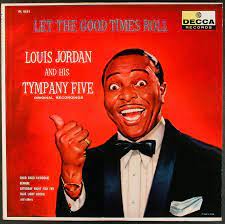
Louis Thomas Jordan was born on July 8, 1908 in Brinkley, Arkansas. His father, James Aaron Jordan, was a music teacher and bandleader for the Brinkley Brass Band and the Rabbit Foot Minstrels. His mother died when he was young and his grandmother Maggie Jordan and his aunt Lizzie Reid raised him. At an early age he studied clarinet and saxophone with his father and by his teens he was a member of the Rabbit Foot Minstrels and was playing professionally in the late 1920s.
In the early Thirties he was performing in Philadelphia, Pennsylvania and New York City with Charlie Gaines. He recorded with Clarence Williams and was a brief member of the Stuff Smith Orchestra. Joining the Chick Webb Orchestra he sang and played alto saxophone, however, in 1938 he started a band that recorded a year later as the Tympany Five.
In 1942, Jordan and his band moved to Los Angeles, California where he began making soundies, the precursors of music video. He appeared on many Jubilee radio shows and a series of programs for the Armed Forces Radio for distribution to American troops overseas. Though a hernia condition kept him out of the war his recordings made him very popular with both black and white soldiers.
During the 1940s Jordan and the band became popular with such hits as Choo Choo Ch’Boogie, Knock Me a Kiss, Is You Is or Is You Ain’t My Baby, and Five Guys Named Moe. Within a year of his breakthrough, the Tympany Five’s appearance fee rose from $350 to $2,000 per night. But the breadth of Jordan’s success and the size of his combo had larger implications for the music industry. His raucous recordings were notable for the use of fantastical narrative, best exemplified on Saturday Night Fish Fry, a two-part 1950 hit that was split across both sides of a 78-rpm record. It was one of the first popular songs to use the word “rocking” in the chorus and to feature a distorted electric guitar.
From July 1946 through May 1947, Jordan had five consecutive number one songs, holding the top slot for 44 consecutive weeks. In 1961, the IRS filed an income tax lien against Jordan and he had to sell property well below its value to pay off his debts. Musician Ike Turner stepped in and contacted and convinced the president of Jordan’s booking agency in Chicago, Illinois. to send Jordan a check for $20,000. He was unaware of this deed.
Over his career he charted dozens of singles, eighteen #1 and fifty-four in the Top Ten. He ranked fifth among the most successful musicians of the period 1942~1995, however, many he did not own the rights to, hence no financial benefit. Saxophonist, multi~instrumentalist, songwriter and bandleader Louis Jordan suffered a heart attack and transitioned on February 4, 1975, in Los Angeles.
More Posts: bandleader,history,instrumental,jazz,music,saxophone,songwriter
The Quarantined Jazz Voyager
As the virus is continuing to evolve the Jazz Voyager is staying close to home, especially since the country has lifted the masking mandate and it appears that everything is “back to normal”, even though it is not yet. Supply chain is still limiting production and delivery of items. As you travel around your city, state, country, and internationally please continue to be careful and protect yourself and others.
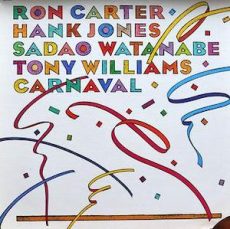
Carnaval is an album recorded Live Under The Sky in Denen Coliseum in Tokyo, Japan on July 30, 1978 by bassist Ron Carter, pianist Hank Jones, saxophonist Sadao Watanabe and drummer Tony Williams. The album was produced by Ed Michel and released five years later in 1983 on the Galaxy record label.
he art direction for the album was performed by Phil Carroll, the recording engineer was Jim Stern, mastered by George Horn, and the remix was done by Allen Sudduth.
Tracks | 43:18- Chelsea Bridge (Billy Strayhorn) ~ 10:12
- Manhã de Carnaval (Luiz Bonfá, Antônio Maria) ~ 9:01
- I’m Old Fashioned (Jerome Kern, Johnny Mercer) ~ 8:18
- Confirmation (Charlie Parker) ~ 6:40
- Moose the Mooche (Parker) ~ 8:05
- Ron Carter ~ bass
- Hank Jones ~ piano
- Sadao Watanabe ~ alto saxophone
- Tony Williams ~ drums

More Posts: adventure,album,bass,club,drums,genius,jazz,museum,music,piano,preserving,restaurant,saxophone,travel