

Daily Dose Of Jazz…
Jerry Blake was born Jacinto Chabania on January 23, 1908 in Gary, Indiana and grew up in Nashville, Tennessee. He began his musical education playing violin before switching to reeds.
In 1924 he toured with the Sells-Fioto Circus Band but was left stranded in Chicago. Making the best of the situation, he joined Al Wynn’s band, then played with Bobby Lee and Charlie Turner. He then toured Europe in 1928-29 as a member of Sam Wooding’s ensemble.
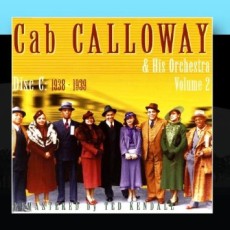
Back in the States in the 1930s Jerry played in the US with Chick Webb,Zack Whyte and Don Redman, then was off to Europe again with Willie Lewis from 1934 to 1935. After his return home he spent time performing with Claude Hopkins, Fletcher Henderson and Cab Calloway, acting as the latter’s musical director during his 1938-42 stint.
In the early 1940s Blake played with Count Basie, Earl Hines, Lionel Hampton and Redman again. Sometime around 1943 he had a mental breakdown and never played again for the rest of his life, most of which he spent in institutions. Alto saxophonist and clarinetist Jerry Blake, who never recorded as a leader, passed away on December 31, 1961.

Put A Dose In Your Pocket

Daily Dose Of Jazz…
Michał Urbaniak was born on January 22, 1943 in Warsaw, Poland. He started his music education during high school and continued from 1961 in Warsaw in the violin class of Tadeusz Wronski. Learning to play the saxophone he first played in a Dixieland band, and later with Zbigniew Namyslowski and the Jazz Rockers, performing during the 1961 Jazz Jamboree festival.
The following year Michal played with Andrzej Trzaskowski band, The Wreckers, touring festivals and clubs in the USA in Newport, San Francisco, Chicago, Washington and New York City. A return to Poland saw him working with the Krzysztof Komeda Quintet from 1962 to 1964, touring Scandinavia and remaining to form his own band with Wojciech Karolak, that became starting point for the famous Michał Urbaniak Fusion.
Urbaniak returned to Poland and the violin, and created the self-named Michał Urbaniak Group, to which he invited, among others, vocalist Urszula Dudziak, pianist Adam Makowicz, bassist Pawel Jarzebski and on drums Czeslaw Bartowski. Their debut recording on the international scene was in 1970 with Parathyphus B, and during the Montreux ’71 festival, he was awarded “Grand Prix” for the Best Soloist and a scholarship to the Berklee Colege of Music, though he declined to attend.
He played his final concert in Poland in 1973 and emigrated with Urszula Dudziak to the United States, signed with Columbia Records, formed the band Fusion and released Super Constellation. His 1978 Urbanizer project fused rap, hip-hop and a R&B vocal quartet. By 1995 he was engaging a 60-piece full symphony with jazz group, rapper and Apple computer in concert and recorded both CD and DVD.
Over the course of his career he has performed and recorded with Steve Jordan, Marcus Miller, Kenny Kirkland, Tony Bun, Omar Hakim, Victor Bailey, Weather Report, Freddie Hubbard, Elvin Jones, Herbie Hancock, Chick Corea, George Benson, Billy Cobham, Joe Zawinul, Ron Carter, Kenny Barron, Buster Williams and Quincy Jones.
Violinist Michal Urbaniak played on the 1985 session of the Miles Davis Tutu album and in 2012 appeared in the Polish film My Father’s Bike. He hs recorded thirty-eight albums to date and continues to perform, record and compose.
Jazz Is Global – Share
Daily Dose Of Jazz…
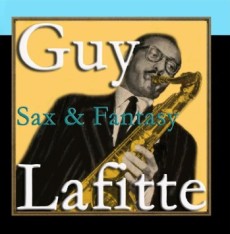
Guy Lafitte was born on January 12, 1927 in Saint-Gaudens, France. Most notable for his tenor saxophone work with Mezz Mezzrow from 1951–1952 and also toured with Big Bill Broonzy in 1951.
In 1954 Lafitte made Paris his home, and worked with Lionel Hampton Emmett Berry. He also collaborated on various other projects with musicians such as Wild Bill Davis and Bill Coleman.
Guy recorded six albums as a leader beginning with his debut in 1953 with All The Things You Are playing with Franck Pourcel, and continued on with Peanuts Holland, Raymond Fol, Jean-Claude Pelletier, Geo Daly, Andre Persiany, Paul Rovere, Teddy Martin, Hank Jones, George Duvivier, J.C. Heard, Clyde Lucas, Jacky Terrasson, Pierre Boussaguet and Al Lewitt.
He recorded another seven sessions as a sideman with Arnett Cobb, Bill Coleman, Sammy Price, Lucky Thompson, Buck Clayton, Charlie Singleton and Ben Webster. Tenor saxophonist Guy Lafitte passed away on June 10, 1998.
Dose A Day – Blues Away
More Posts: saxophone
Daily Dose Of Jazz…
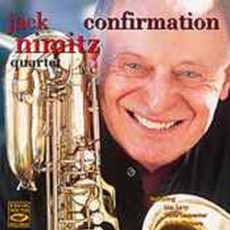
Jack Nimitz was born in Washington, DC on January 11, 1930. He first began playing clarinet at age 12, and picked up the alto saxophone at 14. He played in local DC bands and after specializing on baritone sax he found work in the territory bands of Willis Connover, Bob Astor, Johnny Bothwell and Daryl Harpa.
Through the Fifties Nimitz played with Woody Herman, Stan Kenton and Herbie Mann and was in the house band of the Savoy Theater. Moving to Los Angeles, California he worked in film music in addition to performing with Bill Berry, Benny Carter, Onzy Matthews, Gerald Wilson, Supersax, Frank Strazzen, Thelonious Monk, Terry Gibbs, Dizzy Gillespie, Louis Bellson, Quincy Jones, Kenny Burrell, Horace Silver, Gene Ammons, Shelly Manne, Chuck Mangione, Charles Mingus, Gil Fuller, Oliver Nelson, Milt Jackson, Frank Capp and Joey DeFrancesco into the 1980s.
Additionally Jack recorded with the vocalists Johnny Hartman, June Christy, Peggy Lee, Nat King Cole, Carmen McRae, Anita O’Day and Diane Schuur. By the Nineties he was recording again with Claire Fischer, Lalo Schifrin, Stewart Liebig, Bill Perkins, Bud Shank and Gerald Wilson.
In 1995 he released his first of two albums under his own name, The Jack Nimitz Quintet, and played his final performance on May 10, 2009, in Northridge, California. Baritone saxophonist Jack Nimitz passed away at the age of 79 one month later on June 10, 2009 from complications from emphysema in Studio City, Los Angeles, California.
Take A Dose On The Road
More Posts: saxophone
Daily Dose Of Jazz…
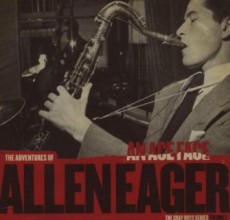
Allen Eager was born on January 10, 1927 in New York City and grew up in the Bronx. Reading by age 3, he learned to drive at the age of 9 with the help of his mother, after catching him driving a garbage truck near their hotels in the Catskill Mountains. He took clarinet lessons with David Weber of the New York Philharmonic at the age of 13 and went on to make the tenor saxophone his instrument.
When he was 15 Eager briefly played with Woody Herman and also took heroin for the first time. The next year he played in the Bobby Sherwood band, then went on to play with Sonny Dunham, Shorty Sherock, Hal McIntyre, Tommy Dorsey and John Bothwell all by 1945. After World War II he became a regular on the 52nd Street scene in New York, led his own ensemble there from 1945–47 and recorded his debut as leader for Savoy Records in 1946 with pianist Ed Finckel, bassist Bob Carter and drummer Max Roach.
Influenced by the playing of Lester Young, he was in good company with his contemporaries Zoot Sims, Stan Getz, Al Cohn and others. He adopted the musical forms pioneered in bebop but also adopted the drug dependency of a lot of the bebop players in the 1940s. As a white saxophonist of the time, Eager was a member of several bands led by black musicians including Coleman Hawkins, Fats Navarro, Charlie Parker, Red Rodney and Tadd Dameron by 1950.
During the Fifties he played with Gerry Mulligan, Terry Gibbs, Buddy Rich and Howard McGhee. He lived and performed in Paris from 1956-1957, returned to the States and recorded his last session for the next 25 years, The Gerry Mulligan Songbook with Mulligan leading. He essentially retired from jazz and while dealing with his own drug addiction did appear in Jack Kerouac’s 1958 book The Subterraneans as the character Roger Beloit. Allen went on to pursue other activities such as skiing, auto racing, and LSD experimentation with Timothy Leary. After several notable racing finishes at Sebring and Europe in 1963 a crash left him with broken bones.
He occasionally dabbled in music again, playing alto saxophone with Charles Mingus, Frank Zappa, recorded a 1982 Uptown Records session titled Renaissance. He toured with Dizzy Gillespie and Chet Baker and played in England. Tenor and alto saxophonist Allen Eager passed away from liver cancer on April 13, 2003 in Daytona Beach, Florida.
Give The Gift Of Knowledge
More Posts: saxophone