

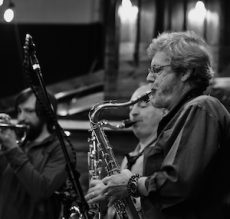
THE JAZZ SYMBIOSIS QUINTET
More Posts: adventure,bass,club,cornet,drums,flugelhorn,flute,genius,jazz,music,piano,preserving,saxophone,travel,trombone,trumpet
Daily Dose Of Jazz…
William Henry Graham was born on September 8, 1918 in Kansas City, Missouri and grew up in Denver, Colorado. During his years in Denver he led his own ensemble which included Paul Quinichette among its members. He went on to study at Tuskegee University and then Lincoln University of Missouri after a stint in the Army during World War II.
He worked with Count Basie, Lucky Millinder, Herbie Fields, and Erskine Hawkins early in his career. From 1946 to 1953, he worked with Dizzy Gillespie as a baritone saxophonist. As a composer under Gillespie, he penned the tune Oh-Sho-Be-Do-Be.
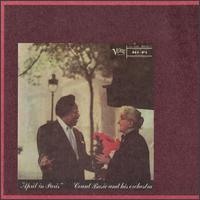
Following his Gillespie years he led his own band in New York City, in addition to touring Europe with Sarah Vaughan in 1953. From 1955 to 1957, Bill was back with Basie, including on the 1956 release April in Paris and the Newport Jazz Festival. In 1956-57 he teamed again with Quinichette, then in 1958 he found work with Duke Ellington and Mercer Ellington from 1958–59.
Outside of jazz, Graham also played on numerous R&B recordings, including those of Wynonie Harris, Joe Williams, and Little Willie John. In the 1960s he quit active touring and became a teacher in the New York City Public Schools system.
Saxophonist Bill Graham transitioned on December 29, 1975 in New York at the age of 57.
More Posts: history,instrumental,jazz,music,saxophone
The Jazz Voyager
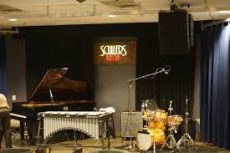
The Jazz Voyager is heading to Logan Airport in Beantown for a summer experience at the famous Scullers Jazz Club that has been a jazz landmark in the city since its founding in 1989. Led by jazz impresario Fred Taylor, the 200-seat club offers spectacular views of Boston’s skyline and the Charles River that serve as the perfect backdrop for world-class entertainment you won’t see anywhere else in Boston.
This week I’ll be enjoying NEA Jazz Master saxophonist Kenny Garrett. His illustrious career includes hallmark stints with Miles Davis, Art Blakey and The Jazz Messengers, Donald Byrd, Freddie Hubbard, Woody Shaw and the Duke Ellington Orchestra. With a heralded career as a solo artist of more than 30 years ago, he is easily recognized as one of modern jazz’s brightest and most influential living masters.
The venue is located on the ground floor of the DoubleTree Suites at 400 Soldiers Field Road, MA 02134. More information can be obtained by calling 617-747-2261 or by visiting scullersjazz.com.
More Posts: adventure,club,genius,jazz,music,preserving,saxophone,travel
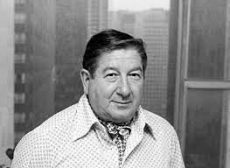
Three Wishes
While the Baroness was in conversation with Teo Macero he was asked by her what three wishes he would make if given. He told her:
- “Peace of mind.”
- “To change the status of jazz. That is, to get rid of the stigma attached to jazz music. You know. A jazz musician is regarded as some kind of freak! This is something that has bugged me for a long, long time. Like, someone will come up to me and say, “Oh, so you’re a jazz musician?” And when I say< “Yes. A jazz musician and a composer,” they will look at me altogether differently. It would be marvelous if jazz musicians could be given a status equal to that or great figures of contemporary music.”
- “To have no problems with people recording. No problems in the studio.”
*Excerpt from Three Wishes: An Intimate Look at Jazz Greats ~ Compiled and Photographed by Pannonica de Koenigswarter

More Posts: baroness,composer,history,instrumental,jazz,music,pannonica,producer,saxophone,three,wishes

Daily Dose Of Jazz…
Jimmy Strong was born August 29, 1906 in Chicago, Illinois. As a teenage clarinetist he performed in Lottie Hightower’s Nighthawks. Around 1925, he did a national tour with a traveling revue and stayed in California for a time, freelancing with several groups.
Returning to Chicago he joined Carroll Dickerson’s orchestra, where he worked with Louis Armstrong, appearing on Armstrong’s Hot Fives recordings. In 1928, he also worked briefly with Clifford King. The 1930s saw him playing with Cassino Simpson, Zinky Cohn, and Jimmie Noone, as well as his own bands.
Around 1940 relocating to Jersey City, New Jersey he performed with local bands until his death. Clarinetist and tenor saxophonist Jimmy Strong transitioned in April 1977.
More Posts: clarinet,history,instrumental,jazz,music,saxophone