

Daily Dose Of Jazz…
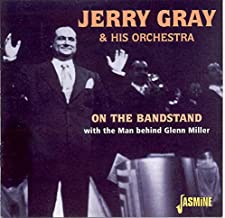
Jerry Gray was born Generoso Graziano on July 3, 1915 in East Boston, Massachusetts. His father was a music teacher who began teaching his son violin at age seven. As a teenager he studied with Emanuel Ondříček and was a soloist with the Boston Junior Symphony. By age eighteen he had formed a jazz band and was performing in Boston clubs.
1936 saw Gray joining the Artie Shaw orchestra as lead violinist and studied musical arrangement under Shaw. A year later he became a staff arranger. Over the next two years he penned some of the band’s most popular arrangements, including Carioca, Softly, As In A Morning Sunrise, Any Old Time, and Begin the Beguine. After the band broke up in 1939, Glenn Miller offered him a job arranging
In November 1939, Shaw suddenly broke up the band and moved to Mexico. On the next day, Glenn Miller called Gray and offered him a job arranging for his band. During his time with the Glenn Miller Orchestra, Jerry produced many of the most recognizable recordings of the era, arranging Elmer’s Tune, Moonlight Cocktail, Perfidia, and Chattanooga Choo-Choo among others, while his compositions among numerous others included Sun Valley Jump, The Man In The Moon, Caribbean Clipper, Pennsylvania 6-5000, and his most famous song, A String of Pearls. Many of his compositions became best-sellers.
The war years saw Jerry in Miller’s unit and became chief arranger for Miller’s “Band of the Training Command”, better known today as the Glenn Miller Army Air Forces Orchestra. He was the full orchestra’s assistant conductor, and conducted the orchestra’s first concert in Paris after Miller’s airplane disappeared over the English Channel.
After the war for a while he did radio and studio work around Los Angeles, California, including leading the band on a radio show called Club 15 that featured Dick Haymes. In 1949 he accepted a request from Decca Records to lead his own Miller-esque orchestra that was called Jerry Gray and the Band of Today.
Violinist, arranger, composer, and leader of swing big bands Jerry Gray, who continued to lead the Fairmont Hotel band into the 1970s, passed away of a heart attack on August 10, 1976 in Dallas, Texas. He was 61.

More Posts: arranger,composer,history,instrumental,jazz,music,violin

Daily Dose Of Jazz…
Lutz Templin was born Ludwig Templin on June 18, 1901 in Düsseldorf, Germany. He started out playing violin and saxophone, and studied composition before finding work playing and arranging in dance ensembles.
From 1941 to 1949 Lutz led a big band in Germany which recorded extensively and was broadcast on German radio. This ensemble also recorded as Charlie and his Orchestra, doing arrangements of American jazz hits with propagandistic lyrics inserted. These were broadcast on Nazi radio stations and whether he was forced to do so is unknown.
Templin’s ensemble operated out of Berlin until 1943, when Allied bombing resulted in their relocation to Stuttgart. He remained there after the war and continued performing there for most of the rest of his life. Bandleader Lutz Templin passed away on March 7, 1973 in Stuttgart, Germany.
More Posts: bandleader,history,instrumental,jazz,music,saxophone,violin
Daily Dose Of Jazz…
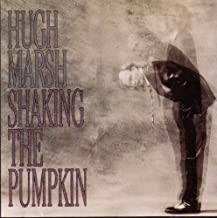
Hugh Marsh was born June 5, 1955 in Montreal, Quebec, Canada and brought up in Ottawa, Ontario, where he learned to play the violin from the age of five. While in high school, when trying to play the saxophone he was led to exploring jazz, funk and rhythm and blues. With his father’s encouragement, he transferred these improvisation skills to the electric violin.
By 1978, Marsh was invited by jazz musician Moe Koffman to perform with him in a concert series at the Art Gallery of Ontario in Toronto. This led to gigs at top Toronto clubs and to perform with Canadian jazz musicians Doug Riley, Claude Ranger, Sonny Greenwich and Don Thompson. In 1979 he joined Bruce Cockburn, recording and touring with him.
In 1984, he recorded his independent album The Bear Walks and was distributed by Duke Street Records. He was joined by Doug Riley on keyboards, Peter Cardinali on bass, and Michael Brecker on tenor saxophone. His next recording ventured into other genres mixed with jazz. Since 1990 HUgh has recorded and toured with Celtic songstress Loreena McKennitt, contributing to six multi-platinum albums and a number of world tours. He has worked with Turkish Sufi deejay Mercan Dede, and has worked with Turkish artists Ihsan Ozgen, Kani Karaca, Goksel Baktagir and Ozcan Deniz.
Marsh would go on to collaborate on film scoring projects with composers Harry Gregson Williams and Don Rooke, and with Hans Zimmer on scores for Tears of the Sun and The Da Vinci Code.
In 2004 he joined clarinetist Don Byron’s new quartet “Swiftboat”, along with bassist Kermit Driscoll, and drummer Pheeroan Aklaff. He toured as a member of trumpeter Jon Hassell’s new quartet with bassist Peter Freeman and percussionist Steve Shehan. A four-time winner of the Jazz Report Award for violinist of the year and a three-time recipient of the National Jazz Award for violinist of the year, he has been nominated for a 2007 Juno Award in the best contemporary jazz album category.
Violinist Hugh Marsh continues to perform and record across genres, regularly performing with Rheostatics.
More Posts: bandleader,history,instrumental,jazz,music,violin

Daily Dose Of Jazz…
John W. Russell was born on June 4, 1909 in Charlotte, North Carolina but was raised in New York City. He began on violin at age nine, later picking up saxophone and clarinet. He played in both capacities with Jimmy Campbell in 1926, then worked at the Strand Danceland under Earle Howard.
While continuing to play violin in live settings, there are no known recordings of him as a violinist. In the early 1930s after working with Harry White, he replaced Chu Berry in Benny Carter’s ensemble in 1933-34, then joined up with Willie Bryant in 1935-36. Johnny toured with Bobby Martin’s orchestra in Europe in 1938, and played with this group on the soundtrack to the 1938 Erich von Stroheim film, L’alibi; it is for his solos in this recording that he is best known.
Following this Russell remained in Europe to play with Willie Lewis from 1939 to 1941. Upon his return to the U.S. he played with Garvin Bushell briefly before being drafted. He played in military bands, including Russell Wooding’s, during World War II, then played following the war with Cecil Scott in 1945 and Eddie Cornelius.
Tenor saxophonist, clarinetist, and violinist Johnny Russell, who stopped playing full-time later in the 1940s, but occasionally did club dates later in his life, passed away on July 26, 1991 in New York City.
More Posts: clarinet,history,instrumental,jazz,music,saxophone,violin
Daily Dose Of Jazz…
Ray Perry was born on February 25, 1915 in Boston, Massachusetts to a musical family and began playing the violin at a young age, and didn’t pick up the alto saxophone till he was twenty. He organized his first band, the Arabian Knights, in 1932.
Working the bread and butter gigs, he performed with the best in the business from 1935 to 1943, among numerous others, Dean Earl in the Little Harlem Orchestra, Clarence “Chick” Carter Orchestra with Gerald Wilson, then with Joe Nevils band when it masqueraded as the Blanche Calloway Orchestra, before joining the Lionel Hampton band. In the mid-thirties Ray developed a technique of simultaneously singing an octave below his playing as he bowed his violin. Hearing him, bassist Slam Stewart adopted the same technique, except he sang an octave above his playing.
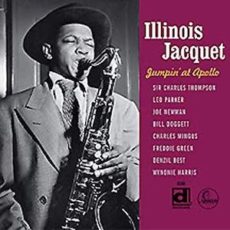
Poor health forced him to return to Boston in late 1942, where he found work with Sherman Freeman, Sabby Lewis, and his fraternal band, the Perry Brothers Orchestra with Joe on tenor saxophonoe and Bey on drums, Performing more frequently on alto saxophone, despite his short career, Perry worked with Shadow Wilson, Illinois Jacquet Vernon Alley, J. C. Heard, Joe Newman, Fred Beckett, Sabby Lewis, Sir Charles Thompson, and Irving Ashby.
Health problems continued to dog him for almost a decade leading to the passing away of violinist and alto saxophonist Ray Perry from kidney disease at age 35 in November 1950 in New York City. However, his final record date was with Illinois Jacquet earlier that year. Some of his best surviving violin work was recorded with a Hampton septet in late 1940.

More Posts: bandleader,history,instrumental,jazz,music,saxophone,violin