

Requisites
Harold In The Land of Jazz ~ Harold Land | By Eddie Carter
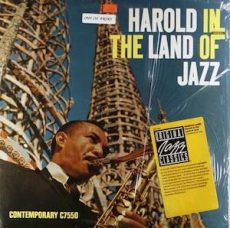
Harold Land steps into the spotlight this morning with his 1958 album, Harold In The Land of Jazz (Contemporary Records C7550/S7550). Harold was one of the best West Coast tenor saxophonists with fifteen albums as a leader and an extensive discography as a sideman to his credit. He was on track for more success in some of the best small jazz groups when an illness in his family caused him to leave the East Coast and return to Los Angeles in 1956. For his first date as a leader, Land’s assembled a splendid supporting cast; Rolf Ericson on trumpet, Carl Perkins on piano, Leroy Vinnegar on bass, and Frank Butler on drums. My copy used in this report is the 1984 Contemporary Records Original Jazz Classics US Stereo reissue (OJC-162 – C-7550).
Side One kicks off this trip with Speak Low by Kurt Weill and Ogden Dash. This jazz standard was introduced in the Broadway musical, One Touch of Venus (1943), and the quintet gets busy quickly with the melody. Harold heats up the lead solo vigorously. Rolf keeps up the exhilarating pace on the second statement. Carl enters next with enthusiastic energy, then Frank exhibits his wizardry ahead of the ensemble’s rousing finale. Up next is Delirium, a medium swinger by Harold Land. The trio makes the introduction, succeeded by the quintet’s theme. Harold begins cruising down the road at a comfortable speed, then Rolf picks up the journey at an unhurried pace. Carl gets the next spot for an impressive presentation that flows vibrantly, and Frank adds a brief footnote leading to the group’s exit.
You Don’t Know What Love Is by Don Raye and Gene De Paul was written for an Abbott and Costello comedy, Keep ‘Em Flying (1941). It didn’t appear in the film but became a jazz standard after Miles Davis recorded it a few years later on All-Star Sextet (1954). It’s a beautiful quartet performance by Harold and the trio. As the song’s only soloist, the tenor sax tells a poignant, bittersweet story reinforced by the rhythm’s serene support. Nieta by Elmo Hope takes us to a tropical climate with a cheerful introduction ahead of the ensemble’s happy theme. Harold partakes in the festivities on the first solo. Carl adds to the celebratory spirit in the next reading, and Rolf sinks his teeth into a spicy statement. Frank gets a brief moment to shine before the reprise.
Side Two opens with Grooveyard, a breezy blues by Carl Perkins who passed away two months later from a drug overdose on March 16, 1958. As a tribute to the pianist, Harold changed the album’s title to Grooveyard for the Stereo release. After the trio’s introduction, the quintet begins the charming melody. Carl opens with a delightfully mellow groove. Rolf takes over on the muted horn with a solo as relaxing as a cup of Chamomile Tea. Harold is up next with an exquisite display that builds to a satisfying peak. Leroy puts the cherry on top with a gorgeous reading. Lydia’s Lament is Harold’s tune named for his wife. It starts with a sublimely solemn collective melody. Harold is the only soloist, and he delivers a touching performance reminiscent of a faint and lamentable cry of sadness.
Smack Up by Harold Land wraps up our seven-song journey with Butler’s brisk introduction ahead of the ensemble’s theme. Harold sets the table with a spirited lead solo; next Rolf follows with a reading of pure delight. Carl shows off his impeccable chops then gives way to Frank’s rousing exchange with the front line into the close. Harold In The Land of Jazz was originally produced by Lester Koenig, and the engineers are Roy DuNann and Howard Holzer. Their work clearly shows in this OJC reissue because it possesses an excellent soundstage that transports the listener’s sweet spot to the studio surrounded by the musicians. Elmo Hope and Harold worked together on the arrangements of all seven tracks.
Harold Land had a lengthy career lasting nearly five decades and also taught jazz studies at the University of California. He passed away at age seventy-two from a stroke on July 27, 2001; but is still remembered for his robust tone and his skill as an improviser. If you’re in the mood for Hard-Bop, I offer for your consideration, Harold In The Land of Jazz by Harold Land. It’s a terrific album of wonderful performances that I happily recommend to anyone who loves jazz and should not be overlooked the next time you’re shopping for vinyl treasure!
~ Miles Davis All-Star Sextet (Prestige PRLP 182) – Source: Discogs.com ~ Speak Low, You Don’t Know What Love Is – Source: JazzStandards.com ~ Harold Land, Carl Perkins – Source: Wikipedia.org © 2022 by Edward Thomas Carter

More Posts: choice,classic,collectible,collector,history,instrumental,jazz,music,saxophone

Daily Dose Of Jazz…
Milton Brent Buckner was born July 10, 1915 in St. Louis, Missouri to parents who encouraged him to learn to play piano, but they both died when he was nine years old. Milt and his younger brother Ted were sent to Detroit where they were adopted by members of the Earl Walton band, trombonist John Tobias, drummer George Robinson fostered Milt and reedplayer Fred Kewley fostered Ted. He studied piano for three years from the age 10, then at 15 began writing arrangements for the band. He and his brother went on to become active in the Detroit jazz world in the 1930s.
He first played in Detroit with the McKinney’s Cotton Pickers and then with Cab Calloway. In 1941, he joined Lionel Hampton’s big band, and for the next seven years served as its pianist and staff arranger. Buckner was part of a Variety Revue of 1950 organized by Lionel Hampton at the Cavalcade of Jazz concert held at Wrigley Field in Los Angeles, California. He led a short-lived big band of his own for two years, but then returned to Hampton’s in 1950.
In 1952, Milt formed his own trio and pioneered the use of the electric Hammond organ. He often played in Europe in the late 1960s. His last studio session took place in Paris. France on July 4, 1977. He is also known for the use of his song The Beast in the title menu of the video game, Battlefield: Bad Company.
Pianist and Hammond B3 organist Milt Buckner, who pioneered the parallel chords style that influenced Red Garland, George Shearing, Bill Evans, and Oscar Peterson, transitioned from a heart attack on July 27, 1977, in Chicago, Illinois, at the age of 62.

More Posts: bandleader,hammond b3,history,instrumental,jazz,music,piano
Daily Dose Of Jazz…
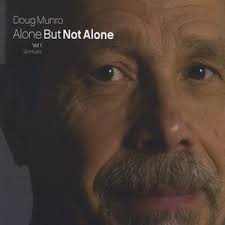
Douglas Anthony Munro was born July 9, 1953 in Yonkers, New York. He started his musical studies at age seven, taking drum lessons and by age fourteen, he was playing dances in Yonkers and New York City. At 20, he broke his back in a gymnastics accident, which ended his career as a drummer. However, in 1977 the 24 year old underwent a successful back surgery, and began playing guitar to pass the time during recovery
After his recovery he became a guitarist, performed locally and taught guitar lessons. In 1986 he released the LP Courageous Cats. and towards the end of the decade Doug met record producer Joe Ferry, and began a 25 year professional relationship. He would go on to divide his career into arranging, performing, teaching, and producing with Ferry. In 2004 he started a series of four Boogaloo recordings for Scufflin’ Records. The first, Boogaloo to Beck, featured Lonnie Smith, David “Fathead” Newman, and Lafrae Olivia Sci. He would go on to release to Brazilian jazz albums under the Big Boss Bossa Nova title.
The early Nineties saw Doug arranging and producing with Joe Ferry. Their first album, We Remember Pastorius, was a tribute to jazz bassist Jaco Pastorius. He would go on to co-produce and arrange a series of recordings for Shanachie Records. This period saw him delving into ska, receiving two Grammy nominations. In 1997 Munro added orchestrations to the original motion picture soundtrack for the Muhammad Ali documentary When We Were Kings which won the Academy Award for Best Documentary Film.
Munro continued to work on over 40 recording albums into the new millennium with Vitamin Records. He has produced lessons for Just Jazz Guitar, Premier Guitar, and TrueFire.com. He founded the jazz studies program in the Conservatory of Music at Purchase College in 1993, and served as the director of the program from 1993-2002. He retired in 2019 as Professor Emeritus and Director Emeritus of the Jazz Studies program at the Conservatory of Music at Purchase College.
Guitarist, arranger, producer, composer, author, and educator Doug Munro specializes in jazz, bebop, Brazilian jazz, jazz fusion, and gypsy swing. Since 1986 he has released over fifteen albums as a band leader and has appeared on over 75 recordings as a guitarist, sideman, producer, and arranger. He has been nominated for two Grammy Awards and was the recipient of two NAIRD Awards by the American Association of Independent Music.
More Posts: arranger,bandleader,composer,educator,guitar,history,instrumental,jazz,music,producer
Daily Dose Of Jazz…
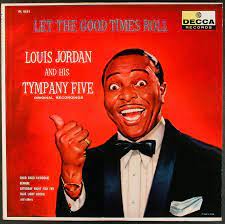
Louis Thomas Jordan was born on July 8, 1908 in Brinkley, Arkansas. His father, James Aaron Jordan, was a music teacher and bandleader for the Brinkley Brass Band and the Rabbit Foot Minstrels. His mother died when he was young and his grandmother Maggie Jordan and his aunt Lizzie Reid raised him. At an early age he studied clarinet and saxophone with his father and by his teens he was a member of the Rabbit Foot Minstrels and was playing professionally in the late 1920s.
In the early Thirties he was performing in Philadelphia, Pennsylvania and New York City with Charlie Gaines. He recorded with Clarence Williams and was a brief member of the Stuff Smith Orchestra. Joining the Chick Webb Orchestra he sang and played alto saxophone, however, in 1938 he started a band that recorded a year later as the Tympany Five.
In 1942, Jordan and his band moved to Los Angeles, California where he began making soundies, the precursors of music video. He appeared on many Jubilee radio shows and a series of programs for the Armed Forces Radio for distribution to American troops overseas. Though a hernia condition kept him out of the war his recordings made him very popular with both black and white soldiers.
During the 1940s Jordan and the band became popular with such hits as Choo Choo Ch’Boogie, Knock Me a Kiss, Is You Is or Is You Ain’t My Baby, and Five Guys Named Moe. Within a year of his breakthrough, the Tympany Five’s appearance fee rose from $350 to $2,000 per night. But the breadth of Jordan’s success and the size of his combo had larger implications for the music industry. His raucous recordings were notable for the use of fantastical narrative, best exemplified on Saturday Night Fish Fry, a two-part 1950 hit that was split across both sides of a 78-rpm record. It was one of the first popular songs to use the word “rocking” in the chorus and to feature a distorted electric guitar.
From July 1946 through May 1947, Jordan had five consecutive number one songs, holding the top slot for 44 consecutive weeks. In 1961, the IRS filed an income tax lien against Jordan and he had to sell property well below its value to pay off his debts. Musician Ike Turner stepped in and contacted and convinced the president of Jordan’s booking agency in Chicago, Illinois. to send Jordan a check for $20,000. He was unaware of this deed.
Over his career he charted dozens of singles, eighteen #1 and fifty-four in the Top Ten. He ranked fifth among the most successful musicians of the period 1942~1995, however, many he did not own the rights to, hence no financial benefit. Saxophonist, multi~instrumentalist, songwriter and bandleader Louis Jordan suffered a heart attack and transitioned on February 4, 1975, in Los Angeles.
More Posts: bandleader,history,instrumental,jazz,music,saxophone,songwriter
The Quarantined Jazz Voyager
As the virus is continuing to evolve the Jazz Voyager is staying close to home, especially since the country has lifted the masking mandate and it appears that everything is “back to normal”, even though it is not yet. Supply chain is still limiting production and delivery of items. As you travel around your city, state, country, and internationally please continue to be careful and protect yourself and others.
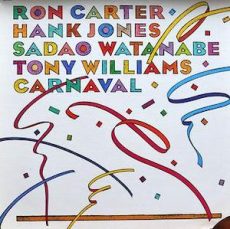
Carnaval is an album recorded Live Under The Sky in Denen Coliseum in Tokyo, Japan on July 30, 1978 by bassist Ron Carter, pianist Hank Jones, saxophonist Sadao Watanabe and drummer Tony Williams. The album was produced by Ed Michel and released five years later in 1983 on the Galaxy record label.
he art direction for the album was performed by Phil Carroll, the recording engineer was Jim Stern, mastered by George Horn, and the remix was done by Allen Sudduth.
Tracks | 43:18- Chelsea Bridge (Billy Strayhorn) ~ 10:12
- Manhã de Carnaval (Luiz Bonfá, Antônio Maria) ~ 9:01
- I’m Old Fashioned (Jerome Kern, Johnny Mercer) ~ 8:18
- Confirmation (Charlie Parker) ~ 6:40
- Moose the Mooche (Parker) ~ 8:05
- Ron Carter ~ bass
- Hank Jones ~ piano
- Sadao Watanabe ~ alto saxophone
- Tony Williams ~ drums
More Posts: adventure,album,bass,club,drums,genius,jazz,museum,music,piano,preserving,restaurant,saxophone,travel