

Daily Dose Of Jazz…
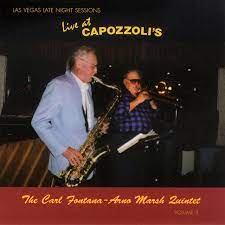
Arno Marsh was born on May 28, 1928 in Grand Rapids, Michigan and played early on in local dance bands, then played in Woody Herman’s ensemble from 1951 to 1953, where he soloed frequently on Herman’s Mars Records releases.
He led a band in a Grand Rapids residency from 1953 to 1955, then rejoined Herman intermittently through 1958. He recorded with Stan Kenton, Charlie Barnet, Lionel Hampton, Buddy Rich, and Harry James. After the late 1950s most of Marsh’s activity was in Las Vegas, Nevada leading hotel orchestras. He accompanied Nancy Wilson on record with one of them in 1968, and did a Woody Herman tribute in 1974.
Tenor saxophonist Arno Marsh transitioned at the age of 91 on July 12, 2019.

More Posts: history,instrumental,jazz,music,saxophone
Daily Dose Of Jazz…
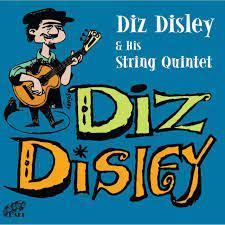
William Charles “Diz” Disley was born on May 27, 1931 in Winnipeg, Manitoba, Canada, where his parents worked. When he was four, they moved back to Llandyssil in Montgomeryshire, Wales and then five years later to Ingleton, North Yorkshire, England where his mother worked as school teacher. During his childhood he learned to play the banjo, but took up jazz guitar at the age of 15, after being exposed to the playing of Django Reinhardt. His neighbour Norry Greenwood taught him the chords to Miss Annabel Lee and Try a Little Tenderness in the summer of 1946.
Showing an early gift for drawing, he left school to enroll at Leeds College of Art, which had a reputation for student music making, in particular trad jazz. Soon he was playing in the Vernon City Ramblers and the Yorkshire Jazz Band with trumpeter Dick Hawdon and clarinettist Alan Cooper.
Post National Service in 1953, he resumed his studies in Leeds, and began selling cartoons to national newspapers and periodicals. A move to London, England saw him joining Mick Mulligan’s band with George Melly. He worked with most of the trad jazz bands of the day, including Ken Colyer, Cy Laurie, Sandy Brown, Kenny Ball, and Alex Welsh. In 1958, he formed a quintet to replicate that sound, employing violinist Dick Powell, guitarists Danny Pursford and Nevil Skrimshire, and a range of double bassists including Tim Mahn.
Disley started working as guitarist with a number of skiffle groups as it took over from trad jazz working and recording with Ken Colyer, Lonnie Donegan, Bob Cort, Nancy Whiskey. He would go on to persuade Stephane Grappelli to return to public performances using an all-strings acoustic line-up, recreating the spirit of the Quintette for a new generation of listeners. This began a collaboration between Grappelli and the Diz Disley Trio, sometimes billed The Hot Club of London, and after twenty years he broke his wrist when he was knocked down by a motorcycle. In 1978 Grappelli, Disley, and others were invited by David Grisman to contribute the score to the film King of the Gypsies. Grappelli and Disley had walk-on parts as gypsy musicians and were suitably attired for the occasion, but the soundtrack to the movie was never released.
In the 1980s Disley formed a working partnership with gypsy jazz guitar prodigy Bireli Lagrene, then put together a club quintet for Nigel Kennedy, and the Soho String Quintette that recorded Zing Went The Strings for Waterfront Records.
In the 1990s, he spent several years in Los Angeles, California and delved into blues and country-rockabilly. He moved to Spain in the 2000s and painted several portraits of jazz musicians in the cubist style. In early 2010 his health took a turn for the worse, and he was admitted to the Royal Free Hospital in Hampstead, England on February 2nd. Guitarist Diz Disley transitioned on March 21, 2010.
More Posts: bandleader,guitar,history,instrumental,jazz,music
The Quarantined Jazz Voyager
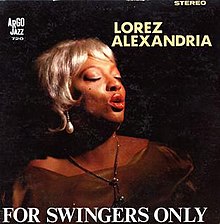
The Jazz Voyager has been combing the stacks of music in his library for the right album and has selected For Swingers Only by vocalist Lorez Alexandria that was released by the Argo label in 1963.
A stylized, disciplined, soulful, and satisfying session, the recording of this album took place over two days on January 2 & 3, 1963 at Ter Mar Recording Studios in Chicago, Illinois. The session was produced by Esmond Edwards.
Tracks | 29:00- Baltimore Oriole (Hoagy Carmichael, Paul Francis Webster) ~ 3:11
- Little Girl Blue (Richard Rodgers, Lorenz Hart) ~ 3:34
- All or Nothing at All (Arthur Altman, Jack Lawrence) ~ 4:55
- Traveling Down a Lonely Road (Nino Rota, Michele Galdieri, Don Raye) ~ 3:45
- Mother Earth (Peter Chatman) ~ 3:03
- Love Look Away (Richard Rodgers, Oscar Hammerstein II) ~ 3:49
- The End of a Love Affair (Edward C. Redding) ~ 2:49
- That Old Devil Called Love (Alan Roberts, Doris Fisher) ~ 3:54
- Lorez Alexandria – vocals
- Ronald Wilson – tenor saxophone, flute
- John Young – piano, arranger
- George Eskridge – guitar
- Jimmy Garrison – bass
- Phil Thomas – drums
- Cover Design ~ Don Bronstein
- Cover Photography ~ Roger Marshutz
- Engineer ~ Eddie Rio
- Liner Notes ~ Leonard Feather

More Posts: adventure,album,club,genius,jazz,museum,music,preserving,restaurant,travel,vocal
Daily Dose Of Jazz…
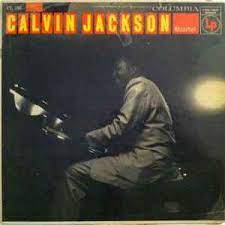
John Calvin Jackson was born May 26, 1919 in Philadelphia, Pennsylvania to a concert singer mother. He played piano from childhood, taking lessons with a private teacher. He went on to study at Juilliard and New York University.
At the beginning of his career Jackson worked with Frankie Fairfax. Moving to Los Angeles, California from 1943–47 he worked in Hollywood as an assistant director of music for MGM on productions including Meet Me in St. Louis and Anchors Aweigh.
1947 saw Calvin recording with Phil Moore and also as a solo pianist for Discovery Records. The following summer he played with singer Mildred Bailey and dancer Avon Long at Café Society in New York City. In 1950, he moved to Toronto, Canada where he often played on television and radio. Throughout the 1950s and early 1960s he released several LPs for labels such as Columbia Records.
Returning to Los Angeles in 1957 he resumed work as a composer and orchestrator for television and hit musicals like Where The Boys Are and The Unsinkable Molly Brown, which was Oscar-nominated for best adapted score. Occasionally he could be seen on screen as a piano-playing character.
Jackson arranged for Ray Charles at one point, receiving an arrangement and co-producer credit for Charles’ 1964 release Sweet & Sour Tears . By the early 1980s, he moved to San Diego County, where he lived in semi-retirement where he gave music lessons on a piano in his apartment. In 1984 he sat in as a guest at the Sunday night jam sessions Jeannie and Jimmy Cheatham hosted at the Bahia resort on Mission Bay, playing piano and harmonica between sets and occasionally with the band.
He was working on arrangements for a 31-piece concert jazz orchestra in Point Loma when he developed a heart ailment and was taken to the hospital. Pianist, composer, and bandleader Calvin Jackson transitioned on December 9, 1985 at age 66.
More Posts: history,instrumental,jazz,music,piano

Daily Dose Of Jazz…
Buddy Petit was born Joseph Crawford on May 25, 1897 in White Castle, Louisiana. His early life is somewhat mysterious but he was adopted by trombonist Joseph Petit, whose name he took.
Taking Freddie Keppard’s place in the Eagle Band, a place earlier held by Buddy Bolden, when Keppard left town. Briefly lured to Los Angeles, California by Jelly Roll Morton and Bill Johnson in 1917, but objecting to being told how to dress and behave differently from what he was accustomed to he returned to New Orleans, Louisiana.
Buddy spent the rest of his career in the area around greater New Orleans and the towns north of Lake Pontchartrain, not venturing further from home than Baton Rouge and the Mississippi Gulf Coast.
Okeh Records offered him a chance to record on their 1925 field trip to New Orleans, but Petit held out for more money and was never recorded. Danny Barker and Louis Armstrong said that it was a great loss to jazz history that there are no recordings of Petit.
After over-indulging in food and drink, cornetist Buddy Petit, which was sometimes spelled Buddie, transitioned on July 4, 1931.
More Posts: cornet,history,instrumental,jazz,music