


Daily Dose Of Jazz…
George James was born in Boggs, Oklahoma on December 7, 1906. His career didn’t begin until the late 1920s joining the bands of Charlie Creath and Johnny Neal. He moved to Chicago, Illinois in 1928, where he played with Jimmie Noone, Sammy Stewart, Ida Marples, Jabbo Smith, and Bert Hall.
In 1931 through the first quarter of 1932 he toured with Louis Armstrong, and at the end of the tour he remained in New York City. There he joined the Savoy Bearcats and later played with Charlie Turner’s Arcadians. By the middle of the decade Fats Waller assumed leadership of the Arcadians, and James played under him until 1937.
Finishing the decade playing in the Blackbirds Revue, early in the 1940s he worked with James P. Johnson, Benny Carter, Teddy Wilson, and Lucky Millinder, and led his own bandhttps://notoriousjazz.com/jazz-type/swing/daily-dose-of-jazz-3977↗ in 1943-44. Later in the decade James played with Claude Hopkins and Noble Sissle.
He was active both as a leader and a sideman into the 1970s, playing with Clyde Bernhardt and the Harlem Blues and Jazz Band in that decade. Saxophonist, clarinetist, and flautist George James died on January 30, 1995 in Columbus, Ohio.

More Posts: bandleader,clarinet,flute,history,instrumental,jazz,music,saxophone
Daily Dose Of Jazz…
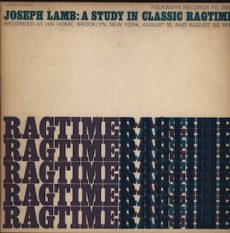
Joseph Francis Lamb was born of Irish parents on December 6, 1887 in Montclair, New Jersey. The youngest of four children, he taught himself to play the piano and admired the early ragtime publications of Scott Joplin. His first known works were Meet Me At The Chutes and Idle Dreams, at the age of 13 in 1900, but they are unpublished and assumed lost.
During his teenage years while living in Toronto, Canada he published several march and waltz compositions for Harry H. Sparks Music Publisher. Most notable were The Lilliputian’s Bazaar, Celestine Waltzes, and Florentine. Most were published after he left Canada
Lamb dropped out of St. Jerome’s College in 1904 to work for a dry goods company. He met Joplin in 1907 while purchasing the latest Joplin and Scott sheet music in the offices of John Stark & Son. It was there that Joplin was impressed with Lamb’s compositions and recommended him to ragtime publisher John Stark. Stark published Lamb’s music for the next decade, starting with Sensation.
Joseph’s twelve rags published by Stark from 1908 to 1919 can be divided into two groups: the “heavy” rags are incorporated with Joplin’s melody–dominated style and Scott’s expansive use of the keyboard registers. The “light” rags with the cakewalk tradition show the narrow-range melodies inspired by Joplin.
He went on to work as an arranger for the J. Fred Helf Music Publishing Company and in 1914 became an accountant for L. F. Dommerich & Company. When popular music interest shifted from ragtime to jazz Lamb stopped publishing his music, playing and composing only as a hobby.
Composer Joseph Lamb, who was the only non-African American of the Big Three composers of classical ragtime, the other two being Scott Joplin and James Scott, died of a heart attack in Brooklyn, New York at age 72 on September 3, 1960.
More Posts: composer,history,instrumental,jazz,music

Daily Dose Of Jazz…
Theodor Christian Frølich Bergh, better known as Totti Bergh was born December 5, 1935 in Oslo, Norway. He began playing clarinet, and started learning to play the saxophone in 1952. By the time he turned 21 in 1956, he became a professional musician, becoming a regular member of Kjell Karlsen Sextet for three years, in addition to collaborating sporadically with Rowland Greenberg and other musicians on the Norwegian jazz scene.
He joined the Norwegian America Ships house orchestra on the voyage to New York City. In 1960 Totti succeeded Harald Bergersen as tenor saxophonist in Karlsen’s new big band and in the summer of 1961 he met his future wife Laila Dalseth, who joined the band.
He would go on to play with the bands of Einar Schanke, Rowland Greenberg, Per Borthen and in Dalseth’s orchestra. During the Nineties he played tenor and soprano saxophone with Christiania Jazzband and with Christiania 12.
Saxophonist Totti Bergh, who released several albums as a leader and whose music is reminiscent of Lester Young and Dexter Gordon, died January 4, 2012 in his home city.
More Posts: author,educator,history,instrumental,jazz,music,piano

Daily Dose Of Jazz…
Connee Boswell was born Constance Foore Boswell on December 3, 1907 in Kansas City, Missouri but raised in New Orleans, Louisiana. With sisters Martha and Helvetia “Vet”, she performed in the 1920s and 1930s as the trio The Boswell Sisters. They came to be well known locally while still in their early teens, making appearances in New Orleans theaters and on radio. The girls started their career as instrumentalists but became a highly influential singing group via their recordings and film and television appearances.
They made their first recordings for Victor Records in 1925, which featured Connee singing in the style of her early influence, Mamie Smith. The sisters became stage professionals that year when they were tapped to fill in for an act at New Orleans’ Orpheum Theatre. This led to a gig in Chicago, Illinois and then on to San Francisco, California. The desk clerk at the recommended hotel was Harry Leedy was part owner of Decca Records, became their manager on a handshake and later Connee’s husband.
The next stop was Los Angeles, California where they performed on local radio and “side-miked” for the soundies. National attention came with a move to New York City in 1930 and the making of national radio broadcasts. After a few recordings with Okeh Records, they recorded for Brunswick Records from 1931 to 1935.
Connee recorded as a solo artist and had several successful singles. In 1935, the sisters had a No. 1 hit with The Object of My Affection, and the group signed to Decca Records, but after just three releases two sisters called it quits in 1936. Connee, however, continued to have a successful solo career as a singer for Decca but also later recorded for the new Apollo label, RCA Victor, and Decca subsidiary, Design.
During the Forties she was a co-star on NBC Radio’s Kraft Music Hall, starred in her own radio show on the NBC Blue Network, The Connee Boswell Show, and featured on CBS Radio’s Tonight On Broadway, among numerous other radio appearances and films. She was a favorite duet partner of Bing Crosby, and they frequently sang together on radio, as well as recording several hit records as a duo in the 1930s and 1940s.
Vocalist Connee Boswell, who recorded ten albums as a leader and had fifteen hits reach the top 12 on the Billboard list, died on October 11, 1976 from stomach cancer at Mount Sinai Hospital in New York City at age 68.
More Posts: bandleader,history,instrumental,jazz,music,vocal