

Daily Dose Of Jazz…
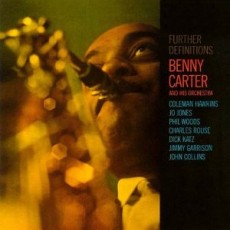
Benny Carter was born Bennett Lester Carter on August 8, 1907 in New York City. He received his first piano lessons from his mother but was largely self-taught. Growing up in Harlem under the influence of trumpeter Bubber Miley and was inspired to buy his own. Unable to play like Miley, he switched to saxophone.
By age fifteen he was sitting in at Harlem night spots and from 1924 to 1928, Carter gained valuable professional experience as a sideman in some of New York’s top bands. For the next two years he played with such jazz greats as cornetist Rex Stewart, Sidney Bechet, Earl Hines, Willie “The Lion” Smith, Fats Waller, James P. Johnson, Duke Ellington and others.
His first recordings of a prolific catalogue were made in 1928 with the Charlie Johnson’s Orchestra and he formed his first big band the following year. In the early 30s he played with Fletcher Henderson, led the McKinney’s Cotton Pickers in Detroit, then returned to New York to once again lead his own band. He would work with Sid Catlett, Chu Berry, Teddy Wilson and Dicky Wells.
Benny’s name first appeared on records with a 1932 Crown label, then on Columbia, Okeh and Vocalion. In 1935 he moved to Europe to play trumpet with Willie Lewis’s orchestra, became staff arranger for the BBC dance orchestra, made several records, returned home in 1938, formed another orchestra and spent much of 1939 and 1940 at Harlem’s Savoy Ballroom. He relocated to Los Angeles in 1943, moved increasingly into studio work and arrange for dozens of feature films and television productions, influencing and mentoring Quincy Jones, as well as arranging for Billie Holiday, Sarah Vaughan, Billy Eckstine, Pearl Bailey, Ray Charles, Peggy Lee, Lou Rawls, Louis Armstrong and Mel Torme among others over the course of his career.
Carter has been honored as a jazz master by the National Endowment for the Arts, received the National Medal of Arts from President Clinton, was a Kennedy Center honoree, was awarded the Grammy Lifetime Achievement Award, won six Grammy Awards, has a star on the Hollywood Walk of Fame and was inducted into the Downbeat Jazz Hall of Fame.
Alto saxophonist, clarinetist, trumpeter, composer, arranger and bandleader Benny Carter, who was a major figure known as “King” in the jazz community and the only musician to record in eight different decades, passed away on July 12, 2003 in Los Angeles, California at age 95.
More Posts: saxophone
Daily Dose Of Jazz…
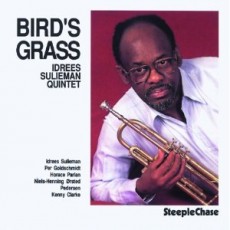
Idrees Sulieman was born on August 7, 1923, in St. Petersburg, Florida. He studied trumpet and music at the Boston Conservatory, and gained early experience playing with the Carolina Cotton Pickers and the wartime Earl Hines Orchestra in the early Forties.
Sulieman was closely associated with Mary Lou Williams, worked with cab Calloway, John Coltrane, Count Basie and Lionel Hampton. He recorded with Coleman Hawkins and gigged with Randy Weston in the 50s, toured with Oscar Dennard through Europe in 1961, and then settled in Stockholm, moving to Copenhagen in 1964.
A major soloist with The Kenny Clarke-Francy Boland Band in the mid-’60s through 1973, and frequently worked with radio orchestras. Idrees recorded as a leader for Swedish Columbia and SteepleChase, he played in the 1985 big band of Miles Davis on the album “Aura,” which was released in 1989. He worked and recorded some twenty-two albums as a leader and sideman with Teddy Charles, Mal Waldron, Lester Young, Cedar Walton, Sam Jones, Billy Higgins, Horace Parlan and Niels-Henning Orsted Pederson among others.
Hard bop trumpeter Idrees Sulieman’s career slowed down considerably in the ’90s as he aged and he died of bladder cancer on July 23, 2002 at St. Anthony’s Hospital in his hometown of St. Petersburg, Florida.
More Posts: trumpet
Daily Dose Of Jazz…
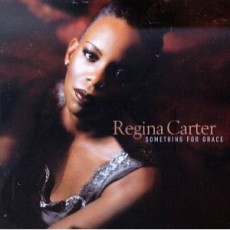
Regina Carter was born on August 6, 1966 in Detroit, Michigan and is the cousin of jazz saxophonist James Carter. She began piano lessons at the age of two after playing a melody by ear for her brother’s piano teacher. After deliberately playing the wrong ending note at a concert, the piano teacher suggested she take up the violin, was enrolled at the Detroit Community Music School when she was four years old and she began studying the violin, piano, tap and ballet.
As a teenager, she played in the youth division of the Detroit Symphony Orchestra and took master class with Itzhak Perlman and Yehudi Menuhin. Carter attended Cass Technical High School with jazz vocalist Carla Cook who introduced her to Ella Fitzgerald. She also played with the Detroit Civic Orchestra and the group Brainstorm.
She went on to study at the New England Conservatory of Music, switched to jazz, transferred to Oakland University, studied with Marcus Belgrave, in addition to taking viola, oboe and choir lessons. After graduating, she taught strings in Detroit public schools, moved to Europe and spent two years in Germany making connections, working as a nanny and teaching violin on a U.S. military base.
In 1987 Carter came to prominence in the all female pop-jazz quintet Straight Ahead. After three albums she went solo and moved to New York City working with Aretha Franklin, Lauryn Hill, Mary J. Blige, Billy Joel, Dolly Parton, Max Roach, and Oliver Lake and became a member of the String Trio of New York. She released her debut self-titled album in 1995 and has since followed up with a series of acclaimed recordings.
Regina is an active educator and mentor, has taught at numerous institutions, including Berklee College of Music and Stanford Jazz Workshop among others. She was awarded a MacArthur Fellows grant, has created her own violin voice and currently leads a quintet.
More Posts: violin
Daily Dose Of jazz…
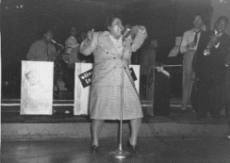
Ernestine Davis was born on August 5, 1907 in Memphis Tennessee. Little is known about her early life but along the way to becoming a vocalist and trumpeter. In 1937, the Piney Woods Country Life School of Mississippi founded to educate black children, created a 16-piece band known as The International Sweethearts of Rhythm to financially support the school.
In 1941, the International Sweethearts of Rhythm severed their ties with the school, moved to Virginia and recruited seasoned professionals of all ethnicities to join their band such as singer Anna Mae Winburn, Ernestine “Tiny” Davis, and alto saxophonist Roz Cron.
Holding their own during the Swing Era, the ladies toured the United States extensively up until 1945 with the end of the war and opportunities dried up as the men returned home. Their high points of touring were the Apollo Theater in New York, the Regal Theater in Chicago, and the Howard Theater in Washington, D. C., where their debut set a box office record of 35,000 patrons in one week.
One such engagement was at The Apollo where the audience was on their feet, Louis Armstrong and Eddie Durham stood in the wings, smiling broadly as Ernestine “Tiny” Davis took off in a riveting solo. The band pushed the fevered audience to new levels as Edna Williams, Willie Mae Wong, and Ruby Lucas upped the ante on the song “Swing Shift.”
Admired by the likes of Count Basie and Louis Armstrong, the later unsuccessfully attempted to lure Davis away at ten times her salary when she was at the height of notoriety. They recorded “The Jubilee Sessions” for radio broadcasts aimed toward America’s black soldiers serving during 1943 to 1946. However, because of the racial makeup of the Sweethearts, they did not get as much exposure to mainstream audiences in the South.
While their exposure to white audiences was somewhat limited, they were extremely popular with black audiences. Tiny and her partner Ruby Lucas owned Tiny and Ruby’s Gay Spot in Chicago during the 1950s.
In 1988, a short film titled “Tiny & Ruby: Hell Divin’ Women” was made as a tribute to Davis, and her lesbian partner of 40 years, drummer Ruby Lucas. Trumpeter and vocalist Ernestine “Tiny” Davis died in 1994.
Daily Dose Of Jazz…
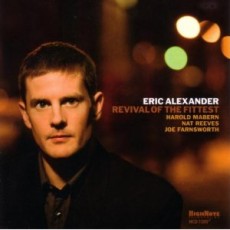
Eric Alexander was born August 4, 1968 in Galesburg, Illinois and began as a classical musician studying piano at six, clarinet at nine, switching to alto saxophone three years later. While at Indiana University he switched to the tenor saxophone and jazz before transferring to William Paterson University where he studied with Harold Mabern, Rufus Reid, Joe Lovano, Gary Smulyan, Ralph LaLama, Norman Simmons, Steve Turre and many others.
Alexander first achieved fame by finishing second behind Joshua Redman and ahead of Chris Potter at the 1991 Thelonious Monk International Jazz Saxophone Competition. He was quickly signed and began recording his more than three-dozen albums as a leader and collaborator.
Influenced primarily by Sonny Stitt, Dexter Gordon and George Coleman, playing in the hard bop and post-bop styles, he has worked with such notables as Ron Carter, Joe Farnsworth, Pat Martino, Peter Bernstein, Vincent Herring, Grant Stewart and Mike LeDonne among others. Alto saxophonist Eric Alexander continues to record and tour as a leader, extensively with the sextet One For All.
More Posts: saxophone