


Daily Dose Of Jazz…
Alan Haven was born Alan Halpern on April 1, 1935 in Prestwich, Lancashire, United Kingdom. His early work was performed on a Lowrey organ. He collaborated with John Barry on two Bond movies ~ From Russia With Love and Dr. No, and Barry wrote an extended jazz organ solo for his Oscar-winning theme from The Lion in Winter and recorded it as a single.
He released several albums in the 1960s and 1970s, initially on Fontana Records, CBS Records including a recording of a live set at Ronnie Scott’s in London, England. He released Live at Annie’s Room and Mastersound, remastered and re-released three of Alan’s previous albums Organ Show, Images and Collector’s Item.
Local musicians, including Eric Delaney, organized a big band night featuring Alan. With his wife Karen they produced four albums which were Two, Day By Day, Libra and By The Seaside, which was released in 1992.
Organist Alan Haven transitioned on January 7, 2016.
More Posts: bandleader,history,instrumental,jazz,music,organ
Daily Dose Of Jazz…
Jimmy Vass was born March 31, 1937, in Philadelphia, Pennsylvania and acquired his first saxophone at age 18. After honing his chops on the local club scene, he relocated to New York City in 1963, working a series of day jobs while moonlighting as a musician.
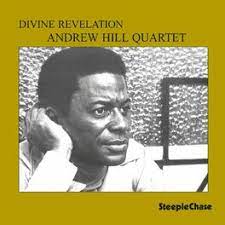
Vass first appeared on record in 1968 via Sunny Murray’s Hard Cores. With 1971’s Soul Story, he began an extended collaboration with the great soul-jazz organist Charles Earland. His most notable partnership paired him with avant-jazz pianist Andrew Hill, beginning with 1975’s Divine Revelation.
He played on Roberta Flack’s Feel Like Makin’ Love. He also lent his talents to recording sessions with Muhal Richard Abrams, Rashied Ali, Charles Mingus, Lionel Hampton, Ronnie Boykins and Woody Shaw. Never leading a recording date of his own, in the autumn of his career Jimmy worked as a music instructor and led his own New York-based group playing standards and originals.
Alto and soprano saxophonist and flutist Jimmy Vass, who emerged as one of the premier jazz sidemen of the 1970s, transitioned on September 21, 2006, at the age of 69.
Daily Dose Of Jazz…
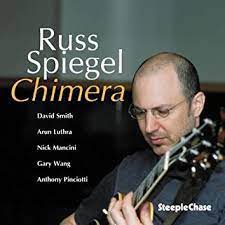
Russ Spiegel was born March 30, 1962 in Los Angeles, California, and raised in Santa Monica, California. His family was musical as he has an older sister who plays the bluegrass fiddle, a pianist and composer brother and a father who is an avid amateur jazz trumpeter.
A fan of pop radio as a youngster, Russ discovered rock music as he entered his teens. Picking up the electric guitar he took lessons at a local music store, eventually buying a Fender Stratocaster. He started jamming with area musicians, which led to forming a rock cover band. Finishing high school in Frankfurt, Germany he enrolled in the University of Maryland that had a campus in Munich, Germany. While there, he formed a progressive-rock band, joined a local R&B and soul unit, and began learning jazz standards. In 1982 Spiegel returned to the U.S. to complete his bachelor’s degree at the University of Michigan, in Ann Arbor, earning a degree in philosophy.
In 1986 had Spiegel in Boston, Massachusetts on scholarship at Berklee College of Music. Upon completion of his studies, he relocated to Germany in 1988 where he gradually made contacts in the music world. He began playing on military bases and at local jazz clubs and festivals. During a stint in Paris, France he formed a quartet called Guitar Hell, which toured widely in France and Germany. He soon found himself in demand as a guitarist and electric bassist with various European big bands, jazz ensembles, and blues groups.
Around the same time, Russ joined the band of German jazz organist Barbara Dennerlein and toured Europe with her before receiving the coveted Jazz Scholarship by the city of Frankfurt for his contributions to the city’s artistic scene.
In 2001 Spiegel returned to the U.S. settled in New York City and studied under teachers Adam Rogers, Paul Bollenback, Ben Monder and John Patitucci, receiving his master’s degree in jazz performance from the City College of New York.
In 2008 his Jazz/North Indian classical fusion ensemble, Sundar Shor, undertook a tour of India under the auspices of the American Center, and it has toured widely in Europe as well. Guitarist Russ Spiegel continues to perform and record.
More Posts: bandleader,guitar,history,instrumental,jazz,music
Daily Dose Of Jazz…
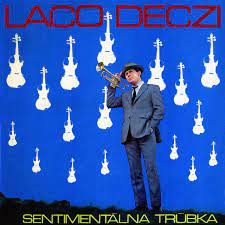
Ladislav Déczi was born on March 29, 1938 in Bernolákovo, Czechoslovakia and showed an interest in the trumpet while in elementary school. He went through several music ensembles in high school and during his military service performed in Prague, Czechoslovakia. After his discharge he remained in Prague and started performing with the Rokoko Theater Sextet and then with the Jazz Outsiders. He then went on to work with Karel Velebny’s S+HQ and as the frontman for the Reduta Quartet.
By the mid-Sixties he founded Jazz Celulla, joined the Czechoslovak All Star Band, the Jazz Orchestra of the Czechoslovak Radio, and the Dance Orchestra of the Czechoslovak Radio. He recorded several solo albums, composed orchestral compositions.
Emigrating to America in 1986 he again took the frontman space for Celula New York. He performed with Elvin Jones, Bill Watrous, Junior Cook, Dave Weckl and Sonny Costanzo. He recorded several duo albums with Sarka Dvorak and composed an abundance of music for film and television productions. He has won several awards during his career and has toured Eastern Europe especially his homeland, Germany and Austria.
Trumpeter, composer, and bandleader Laco Déczi, who also paints, continues to perform, compose and record.
More Posts: composer,history,instrumental,jazz,music,trumpet
Daily Dose Of Jazz…
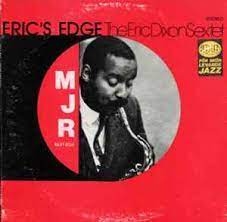
Eric “Big Daddy” Dixon was born on March 28, 1930 in New York City, New York. Although he played bugle as a child,he switched to the tenor saxophone at the age of 12. Following a stint as a musician in the US Army from 1951 to 1953 he played in groups that sometimes included Mal Waldron, with whom he would later record.
In 1954, he played with Cootie Williams and the following year with Johnny Hodges. In 1956, he performed and recorded with Bennie Green and also took up the flute.
The late Fifties had him spending four years in the house band led by Reuben Phillips at the Apollo Theatre in New York. At the end of the decade he toured Europe and recorded with the Cooper Brothers.
He also worked with Paul Gonsalves, Ahmed Abdul-Malik, Oliver Nelson, Quincy Jones, Jack McDuff, Joe Williams, Frank Foster, and Eddie “Lockjaw” Davis, but is probably best known for his tenure in Count Basie’s band, which lasted almost two decades. Dixon continued to play in the ghost band after Basie’s death.
Tenor saxophonist, flautist, composer, and arranger Eric Dixon, who has been credited on as many as 200 recordings, transitioned on October 19, 1989 in New York City.
More Posts: arranger,composer,flute,history,instrumental,jazz,music,saxophone