

Daily Dose Of Jazz…
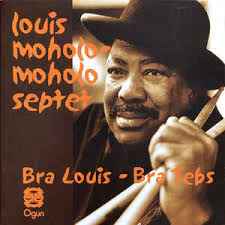
Louis Tebogo Moholo was born on March 10, 1940 in Cape Town, South Africa. He formed The Blue Notes with Chris McGregor, Johnny Dyani, Nikele Moyake, Mongezi Feza and Dudu Pukwana, and at the age of twenty-four, emigrated to Europe with them. He eventually settled in London, England where he formed part of a South African exile community that made an important contribution to British jazz.
In 1966, he toured Buenos Aires, Argentina, where he performed at the Theatron with Steve Lacy, Johnny Dyani and Enrico Rava and recorded the album The Forest and the Zoo with the same musicians. During the 1970s he was a member of the Brotherhood of Breath, a big band comprising several South African exiles and leading musicians of the British free jazz scene in the 1970s. He is the founder of Viva la Black and The Dedication Orchestra.
His first album under his own name, Spirits Rejoice on Ogun Records, is considered a classic example of the combination of British and South African players. In the early 1970s, Moholo was also a member of the afro-rock band Assagai.
He has played with, among others, Derek Bailey, Steve Lacy, Evan Parker, Enrico Rava, Roswell Rudd, Irène Schweizer, Cecil Taylor, John Tchicai, Archie Shepp, Peter Brötzmann, Mike Osborne, Keith Tippett, Elton Dean and Harry Miller.
Moholo returned to South Africa in September 2005, performing with George Lewis at the UNYAZI Festival of Electronic Music in Johannesburg, South Africa. Now going by the name Louis Moholo-Moholo because the name is more ethnically authentic, the drummer continues to perform and record.

More Posts: bandleader,drums,instrumental,jazz,jistory,music

Daily Dose Of Jazz…
Victor Ash was born in East London, England on March 9, 1930, of Jewish ancestry and began playing professionally in 1951 when, with Tubby Hayes, he joined the band of Kenny Baker, with whom he played until 1953. Following this association, Ash played with Vic Lewis from 1953–56, then accompanied Hoagy Carmichael and Cab Calloway on their English tours.
Leading his own group, he became a favourite in the Melody Maker fan polls of the 1950s. Concurrently he had a radio program called Sunday Break, which discussed jazz and religion. In 1954, the Vic Ash Quartet recorded with US singer Maxine Sullivan in London. Ash toured the U.S. in 1957 and returned to play with Lewis in 1959. That same year his ensemble was the only one representing British jazz at the Newport Jazz Festival.
Ash remained a mainstay on the British jazz scene for decades, playing in small and large ensembles including the BBC Big Band. He accompanied Frank Sinatra on his tours in Europe and the Middle East, from 1970 until Sinatra’s death.
He released many albums for Pye, Nixa and MGM, mostly in the mainstream jazz tradition. Saxophonist and clarinetist Vic Ash, who co-authored his autobiography I Blew It My Way in 2006, passed away on October 24, 2014.
More Posts: bandleader,clarinet,history,instrumental,jazz,music,saxophone
Daily Dose Of Jazz…
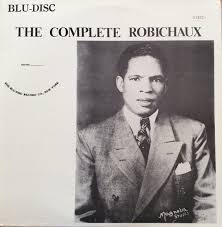
Joseph Robichaux was born on March 8, 1900 in New Orleans, Louisiana and played piano from a young age and studied at New Orleans University. After working in the O.J. Beatty Carnival, he played with Tig Chambers briefly in 1918, then returned to New Orleans where he played with Oscar Celestin, Earl Humphrey, Lee Collins, and The Black Eagles.
Arranging for the Jones-Collins Astoria Hot Eight in 1929, Joe also recorded with them. He accompanied Christina Gray on record that year. In 1931 he formed his own ensemble, which featured Eugene Ware on trumpet, Alfred Guichard on clarinet and alto saxophone, Gene Porter on tenor sax, and Ward Crosby on drums.
The group journeyed to New York City to record for Vocalion in August 1933, laying down twenty-two mostly stomping, uptempo sides and two alternate takes in a marathon five day recording schedule which included Rene Hall on tenor banjo. Vocalion issued ten records over the next year and two tracks with Chick Bullock vocals were issued under his name on Banner, Domino, Oriole, Perfect, and Romeo.
Working and recording during the height of Jim Crow, problems arose with the musicians’ union in New York that prevented the group from playing live there, so they returned to New Orleans not long after recording. Robichaux expanded the size of his ensemble over the course of the 1930s, with Earl Bostic was among those who joined its ranks.
Touring Cuba in the mid-1930s, the band also recorded for Decca Records in 1936, recording 4 sides in New Orleans, but unfortunately they were all rejected. By 1939 Robichaux’s ensemble disbanded and he found work as a solo performer, mostly in New Orleans. During the 1950s he recorded on R&B recordings and played with Lizzie Miles.
From the late 1950s to the mid Sixties he played with George Lewis, Peter Bocage; and performed at Preservation Hall. Pianist Joe Robichaux passed away of a heart attack at the age of 64 on January 17, 1965 in his hometown.
More Posts: bandleader,history,instrumental,jazz,music,piano
Daily Dose Of Jazz…
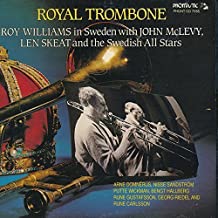
Roy Williams was born on March 7, 1937 in Salford, England and learned piano as a youth, He did not play the trombone until he was 18. After serving his National Service in the military in the late 1950s, he joined the trad jazz group of trumpeter Mike Peters and worked with Terry Lightfoot in the early 1960s.
In 1965 he became a member of Alex Welsh’s band, which accompanied Ruby Braff, Wild Bill Davison, and Bud Freeman. Roy remained with Welsh until 1978, while also collaborating with bandmate John Barnes in a side ensemble. He went on to work with Humphrey Lyttelton from 1978 to 1983), and in 1980 played with the Pizza Express All Stars and Benny Waters.
Leaving Lyttelton’s ensemble in 1983 gave him the opportunity to work as a regular performer at festivals during the 1980s and 1990s. He was a sideman for Doc Cheatham, Jim Galloway, Buddy Tate, the Harlem Blues and Jazz Band, the World’s Greatest Jazz Band, Peanuts Hucko, Bent Persson, Bob Rosengarden, Stan Barker, Bob Wilber, Digby Fairweather, Pete Strange, and Keith Smith.
He co-led a swing-oriented quintet in 1998 with saxophonist Danny Moss. Their musical collaboration produced Steamers! for the Nagel-Heyer Records label.
Trombonist Roy Williams was appointed Member of the Order of the British Empire (MBE) in the 2020 Birthday Honours for services to jazz and continues to perform to this day.
More Posts: history,instrumental,jazz,music,trombone
Daily Dose Of Jazz…
William Root was born March 6, 1934 in Philadelphia, Pennsylvania and was raised in a musical family. His father, a drummer in Philadelphia ensembles, took him to the Earle Theater at an early age, where big bands from Ellington, Basie and Lunceford performed. At the age of ten he learned the saxophone, at the age of 16 he played briefly with Hot Lips Page.
During the early 1950s, he began performing professionally and toured with the Hal McIntyre Orchestra, then returned to his hometown and played in local jazz clubs. Billy played as a member of the house band in appearances with Clifford Brown, Roy Eldridge, Red Rodney, Buddy Rich, Hal McIntyre, J. J. Johnson, Sonny Stitt, Eddie Lockjaw Davis, Art Blakey, Miles Davis and Kenny Dorham. In 1953 he went to New York, where he played with Bennie Green in an orchestra at the Apollo Theater, which was conducted by Earle Warren.
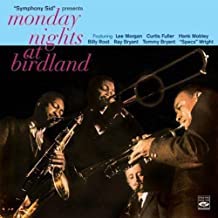
Root went on to play and record with Dizzy Gillespie, Hank Mobley, Lee Morgan, and Curtis Fuller. He led his own ensembles from the late 1950s. In the 1960s he performed with Al Grey and Dakota Staton, as well as working as an accompanist for Ella Fitzgerald, Sarah Vaughan and Billy Eckstine.
For family reasons, Root stopped touring in the early 1960s, from then on worked in local clubs and studied flutes, clarinet and bass clarinet for seven years before playing in various orchestras in Las Vegas, such as in 1968 in the Philadelphia Orchestra at performances of George Gershwin’s Rhapsody in Blue and An American in Paris. In Las Vegas he worked from 1968 with stars such as Tony Bennett and Peggy Lee.
By 1968, settling in Las Vegas, Nevada he played live in casinos for the next two decades, often backing vocalists like Tony Bennett and Peggy Lee. Tenor and baritone saxophonist Billy Root, who recorded as a soloist on several sessions and on no less than ten albums over the course of his career as a sideman, passed away on July 30, 2013.
More Posts: history,instrumental,jazz,music,saxophone