

Daily Dose Of Jazz…
Lavere “Buster” Harding was born on March 19, 1917 to Benjamin and Ada Harding in North Buxton, Ontario, Canada. Raised in Cleveland, Ohio as a teenager he started on his own band.
In 1939 Buster went to work for the Teddy Wilson big band, and then in the early 1940s joined the Coleman Hawkins band. This was followed by his playing with Cab Calloway. He became a freelance arranger and worked with Benny Goodman, Artie Shaw, Roy Eldridge, Dizzy Gillespie, and Count Basie, among others.
In 1949 he became the musical director for Billie Holiday recording sessions. In the early 1960s Harding played with Jonah Jones, though he was known primarily as an arranger and composer.
Pianist, composer and arranger Buster Harding, who never recorded as a leader, passed away on November 14, 1965, in New York City.

More Posts: arranger,composer,history,instrumental,jazz,music,piano
Daily Dose Of Jazz…
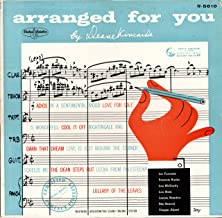
Robert Deane Kincaide was born on March 18, 1911 in Houston, Texas but raised in Decatur, Illinois. He began playing professionally and working as an arranger in the early 1930s, working with Wingy Manone in 1932, then took a job with Ben Pollack from 1933 to 1935.
He arranged for Benny Goodman on the side before joining Bob Crosby’s group in 1935. Deane went on to work with Woody Herman and Manone again and by the end of the decade he worked briefly with Tommy Dorsey. In the first half of the 1940s he worked with Joe Marsala, Glenn Miller, Ray Noble, and Muggsy Spanier.
Serving in the United States Navy during World War II, he played in a ship’s band on the USS Franklin. He joined Ray McKinley’s band in 1946, working with him until 1950. From the 1950s until the early 1980s Kincaide worked primarily as an arranger for television. Arranger and saxophonist Deane Kincaide passed away at the age of 91 in St. Cloud, Florida on August 14, 1992.
Share a dose of a Houston arranger to inspire inquisitive minds to learn about musicians whose legacy lends their genius to the jazz catalog…
More Posts: arranger,bandleader,history,instrumental,jazz,music,saxophone
Daily Dose Of Jazz…
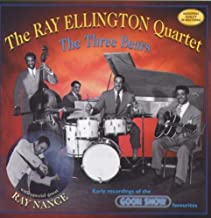
Ray Ellington was born Henry Pitts Brown on March 17, 1916 in Kennington, London, England, the youngest of four children of a Black father and Russian Jew mother. His father died when he was four years old, and was raised as a strictly Orthodox Jew, attending the South London Jewish School before entering show business at the age of twelve, when he appeared in an acting role on the London stage.
Ellington’s first break came in 1937 when he joined Harry Roy and His Orchestra as the band’s drummer, replacing Joe Daniels. His vocal talents were put to good use, from the time of his first session when he recorded Swing for Sale. Called up in 1940 he joined the Royal Air Force as a physical training instructor where he served throughout the war. He played in various service bands including RAF Blue Eagles.
Post military service, Ray resumed his career, fronting his own group, playing at The Bag O’Nails club. By early in 1947, he rejoined the Harry Roy band for a few months, later forming The Ray Ellington Quartet the same year. Specializing in jazz, he experimented with many other genres throughout the show’s history and his musical style was heavily influenced by the comedic jump blues of Louis Jordan.
His band was one of the first in the UK to feature the stripped-back guitar/bass/drums/piano format that became the basis of rock and roll. His band was also one of the first groups in Britain to prominently feature the electric guitar and use an amplified guitar produced and introduced by their guitar player, Lauderic Caton.
Drummer, singer, bandleader Ray Ellington, best known for his appearances on The Goon Show from 1951 to 1960, passed away of cancer on February 27, 1985.
More Posts: bandleader,drums,history,instrumental,jazz,music,vocal
Daily Dose Of Jazz…
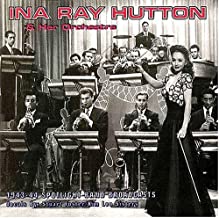
Ina Ray Hutton was born Odessa Cowan on March 13, 1916 in Chicago, Illinois into a family whose mother was a pianist. She began dancing and singing on stage professionally at the age of eight. By 15, she starred in the Gus Edwards revue Future Stars Troupe at the Palace Theater, and Lew Leslie’s Clowns in Clover. On Broadway she performed in George White’s revues Melody, Never Had an Education and Scandals, before joining the Ziegfeld Follies.
1934 saw her being approached by Irving Mills and vaudeville agent Alex Hyde to lead an all-girl orchestra, the Melodears. As part of the group’s formation, Mills asked Odessa to change her name. The group included trumpeter Frances Klein, Canadian pianist Ruth Lowe Sandler, saxophonist Jane Cullum, guitarist Marian Gange, trumpeter Mardell “Owen” Winstead, and trombonist Alyse Wells.
The Melodears appeared in short films and in the movie Big Broadcast of 1936. They recorded six songs, sung by Hutton, before disbanding in 1939. Soon after, she started the Ina Ray Hutton Orchestra (with men only) that included George Paxton and Hal Schaefer. The band appeared in the film Ever Since Venus in 1944, recorded for Elite and Okeh, and performed on the radio. After this band broke up, she started another male band a couple years later. During the 1950s, Hutton again led a female big band that played on television and starred on The Ina Ray Hutton Show.
Although she and some members of her family are known to have been white, historians have theorized that she and her family were of mixed white and African-American ancestry. In 1920, Hutton herself was listed in the US Census as “mulatto” and in 1930 as “negro”. Hutton was also mentioned under her original name in the black Chicago newspaper The Chicago Defender several times in articles describing the early years of her career. A photograph of her as a 7-year-old dancer appeared in a 1924 issue of the paper.
Retiring from music in 1968, Ina Ray Hutton, who led one of the first all-female big bands, passed away on February 19, 1984 from complications due to diabetes at the age of 67 in Ventura, California.
More Posts: bandleader,history,instrumental,jazz,music,vocal
Daily Dose Of Jazz…
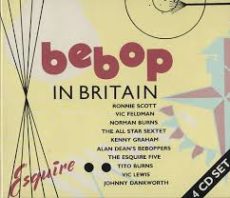
Norman Burns was born in London, England on March 11, 1920. Closely associated with the pianist George Shearing, together they worked the West End nightclub circuit in the mid 1940s, before Shearing made his fame and fortune in the USA.
Though he recorded with Alan Dean Beboppers and others in 1948, he never was a bop musician. He was a regular figure on the modern jazz scene and from 1951, he led a quintet whose format and repertoire were based on the successful George Shearing Quintet formula. From the time of their first gig they were an instant hit and for two and a half years the quintet toured the UK jazz venues with great success. They added vocalists Eileen Draper and Johnny Green in 1954 but the group disbanded in 1955.
Esquire decided to record the quintet in 1952 by which time a number of personnel changes had taken place. Victor Feldman, the highest profile jazz musician working with the group had left prior to the recordings. A later move to Australia, saw drummer Norman Burns residing for many years until he passed away in June 1994.
More Posts: bandleader,drums,history,instrumental,jazz,music